
Issue: Anti-Gentrification Policies in Downtown Revitalization Projects in California Post-COVID ...


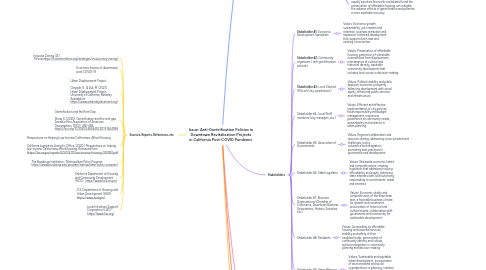
1. **Sources, Reports, References, etc.**
1.1. Inclusive Zoning (IZ): Policieshttps://homeforallsmc.org/strategies/inclusionary-zoning/
1.2. Economic booms of downtowns post COVID-19
1.3. Urban Displacement Project Chapple, K., & Zuk, M. (2021). Urban Displacement Project. University of California, Berkeley. Available at https://www.urbandisplacement.org/
1.4. Gentrification and the Rent Gap Shaw, K. (2020). Gentrification and the rent gap. Annals of the Association of American Geographers, 110(2), 465-484. https://doi.org/10.1080/24694452.2019.1644998
1.5. Perspectives on Helping Low-Income Californians Afford Housing California Legislative Analyst's Office. (2020). Perspectives on helping low-income Californians afford housing. Retrieved from https://lao.ca.gov/reports/2020/4111/low-income-housing-020920.pdf
1.6. The Brookings Institution - Metropolitan Policy Program: https://www.brookings.edu/program/metropolitan-policy-program/
1.7. California Department of Housing and Community Development (HCD): https://www.hcd.ca.gov/
1.8. U.S. Department of Housing and Urban Development (HUD): https://www.hud.gov/
1.9. Local Initiatives Support Corporation (LISC): https://www.lisc.org/
2. **Need:** Many CA cities are looking to revitalize and activate their their aging downtown spaces
2.1. **Problem: ** New development can lead to higher property values, causing gentrification for communities currently inhabiting these areas; Inclusionary Zoning (IZ) policies aim to reduce these effects, but policy experts debate their effectiveness
2.1.1. Research Question: Where have IZ policies been enacted in California?
2.1.2. Research Question: What have been the impacts of IZ policies in California?
2.1.3. Research Question: What have been the unintended consequences of IZ policies in California?
2.1.4. Research Question: Are there any reports or data sets public that can help inform our research?
2.1.5. Research Question: What role does public-private partnership play in sustainable development?
2.1.6. Research Question: What are the effective measures to protect long-term residents?
2.1.7. Research Question: How to ensure inclusive community participation in planning?
2.1.8. Research Question: How can policies balance growth and affordability?
2.1.9. Research Question: Geography: specific downtown areas vs. wider city regions
2.1.10. Research Question: In addition to housing developments, what other improvements can yield economic and community development?
2.1.11. Research Question: Are there grant opportunities that support revitalization projects but require a certain number of affordable housing units?
2.2. Opportunity
2.2.1. Evidence-Based Policy Making: Leveraging better data and analysis to guide policy adjustments can help ensure that IZ policies are effectively targeting the most significant issues and are adaptable to changing conditions.
2.2.2. Collaborative Solutions: Engaging a broader set of stakeholders in the policy-making process can lead to more innovative and inclusive solutions that address the needs of all parties involved.
2.2.3. Balanced Development Approaches: Identifying and implementing development strategies that equally prioritize economic revitalization and the preservation of affordable housing can mitigate the adverse effects of gentrification and promote a more equitable recovery.
3. **Stakeholders**
3.1. **Stakeholder #1:** Economic Development Specialists
3.1.1. Values: Economic growth, sustainability, job creation and retention, business attraction and expansion, balanced development that supports both new and existing communities
3.2. **Stakeholder #2:** Community organizers / anti-gentrification activists
3.2.1. Values: Preservation of affordable housing, protection of vulnerable communities from displacement, maintenance of cultural and historical identity, equitable community development that includes local voices in decision-making
3.3. **Stakeholder #3:** Local Elected Officials (city jurisdictions)
3.3.1. Values: Political stability and public approval, economic prosperity, balancing development with social equity, enhancing public services and infrastructure
3.4. Stakeholder #4: Local Staff members (city managers, etc.)
3.4.1. Values: Efficient and effective implementation of city policies, fiscal responsbility and budget management, responsive governance to community needs, sustainbaility and resilience in urban planning
3.5. Stakeholder #5: Association of Governments
3.5.1. Values: Regional collaboration and resource sharing, addressing cross-jurisdictional challenges, policy coherence and integration, promoting best practices in governance and development
3.6. Stakeholder #6: State Legislator
3.6.1. Values: Statewide economic helath and competitiveness, creating legislation that addresses housing affordability and equity, balancing state interests with local autonomy, responsding to constituents' needs and interests
3.7. Stakeholder #7: Business Organizations (Chamber of Commerce, Downtown Business Associations, Historic Societies, etc.)
3.7.1. Values: Economic vitality and competitivness of the downtown area, a favorable business climate for growth and investment, preservation of historical and cultural assets, collaboration with government and community for sustainable development
3.8. Stakeholder #8: Residents
3.8.1. Values: Accessiblity to affordable housing and essential services, stability and safety of their neighborhoods, preservation of community identity and culture, active participation in community planning and decision-making
3.9. Stakeholder #9: Urban Planners
3.9.1. Values: Sustainable and equitable urban development, incorporation of environmental and social cosniderations in planning, creation of livable and resilient urban spaces, engagement with community stakeholders in the planning process
3.10. Stakeholder #10: Developers and Investors
3.10.1. Values: Return on investment and profitability, minimzation of regulatory and financial risk, market competitiveness and innovation in development
3.11. Stakeholder #11: Labor Groups (building trades)
3.11.1. Values: Job opportunities for union members with prevailing wages and being given job bids on development projects
4. **Consequences of Not Addressing Issue**
4.1. Widening socio-economic disparities
4.2. Increased displacement of long-term residents
4.3. Reduced accessibility to affordable housing
4.4. Loss of local culture and identity
4.5. Lack of accessibility for community members in the Downtown area
5. **Target Population**
5.1. Low-income families
5.2. Local Small Business Owners
5.3. Elderly Residents
5.4. Artists and Cultural Workers
5.5. Historians
6. **Boundaries**
6.1. Geographic Boundaries
6.1.1. Downtown Areas: Specific downtown districts within California cities where revitalization projects are taking place; could include major metropolitan centers like Los Angeles, San Francisco, San Diego, and Sacramento, as well as smaller cities with significant downtown revitalization efforts
6.1.1.1. Case studies
6.1.1.1.1. Boyle Heights, Los Angeles
6.1.1.1.2. Public Realm Action Plan, San Francisco
6.1.1.1.3. Downtown Sacramento
6.1.2. Comparison Sites: Identify areas within California that have not undergone recent downtown revitalization for comparative analysis
6.2. Time Boundaries
6.2.1. Post-COVID Era: Beginning of 2021 around the transition towards recovery