


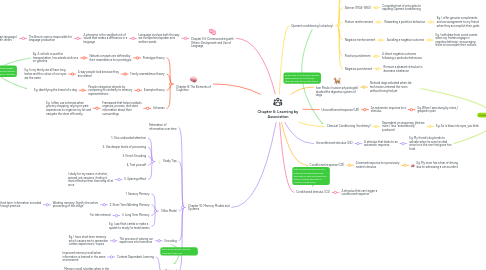
1. Classical Conditioning (Involntary)
1.1. Dependent on responses that are more / less "automatically" produced
1.1.1. Eg. Air is blow into eyes, you blink
2. Ivan Plavlov (russian physiologist) studied the digestive system of dogs
2.1. Noticed dogs salivated when lab technicians entered the room without being fed yet
3. Unconditioned response (UR)
3.1. An automatic response to a stimulus
3.1.1. Eg. When I was stung by a bee, I gasped in pain
4. Conditioned stimulus (CS)
4.1. A stimulus that can trigger a conditioned response
5. Unconditioned stimulus (US)
5.1. A stimulus that leads to an automatic response
5.1.1. Eg. My friend's dog tends to salivate when he sees her dad since he is the one that gives him food
6. Chapter 10: Memory Models and Systems
6.1. Retenation of information over time
6.2. Study Tips
6.2.1. 1. Give undiveded attention
6.2.2. 2. Use deeper levels of processing
6.2.3. 3. Enrich Encoding
6.2.4. 4. Test yourself
6.2.5. 5. Spacing effect
6.2.5.1. I study for my exams in shorter, spaced-out sessions, finding it more effective than clamming all at once
6.3. 3 Box Model
6.3.1. 1. Sensory Memory
6.3.2. 2. Short Term/Working Memory
6.3.2.1. Working memory: Signfiy the active processing of this stage
6.3.2.1.1. Short term: Information encoded through practice
6.3.3. 3. Long Term Memory
6.3.3.1. For late retrieval
6.3.4. Eg. I use flash cartds or make a quizlet to study for tests/exams
6.4. Encoding
6.4.1. The process of placing our experinces into memories
6.4.1.1. Eg. I have short term memory which causes me to remember certain experiences / topics
6.5. Retrieval
6.5.1. Context Dependent Learning
6.5.1.1. Improved memory recall when information is learned in the same environemnt
6.5.2. State Dependent Learning
6.5.2.1. Memory recall is better when in the same condition as when the memory was formed
6.5.3. Serial Position Effect
6.5.3.1. How we recall items better from primacy to recency of a list
7. Operant conditioning (voluntary)
7.1. metod of learning that uses rewards and punishment to modify behavior
7.2. Edward Thorndike (1874-1949)
7.2.1. Law and effect
7.3. Skinner (1904-1990)
7.3.1. Completed set of principles to explaing Operant conditioning
7.4. Postive reinforcement
7.4.1. Rewarding a postitive behaviour
7.4.1.1. Eg. I offer genuine compliments and encouragement to my friend when they accomplish their goals
7.5. Negative reinforcement
7.5.1. Avoiding a negative outcome
7.5.1.1. Eg. I withdraw from social events when my friends engage in negative behavior, encouraging them to reconsider their actions
7.6. Positive punishment
7.6.1. A direct negative outcome following a particular behaviour
7.7. Negative punishment
7.7.1. Remove a pleasant stimulus to decrease a behavior
8. Conditioned response (CR)
8.1. A learned response to a previously neutral stimulus
8.1.1. Eg. My mom has a fear of driving due to witnessing a car accident
9. Chapter 9.3: Communicating with Others: Devlopment and Use of Language
9.1. Language involves both the way we comprehend spoken and written words
9.1.1. A phoneme is the smallest unit of sound that makes a difference in a language
9.1.1.1. The Broca's area is responsible for language production
9.1.1.1.1. Ex: English is my main language I speak to engage with others
10. Chapter 8: The Elements of Cognition
10.1. Prototype theory
10.1.1. Natural concepts are defined by their resemblance to a prototype
10.1.1.1. Eg. A vehicle is used for transportation, has wheels and runs on gasoline
10.2. Family resemblance theory
10.2.1. A way people look because they are related
10.2.1.1. Eg. In my family we all have long lashes and the colour of our eyes are the same.
10.3. Exemplar theory
10.3.1. People categorize objects by comparing its similarity to memory representations
10.3.1.1. Eg. identifying the breed of a dog
10.4. Schemas
10.4.1. Framework that helps inviduals organize, process, and store information about their surroundings
10.4.1.1. Eg. I often use schemas when grocery shopping, relying on past experiences to organize my list and navigate the store efficiently.