

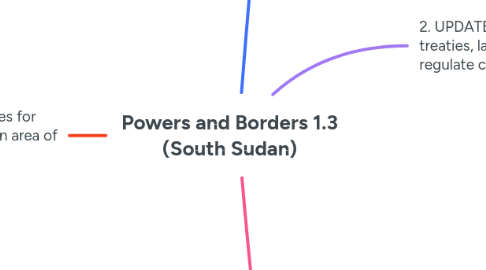
1. South Sudan - Strategies for Global Governance in an area of Conflict
1.1. General information
1.1.1. Fragile state ranking of 113
1.1.1.1. Worlds newest soveriegn state
1.1.2. 12.1 million population
1.1.3. 1600 USD GDP per Capita
1.2. Background to conflict in South Sudan
1.2.1. Colonial History
1.2.1.1. Britian ruled Sudan with a dual colonial government with Egypt
1.2.1.1.1. British developed a school system in the north while education undertaken by christians in the south
1.2.1.1.2. The British Separated the North and South culturally and economically
1.2.2. Poor governance since independance
1.2.2.1. 730,000 refugees leaving for neighbouring countries
1.2.2.1.1. Dinka and Nuer ethnic groups
1.2.3. Competition over resources
1.2.3.1. Natual resources (98% income generated by oil)
1.2.3.2. Purchasing arms and funding militias using the money from oil exports results in war crimes
1.2.3.2.1. Agriculture ruined by conflict
1.3. Interventions in South Sudan
1.3.1. UN
1.3.1.1. UNMISS
1.3.1.1.1. Peacekeeping mission to support government in stabilisation following December 2013 crisis military and police presence has been increased to support government in peace consolidation
1.3.1.1.2. UN peacekeeping mission that involves 12500 military personnel, 1000 police and more
1.3.1.2. UN Agencies working in the country
1.3.1.2.1. OCHA
1.3.1.2.2. UNICEF
1.3.1.2.3. WHO
1.3.2. South Sudanese Government
1.3.2.1. Security council is critical of government for failing to protect citizens
1.3.2.1.1. Human rights violations have continued despite UNHCR attempting to engage government agencies as partners
1.3.2.1.2. IGAD is attempting to include the government in mediation, but the government has prevented representatives from travelling to participate in the plus peace process
1.3.2.2. Signed treaties bringing hope to the country however lack of cooperation in government results in challenges like alleviating poverty
1.3.2.2.1. Convention against torture, african charter on human and peoples rights, convention of the rights of the child
1.3.3. NGO's
1.3.3.1. South Sudan NGO forum organises 300+ NGO's addressing humanitarian and development needs
1.3.3.1.1. But there has been harassment and violence against NGO workers including their forced evacuation of the upper nile state leaving populations vulnerable
1.3.3.2. Save the Children, Oxfam, and MSF all play a role in food and water relief, but struggle with harassment and violence towards their workers
1.4. UPDATED Consequences of Global Governance in South Sudan
1.4.1. Intended Long Term benefits
1.4.1.1. Agricultural training
1.4.1.1.1. Education programmes
1.4.2. Intended Short Term benefits
1.4.2.1. Humanitatarian aid
1.4.2.1.1. Supply of food
1.4.3. Positive Consequences of Global Governance
1.4.3.1. Villagers trained to maintain livestock
1.4.3.1.1. Vulnerable children receive treatment for malnutrition
1.4.3.2. Aid agencies negotiate access into areas in conflict
1.4.3.2.1. Civilian protection camps set up providing shelter, food and protection from the fighting
1.4.4. NEW Factors for essay plan
1.4.4.1. Short term: Humanitatian aid and shelter
1.4.4.1.1. Influence of NGOs
1.4.4.2. Long term: Education programmes and Training
1.4.4.2.1. UN agencies like UNMISS providing stability to allow educational programmes to develop
1.4.4.3. Long term: Establishing Democracy
2. 1. How challenges to sovereignty can be a cause of conflict
2.1. Patterns of conflict are represented by global peace index
2.1.1. Based on 23 indicators including level of security, degree of militarisation and international and domestic conflicts
2.2. Challenges to sovereignty can source conflict in mutliple ways For example
2.2.1. Citizens are exploited or have limited representation in government
2.2.1.1. Government fails to protect its citizens from human rights violations
2.2.2. People seek autonomy, indepemdence if marginalised by a state
2.2.2.1. Differing ethnic identities and ethnic conflict within a state
2.3. Access to Natural Resources, Water supply conflict in Kashmir
2.3.1. Sovereignty has been contested between pakistan and india since partition of india in 1947
2.3.1.1. Although there are cultural differences, water insecurity is the heart of the dispute
2.3.2. The Indus is an important resource to both countries for hydroelectric power and irrigation
2.3.2.1. The Indus is mediated by the world bank and its 1960 Indus water treaty
2.3.2.1.1. But Pakistan was grented the lower part of the Indus basin, claiming india affects it water supplies by damming the upper tributaries
2.3.3. The dispute continues to escalate
2.3.3.1. Because of rapid population growth in both countries increasing the demand for water and the melting of himilayan glaciers is depleting water resource itself in the two countries
3. 2. UPDATED Role of Institutions, treaties, laws and norms that regulate conflict
3.1. Insitutions
3.1.1. United Nations
3.1.1.1. Founded in 1945 the UN has many aims
3.1.1.1.1. Including achieving worldwide peace and security, developing good relations between nations and foster cooperation among nations
3.1.1.2. UN Charter gives security council responsibility to maintain international peace
3.1.1.2.1. Achieved through settling disputes between states via international court of justic, preventative diplomacy
3.1.1.3. UN operates its policies as part of a global partnership, giving its interventions legitimacy and global reach
3.1.1.3.1. Currently there are 16 peacekeeping missions
3.1.2. NATO
3.1.2.1. Its purpose is to safeguard the freedom and security of its 28 members states politically and militarily
3.1.2.1.1. Politically NATO promotes democratic values and encourages cooperation on defense and security to prevent conflict
3.1.3. NGO's
3.1.3.1. NGO's intervene in conflict zones providing humanitarian releif, like health care, medicines, education and monitors for early signs of violence
3.1.3.1.1. They often undertake direct mediation, strenghten local institutions and democratic processes
3.1.3.2. For example Amnesty international, red cross, oxfam and ACCORD
3.1.4. The European Union
3.1.4.1. Aimed to foster economic cooperation after ww2, making members less likely to conflict
3.1.4.1.1. It has foreign affairs and security policy, european neighbourhood policy and common defense policy aiming to regulate conflict
3.1.5. For example South sudan NGO forum organises 300+ NGOs, like OCHA and UNICEF which are concerned with raising provisions for IDPs, distributing agricultural kits, girls can program
3.1.5.1. UNMISS involves 12500 military personnel as a result of UN intervention and security councils article 2132 doubled the unmiss troop size
3.2. Treaty's
3.2.1. International organisations like the UN are involved in creating treaties, laws and norms
3.2.1.1. Governing leadl and generally accepted practices which regulate conflict
3.2.2. Many multilateral treaties are adopted by UN like convention on prohibition of use, stockpiling, production and transfer of anti-personnel mines and on their destruction
3.2.2.1. By 2015 162 countries had signed ip to this legally binding agreement, however it remains open to ratifaction by USA, china and russia
3.2.3. For example the south sudanese government introduced the convention against torture, african charter on humann rights exemplifies the effect of treaties
3.2.3.1. However this effect can be limited by a governments willingness to enforce it, south sudanese governement are preventing representatives taking part in IGADs peace plus process, hence seeming less keen
3.3. Laws and Norms
3.3.1. Law
3.3.1.1. Primary goal of UN to develop international law to define responsibilities of states
3.3.1.1.1. For example laws related to a states responsibility to protect human rights, refugees, disarmament
3.3.1.2. International law regulated conflict over global commons
3.3.1.2.1. There are legal and institutional frameworks addressing environmental issues of the global commons, like the UN convention on the law of the sea
3.3.2. Norms
3.3.2.1. Treaties and laws are derived from norms, long established common practises in many countries set out in UN charter
3.3.2.1.1. Six new norms relating to cyber conflict have been created by microsoft, assuming responsibility for regulating cyber conflicts threat to soveriegnty
3.3.3. Operation Newcombe and Serval in Mali as well as UNMISS in South Sudan all aim to regulate conflict
4. UPDATED 3. Role of Flows of People, Money, Ideas and technology in geopolitical intervention
4.1. People
4.1.1. Flow of people and money are integral in global governance like UN missions and work of regional NGO's
4.1.1.1. These require movement of personnel into conflict zones and transfer of finances donated by member states
4.1.1.1.1. Sometimes more than 10,000 people and 1 billion USD can be transferred per mission
4.1.2. Flow of people could also include refugees and IDPs
4.1.2.1. 730,000 refugees left south sudan for neighbouring countries
4.1.2.1.1. UN agencies also dictate flows of people like WHO, Unicef and Ocha
4.1.3. UNMISS peacekeeping mission following december 2013 crisis involves 12500 military personnel and 1200 police
4.1.3.1. MINUSMA in mali involves 9000 personnel, ECOWAS sent 3300 military personnel to mali to support them in 2012
4.1.3.1.1. Article 2132 doubled UNMISS troop size and aimed to protect IDPs and refugees by regulating conflict
4.1.3.1.2. Operation Serval conducted by the french in Mali successfully captured or killed 2000 islamist fighters attempting to push them out of northern mali
4.2. Money
4.2.1. Money is integral for a peacekeeping/geopolitical intervention, sometimes costing upwards of 1 billion
4.2.2. Geopolitical intervention in Mali has allowed for the development of stability with GDP per capita recovering following military coup
4.2.2.1. Geolpolitical intervention has also allowed for the world bank to set up chains for aquaculture and farming to enhance agricultural competitiveness and to increase the range of malian exports
4.3. Ideas and technology
4.3.1. Planning and execution of intervention involves exchange of ideas
4.3.1.1. For example coordination of strategy and flows of intelligence in bilateral meetings of governments, regional council meetings and UN conferences
4.3.2. Peacekeeping is becoming dependent on technology
4.3.2.1. Advanced technology of military like satellite imagery, remote drones for air strikes and survelliance
4.3.2.1.1. Growth of ICT to allow information to be supplied by internet, databases and media
4.3.3. For example Operation Newcombe in Mali sent a british task force to surveille the area, which is reliant on technology and satellite imagery