


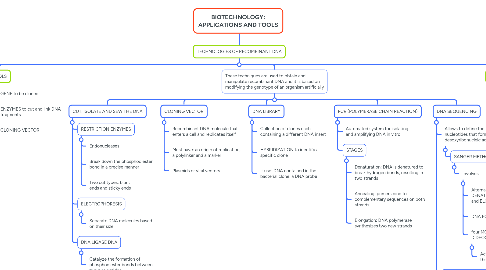
1. TECHNOLOGIES OF RECOMBINANT DNA
1.1. RECOMBINANT DNA is a DNA molecule that contains genetic information from more organisms
1.2. TOOLS
1.2.1. GENE to be cloned
1.2.2. ENZYMES to cut and link DNA fragments
1.2.3. CLONING VECTOR
1.3. These techniques are used to obtain and manipulate recombinant DNA and it is based on modifying the genotype of an organism artificially
1.3.1. CUT, ISOLATE AND SEW THE DNA
1.3.1.1. RESTRICTION ENZYMES
1.3.1.1.1. Endonucleases
1.3.1.1.2. Break down the phosphodiester bond in a precise manner
1.3.1.1.3. Two cut types: blunt ends and sticky ends
1.3.1.2. ELECTROPHORESIS
1.3.1.2.1. Separate DNA molecules based on their size
1.3.1.3. DNA LIGASE DNA
1.3.1.3.1. Catalyze the formation of phosphodiester bonds between two nucleotides
1.3.2. CLONING VECTOR
1.3.2.1. Recombinant DNA molecule that enters a cell and replicates itself
1.3.2.2. Must have: an origin of replication, a polylinker and a marker
1.3.2.3. Plasmids or viral vectors
1.3.3. DNA LIBRARY
1.3.3.1. Collection of clones each containing a different DNA insert
1.3.3.2. HYBRIDIZATION to identify a specific clone
1.3.3.3. It use: DNA contained in the bacterial clone, a DNA probe
1.3.4. PCR (POLYMERASE CHAIN REACTION)
1.3.4.1. Automated system for isolating and amplifying DNA in vitro
1.3.4.2. STAGES
1.3.4.2.1. Denaturation: DNA is denatured to break hydrogen bonds, resulting in two strands
1.3.4.2.2. Annealing: primers bind to complementary sequences on both strands
1.3.4.2.3. Elongation: DNA polymerase synthesizes two new strands
1.3.5. DNA SEQUENCING
1.3.5.1. Allows to define the order of nucleotides that form a molecule of desoxyribonucleic acid
1.3.5.1.1. SANGER METHOD
1.3.5.2. NEXT GENERATION SEQUENCING
1.3.5.2.1. Based on massive parallel sequencing of DNA molecules, allows for sequencing entire genomes in a single session
1.3.5.2.2. THIRD GENERATION SEQUENCING (nanopore sequencing)
1.4. COLLEGAMENTI INTERDISCIPLINARI
1.4.1. SCIENZE
1.4.1.1. Virus (vaccini)
1.4.1.2. Batteri (antibiotici)
1.4.1.3. Clonazione
1.4.1.4. Enzimi
1.4.1.5. Haber (Nobel come Kary Mullis con la PCR)
1.4.2. EDUCAZIONE CIVICA
1.4.2.1. "La malattia da 10 centesimi" (virus)
1.4.3. ITALIANO
1.4.3.1. Pirandello (Nobel)
1.4.4. STORIA
1.4.4.1. Pirma e Seconda guerra mondiale (Haber)
1.4.5. FISICA
1.4.5.1. Campo elettrico
1.4.6. INGLESE
1.4.6.1. "Frankenstein", Mary Shelley