


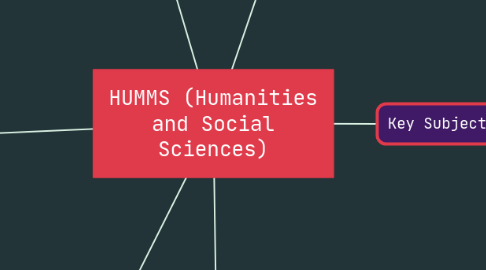
1. Career Paths for HUMMS Graduates
1.1. Education:
1.1.1. Teacher
1.1.2. Professor
1.1.3. Curriculum Developer
1.2. Social Services:
1.2.1. Social Worker
1.2.2. Counselor
1.2.3. Community Organizer
1.3. Government:
1.3.1. Policy Analyst
1.3.2. Researcher
1.3.3. Public Administrator
1.4. Business:
1.4.1. Human Resources
1.4.2. Marketing
1.4.3. Public Relations
1.5. Media and Communications:
1.5.1. Journalist
1.5.2. Public Relations Specialist
1.5.3. Media Producer
2. Introduction to HUMMS
2.1. What is HUMMS
2.1.1. HUMMS is an academic strand in senior high school that focuses on the study of human society, culture, and behavior, encompassing subjects such as history, geography, economics, sociology, anthropology, psychology, and political science.
2.2. What is the Purpose
2.2.1. To develop students' understanding of human behavior and society, critical thinking skills, and awareness of social issues.
3. Practical Applications of HUMMS
3.1. Research:
3.1.1. Conducting Studies on Social Issues
3.1.2. Contributing to Academic Journals
3.1.3. Informing Policy Decisions
3.2. Advocacy:
3.2.1. Raising Awareness on Social Issues
3.2.2. Promoting Social Change
3.2.3. Engaging in Community Outreach Programs
3.3. Cultural Preservation:
3.3.1. Documenting and Preserving Cultural Practices
3.3.2. Promoting Cultural Exchange Programs
3.3.3. Supporting Cultural Heritage Conservation Efforts
4. Skills Developed in HUMMS
4.1. Critical Thinking:
4.1.1. Analyzing Texts and Arguments
4.1.2. Evaluating Evidence
4.1.3. Forming Logical Arguments
4.2. Research Skills:
4.2.1. Conducting Research
4.2.2. Collecting and Analyzing Data
4.2.3. Writing Research Papers
4.3. Communication Skills:
4.3.1. Writing Essays
4.3.2. Presenting Ideas Orally
4.3.3. Engaging in Discussions and Debates
4.4. Cultural Awareness:
4.4.1. Understanding Different Cultures
4.4.2. Appreciating Cultural Diversity
4.4.3. Recognizing Cultural Influences in Society
5. Key Subjects in HUMMS
5.1. History:
5.1.1. World History
5.1.2. Philippine History
5.1.3. Asian History
5.1.4. European History
5.2. Geography:
5.2.1. Physical Geography
5.2.2. Human Geography
5.2.3. Geopolitics
5.2.4. Cartography
5.3. Economics:
5.3.1. Microeconomics
5.3.2. Macroeconomics
5.3.3. Economic Development
5.3.4. International Economics
5.4. Political Science:
5.4.1. Political Theory
5.4.2. Comparative Politics
5.4.3. International Relations
5.4.4. Public Administration
5.5. Sociology:
5.5.1. Basic Concepts
5.5.2. Social Institutions
5.5.3. Social Change
5.5.4. Sociology of Gender
6. Importance of HUMMS in Society
6.1. Cultural Preservation:
6.1.1. Studying Humanities helps preserve cultural heritage and traditions.
6.2. Social Awareness:
6.2.1. Understanding Social Sciences helps individuals become more aware of social issues and challenges.
6.3. Policy Development:
6.3.1. Insights from Humanities and Social Sciences contribute to the development of informed policies in various sectors.