
Artificial Intelligence

Explore the intricate world of Artificial Intelligence through our comprehensive Mind Map. Dive into the definition of AI and understand how computer systems replicate human intelligence through examples like visual perception and speech recognition. Discover different types of AI including rule-based systems, machine learning, deep learning, and robotics and explore detailed insights into Subsets of Machine Learning like Supervised, Unsupervised, and Reinforcement Learning. Delve into the di...

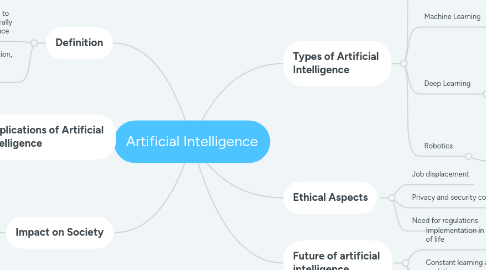
1. Definition
1.1. Computer systems able to perform tasks that normally require human intelligence
1.2. Examples: visual perception, speech recognition, decision-making
2. Applications of Artificial Intelligence
2.1. Healthcare
2.1.1. Predictive diagnosis
2.2. Sales and Marketing
2.2.1. Personalized customer experience
2.3. Finance
2.3.1. Fraud detection and risk management
2.4. Agriculture
2.4.1. Crop and soil monitoring
2.5. Autonomous vehicles
3. Impact on Society
3.1. Improved efficiency and effectiveness
3.2. Enhanced quality of life
3.3. Potential for abuse
4. Types of Artificial Intelligence
4.1. Rule-based Systems
4.1.1. If-Then rules processing the data
4.2. Machine Learning
4.2.1. Systems learning independently
4.2.1.1. Supervised Learning
4.2.1.1.1. Learning with labelled data
4.2.1.2. Unsupervised Learning
4.2.1.2.1. Learning with unlabeled data
4.2.1.3. Reinforcement Learning
4.2.1.3.1. Learning from rewards and punishments
4.3. Deep Learning
4.3.1. Subset of machine learning
4.3.1.1. Encoding thought process in layers
4.3.1.2. Uses large neural networks
4.4. Robotics
4.4.1. Robots performing tasks without human intervention
4.4.1.1. Autonomous vehicles
4.4.1.2. Drones
4.4.1.3. Surgical robots