
Benn's Theory of Transactional Analysis Motivation

Explore the comprehensive mindmap detailing Benns Theory of Transactional Analysis Motivation. This visually engaging mindmap breaks down complex concepts such as ego states, transactions, life scripts, and signs of recognition. It provides an in-depth view of fundamental concepts and their practical applications in personal life and business scenarios including team building, conflict resolution, and effective communication. The map also outlines the benefits and limitations of the theory, w...

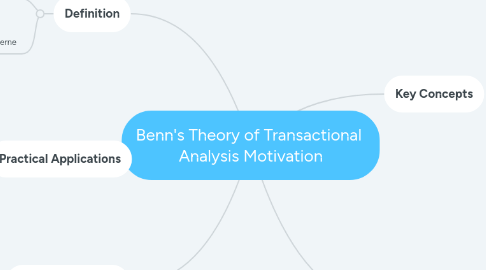
1. Definition
1.1. Transactional analysis as a method of studying interactions between individuals
1.2. Contribution of Eric Berne
1.2.1. Roles of Parent, Adult, and Child in communication
1.2.2. Impact on understanding of personality, human development, and relationships
2. Practical Applications
2.1. Psychotherapy
2.1.1. Understanding & changing patterns of behavior
2.1.2. Coping with traumatic experiences
2.2. Organizational settings
2.2.1. Improving communication
2.2.2. Conflict resolution
2.3. Education & Counselling
2.3.1. Enhancing student-teacher interaction
2.3.2. Coping with stress & prejudice
3. Beneficial Aspects
3.1. Enhanced self-awareness
3.2. Improved interpersonal communication
3.3. Greater understanding of behavioral patterns
4. Key Concepts
4.1. Ego states
4.1.1. Parent
4.1.1.1. Taught concept
4.1.1.2. Prejudiced, criticizing, nurturing
4.1.2. Adult
4.1.2.1. Learned concept
4.1.2.2. Processing information & making predictions
4.1.3. Child
4.1.3.1. Felt concept
4.1.3.2. Emotion-driven
4.2. Transactions
4.2.1. Complementary
4.2.2. Crossed
4.2.3. Ulterior
4.3. Life script
4.3.1. Definition: Unconscious life plan
4.3.2. Impact on personality & behavior
4.4. Games in TA
4.4.1. Description: Repeated sets of transactions
4.4.2. Purpose: Establish patterns & predictability