


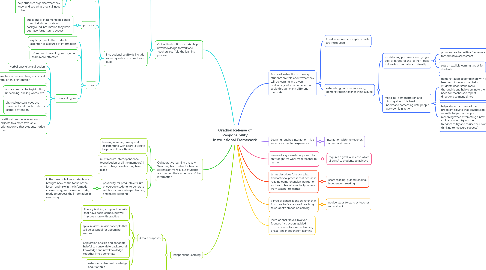
1. Guided instruction = students put new knowledge to work and teachers scaffold the learning process
1.1. learning only advances when students get an opportunity to try it out themselves (application)
1.2. instructional scaffolds include robust questions, prompts and cues
1.2.1. robust questions
1.2.1.1. help jump-start thinking and expose misconceptions or partial undestanding
1.2.1.2. help students organize what they know and see what they still need to learn
1.2.2. prompts
1.2.2.1. questions or statements designed to remind students about background information they have, but have forgotten to access
1.2.3. cues
1.2.3.1. explicity directs the students attention to a source of information
1.2.3.2. often pair different types together to be more effective
1.2.3.3. different types
1.2.3.3.1. verbal cues give a direction
1.2.3.3.2. emphasis cues are changes in vocal rate, pitch, or intonation
1.2.3.3.3. visual cues can be highlighting, underlining, circling words, etc.
1.2.3.3.4. physical/gestural cues use movement and touch to shift a learner's attention
1.2.3.3.5. positional cues involve moving objects to a more favorable orientation so that students notice them
2. Collaborative learning phase = "teaching from behind" - teacher still has active role, but students are creating their schemata of the information
2.1. learning is social, time spend collaborating with peers is vital to help consolidate thinking
2.2. must require interdependence (contribution of all the members) in order to truly have learning take place
2.3. possibility for productive failure encourage students to generate solutions creates deeper learning and better listening
2.3.1. in the case of failure, students are brought back to the focus of the lesson and take in the information in a new way, with a new attitude, ready to process the information in a new way
3. Independent Learning
3.1. 4 main purposes
3.1.1. fluency building - to practice skills that have been learned, but will improve more with practice
3.1.2. spiral review - revisit concepts that will be essential for upcoming lessons
3.1.3. application of skills and concepts - helpful to consolidate background knowledge and new knowledge together into a schemata
3.1.4. extension - deepen knowledge about a topic
3.2. encourage students to think metacognitively - a good way to do this could be through reflective questions
3.3. improved results when self-regulation is part of the process
4. Focused instruction = the way students are told about what they will be learning and given preliminary information about a topic through many different methods
4.1. Used when new concepts or skills are introduced
4.2. estabishing purpose, modeling, demonstration, teacher think-alouds
4.2.1. estabilishing purpose: identifying a goal or target for the learner - best if done both verbally and visually
4.2.1.1. provides teacher with a framework for formative assessment
4.2.1.2. sets an explicit learning target for students
4.2.2. modeling, demonstration and thinking aloud: it is hard to understand something until people have seen it in action
4.2.2.1. demonstration accompanied with a teacher think-aloud can help students understand more thoroughly and help eleminate the need for teachers to repeat directions so many times
4.2.2.2. helps students to see all the procblem solving that teachers do as well - helps them apply reasoning when attempting a new skill or concept (gives them freedom to try and to use their own thinking to measure success)