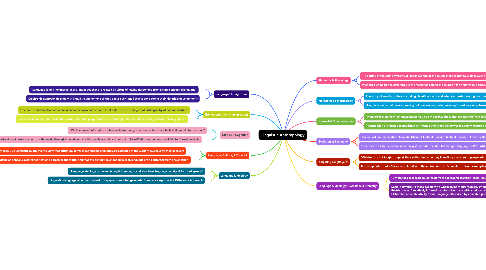
1.1. “Language family includes all those languages that are related by virtue of having descended from a single ancestral language”
1.2. Diachronic approach dealing with linguistic phenomena as they occur over time ( that is considering their historical development)
2. Ethnography Of Communication
2.1. “The nature and function of communicative behavior in the context of culture are the subject of enthography of communication”
2.2. Speech community refers to all those who share a language variety as well as specific rules for speaking and interpreting speech
3. Culture & Cognition
3.1. “We learn much of a culture when we learn the system of meanings for which its linguistic forms stand”
3.2. All languages and cultures classify at least certain aspects of the world through labeled domains that are hierarchical & consist of identifiable components available for formal analysis.
4. Language, Culture, & Thought
4.1. Linguistic determinism: the assumption that the way individual thinks is determined to a significant degree by the language they speak. Vs Linguistic relativity: the view that structural differences among languages are reflected in the world views held by their speakers
4.2. “Language one speaks determines how one perceives the world, and that the distinction encoded in each language are all different from one another”
5. Language & Ideology
5.1. “Language ideology is the mediating link among social structure, language variety, & forms of speech”
5.2. Linguistics language of woman consist of tag questions & hedge words. Dominance Approach & Difference Approach
6. Phonetics & Phonology
6.1. “The study of the sound systems of languages and of the sound changes that take place over time in a language is called phonology” Pg. 54
6.2. Phonetics is finding the difference in the meanings behind the sounds it is an analytical approach to description based on data that are verifiable objectively and are applicable cross-culturally
7. Morphemes & Morphology
7.1. The study of word structure, including classification of and interrelationship among morphemes is referred to as morphology. Large majority of morphemes are commonly “free morphemes” unattached to others
7.2. “Linguistic units that have a meaning but contain no smaller meaningful parts are morphemes.” Pg. 71
8. Nonverbal Communication
8.1. “Nonverbal systems of communication may be divided into those that are derived from spoken language and those that are independent of it” Pg.89
8.2. Transmission of signals accomplished by means other than spoken words ; bodily gestures, facial expressions, spacing, touch, drum language. Communication is not a linear process
9. Evolution of Language
9.1. Channels of communication: Acoustic Channel, Optical Channel, Tactical Channel, Olfactory Channel ( language is a product of evolution)
9.2. “ One may refer to the communication system that preceded full-fledged language as PRELANGUAGE
10. Acquiring Language(s)
10.1. “Children are not taught to speak their native language they learn it by exposure to people who talk to them”
10.2. Brocas aphasia: part of brain associated with the motor control of speech. Wernickes aphasia: area of brain in the upper part of temporal lobe associated with comprehension of language
11. Language & Ideology: Class,Race & Ethnicity
11.1. “Differences in speech could result from geographic isolation, social isolation due to ethnicity,nationality, or race could also create linguistic variation.”
11.2. Social network: All those people with whom an individual regularly interacts. Restrict code: A relatively informal variety of language with a reduced stylistic grammatical range. Elaborated code: Relativity formal language often used by educated people