Part III: Reference Services and Information Literacyda Monica Baron
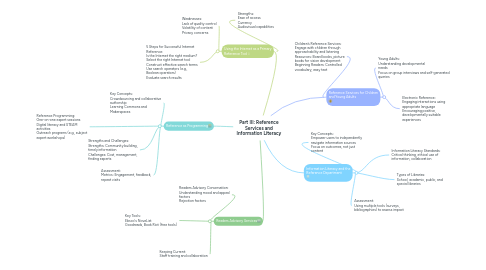
1. Using the Internet as a Primary Reference Tool 🛜
1.1. Strengths: Ease of access Currency Audiovisual capabilities
1.2. Weaknesses: Lack of quality control Volatility of content Privacy concerns
1.3. 5 Steps for Successful Internet Reference: Is the Internet the right medium? Select the right Internet tool Construct effective search terms Use search operators (e.g., Boolean operators) Evaluate search results
4. Reference Services for Children and Young Adults 🚸
4.1. Children’s Reference Services: Engage with children through approachability and listening Resources: Board books, picture books for vision development Beginning Readers: Controlled vocabulary, easy text
4.2. Young Adults: Understanding developmental needs Focus on group interviews and self-generated queries
4.3. Electronic Reference: Engaging interactions using appropriate language Encouraging positive, developmentally suitable experiences
5. Information Literacy and the Reference Department 💡
5.1. Key Concepts: Empower users to independently navigate information sources Focus on outcomes, not just content
5.2. Information Literacy Standards: Critical thinking, ethical use of information, collaboration
5.3. Types of Libraries: School, academic, public, and special libraries
5.4. Assessment: Using multiple tools (surveys, bibliographies) to assess impact