


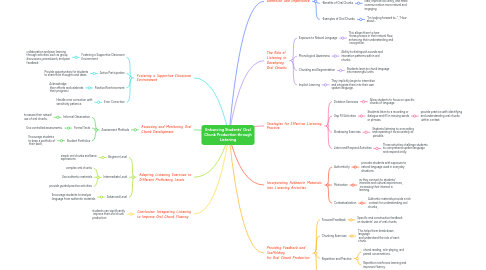
1. Fostering a Supportive Classroom Environment
1.1. Fostering a Supportive Classroom Environment
1.1.1. collaboration and peer learning through activities such as group discussions, paired work, and peer feedback
1.2. Active Participation
1.2.1. Provide opportunities for students to share their thoughts and ideas.
1.3. Positive Reinforcement
1.3.1. Acknowledge their efforts and celebrate their progress i
1.4. Error Correction
1.4.1. Handle error correction with sensitivity patience.
2. Assessing and Monitoring Oral Chunk Development
2.1. Assessment Methods
2.1.1. Informal Observation
2.1.1.1. to assess their natural use of oral chunks.
2.1.2. Formal Tests
2.1.2.1. Use controlled assessments.
2.1.3. Student Portfolios
2.1.3.1. Encourage students to keep a portfolio of their work,
3. Adapting Listening Exercises to Different Proficiency Levels
3.1. Beginner Level
3.1.1. simple oral chunks and basic expressions
3.2. Intermediate Level
3.2.1. complex oral chunks
3.2.2. Use authentic materials
3.2.3. provide guided practice activities
3.3. Advanced Level
3.3.1. Encourage students to analyze language from authentic materials
4. Conclusion: Integrating Listening to Improve Oral Chunk Fluency
4.1. students can significantly improve their oral chunk production
5. Definition and Importance
5.1. -What are Oral Chunks?
5.1.1. Oral chunks are pre-constructed phrases, idioms, collocations, and expressions
5.2. -Benefits of Oral Chunks
5.2.1. Enhance fluency, reduce cognitive load, improve accuracy, and make communication more natural and engaging.
5.3. -Examples of Oral Chunks:
5.3.1. "I'm looking forward to…", "How about…"
6. The Role of Listening in Developing Oral Chunks
6.1. Exposure to Natural Language
6.1.1. This allows them to hear these phrases in their natural flow, enhancing their understanding and recognition.
6.2. Phonological Awareness
6.2.1. Ability to distinguish sounds and intonation patterns within oral chunks.
6.3. Chunking and Segmentation
6.3.1. Students learn to chunk language into meaningful units
6.4. Implicit Learning
6.4.1. They implicitly begin to internalize and integrate them into their own spoken language.
7. Strategies for Effective Listening Practice
7.1. Dictation Exercises
7.1.1. Allow students to focus on specific chunks of language.
7.2. Gap Fill Activities
7.2.1. Students listen to a recording or dialogue and fill in missing words or phrases.
7.2.1.1. provide practice with identifying and understanding oral chunks within context
7.3. Shadowing Exercises
7.3.1. Students listening to a recording and repeating it as accurately as possible.
7.4. Listen and Respond Activities
7.4.1. These activities challenge students to comprehend spoken language and respond orally.
8. Incorporating Authentic Materials into Listening Activities
8.1. Authenticity
8.1.1. provides students with exposure to natural language used in everyday situations.
8.2. Motivation
8.2.1. as they connect to students' interests and cultural experiences, increasing their interest in learning.
8.3. Contextualization
8.3.1. Authentic materials provide a rich context for understanding oral chunks,
9. Providing Feedback and Scaffolding for Oral Chunk Production
9.1. Focused Feedback
9.1.1. Specific and constructive feedback on students' use of oral chunks
9.2. Chunking Exercises
9.2.1. This helps them break down language and understand the role of each chunk.
9.3. Repetition and Practice
9.3.1. choral reading, role-playing, and paired conversations.
9.3.2. Repetition reinforces learning and improves fluency.
9.4. Visual Aids
9.4.1. creating a multi-sensory learning experience
9.4.2. flashcards, posters, and visual aids