


1. Non verbal communication
1.1. Communication
1.1.1. In non verbal communication they can communicate through gesture and facial expressions
1.2. Paralinguistic
1.2.1. Paralanguage is a form of non verbal communication mainly focused on how something is said like the Voice Qualifiers, Voice Characterizers, Vocal Segregates.
1.3. Kinesis
1.3.1. Kinesis Is a study of non verbal communication
1.4. Proxemics
1.5. Edward Hall to develop proxemics, the study of the cultural patterning of the spatial separation individuals maintain in face-to-face encounters. (Page 92 Para 2)
2. Evaluation of language
2.1. Hominids
2.1.1. Members of the family Hominidae including all extinct and contemporary species and their direct fossil ancestors.
2.2. Voice Auditory channel
2.2.1. Among mammals, the use of the vocal-auditory channel for communication is extremely common, though they often use other means of communication( page 124 para1)
2.3. Design features of language
2.3.1. Broadcast transmission and directional reception.Rapid fading, Interchangeability, Complete feedback,specialization.Semanticity.Arbitrariness.Discreteness.Displacement. Productivity/openness. Duality of patterning. Cultural
2.3.1.1. transmission.Prevarication.reflexiveness, Learnability.
2.4. Language Death
2.4.1. It occurs when the last speaker of the language dies.
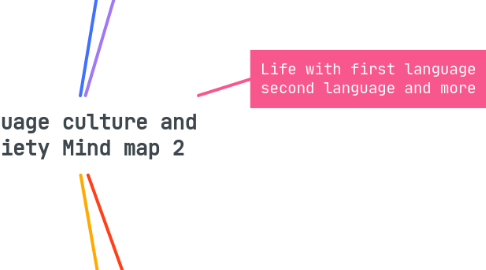
3. Life with first language second language and more
3.1. Innatist Theory
3.1.1. Innatist theory argues that there are at least some aspects of language that must already be present in the child at birth. (page 147 para3)
3.2. Language acquisition device
3.2.1. Language acquisition device (LAD) An inborn capacity of children to acquire their mother tongue.
3.3. Neurolinguistics
3.3.1. Neurolinguistics a branch of linguistics that deals with the role the brain plays in language and speech processing
3.4. Broca”s
3.4.1. A part of the brain in associated with the motor control of speech. Left hemisphere
3.5. Wernicke
3.5.1. A part of the brain which deals with the comperaction of language.Left hemisphere
4. Language through time
4.1. A language family
4.1.1. includes all those languages that are related by virtue of having descended from a single ancestral language. ( page 149 para4)
4.2. Linguistic competence Communicative competence
4.3. Speech community
4.3.1. All those who share the same language are in the speech community.
4.4. Speech area.
4.4.1. Groups that share similar speaking rules are known as a speech area by linguists.
4.5. Unit of speech behavior
4.5.1. Speech situation Speech event Speech act
5. Languages in Variation and Languages in Contact
5.1. Idiolect
5.1.1. The sound of someone's voice connects to specific speech pattern,
5.2. dialect.
5.2.1. When all the idiolects of a group of speakers have enough in common to appear at least superficially alike, we say they belong to the same dialect. The term dialect, then, is an abstraction
5.3. Pidgin
5.3.1. A pidgin is a simplified language that develops between groups of people who don't share a common language.
5.4. creolization,
5.4.1. This process of expansion of a pidgin to other language functions is referred to as creolization, and the end result is termed a creole. (page 187 para 2)