

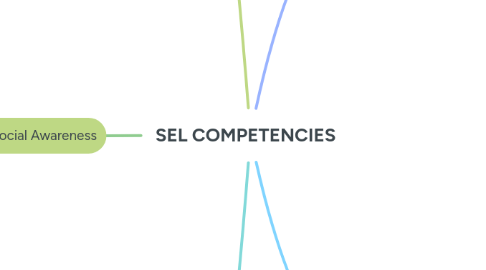
1. Self-Awareness
1.1. Environmental Connections
1.1.1. Being self-aware is closely connected to one's sense of their environment. To be fully aware of oneself, one needs to connect to the sights, sounds, tastes, smells and feel of the world around them. The choice of one's immediate environment greatly impacts which of their senses they are relying on the most, and therefore influences how they think of themseves in a given moment.
1.2. Emotions & Thoughts
1.2.1. Being self-aware is the heart of one's emotions and thoughts. The degree to which a person is self aware is directlty related to how deeply they are connected to their own emotions. How and what a person is thinking directs how they perceive themselves. Those who do not think deeply about their actions or feelings tend to not be very self-aware.
1.3. Other Humans
1.3.1. Self-awarness informs the types of relationships that people form with other humans. Those who are very in touch with their feelings, thoughts and actions tend to attract other like-minded people. Those who seem to have no self-awarness tend to come across as rude, selfish, or unjust in their actions and therefor have trouble connecting with others.
2. Social Awareness
2.1. Environmental Connections
2.1.1. Social awarness is directly connected to environmental concerns. Those who have an awareness of social issues around them, such as equality, discrimination, or injustice tend to also understand the need for envrionements to match their core beliefs. These people tend to seek out the environmental causes of negative issues and work towards changing environments to foster social change.
2.2. Emotions & Thoughts
2.2.1. People tend to have strong emotional responses to social issues, as well as very strong opinions. Those who are most socially aware don't sit on the fence when social issues are presented to them. A person who does not have strong feelings or opinions on issues facing society are usually not very socially aware of said issues.
2.3. Other Humans
2.3.1. The level of a person's social awareness has a direct affect on the people around them. This can go so far as to have have certain groups of people facing dangerous marginalization if those around are not aware of social issues facing those groups. However, when a large group in society are very socially aware, they can fight for the rights of those on the margins and create societies in which their awareness of social issues for some creates a better society for all.
3. Responsible Decision-Making
3.1. Environmental Connections
3.1.1. Concerning the environment, the ability to make responsile decisions is paramount to the integrity of any environment. Whether it is a small and personal environment like a classroom, or the world as a whole, the ability to make decisions in a responsible way impacts the ability of said environment to foster the success of individuals and groups.
3.2. Emotions & Thoughts
3.2.1. The ability to make thoughtful decisions can only happen when a person is in an emotionally stable state. It is very difficult to act responsibly when emotions are out of whack. Emotions and personal bias can have great impact on how well a person can make decisions that are responsible in a given moment.
3.3. Other Humans
3.3.1. Democratic society is based on the idea that a group of people can come together to make responsible decisions that benefit the group as a whole. When individuals struggle with decision making, this basic process breaks down and even the smallest groups cease to be able to function. We rely on other humans to be responsible when making decisios that affect more than themselves.
4. Self-Management
4.1. Environmental Connections
4.1.1. Being able to mange one's self affects how successful an individual can be in any given environment. Any issues presented by an environment, on any scale, cannot be dealt with until the people in said environmet can manage themselves.
4.2. Emotions & Thoughts
4.2.1. Emotions and intrusive thoughts can compete with an individual's ability to manage themselves. While emotions must be felt and not ignored, and thoughts must be given time to process, individuals need the skills to manage themselves and take a step back in situations where their inner world could negatively affect the world around them.
4.3. Other Humans
4.3.1. When people cannot manage themselves, conflict occurs. We as humans depend on individuals to be able to self-manage so that disagreements do not evolve into greater conflict or violence.
5. Relationship Skills
5.1. Environmental Connections
5.1.1. Humans need to form relationships with other humans, and with their environment. It is only through these connections that people can feel a sense of self and a sense of belonging. Those with poor relationship skills tend to not be able to succeed in multiple different environments.
5.2. Emotions & Thoughts
5.2.1. In order to build healthy relationships with other people, individuals need to be in touch with their own emotional state. They also need to be in control of their thought process. Trouble with either of these results in poor relationship skills, which can further alienate individuals already struggling to make connections.
5.3. Other Humans
5.3.1. At our core, everyone yearns for human conection. Learning appropriate skills for forming and maintaining relationships is fundamental to success in all areas of life.