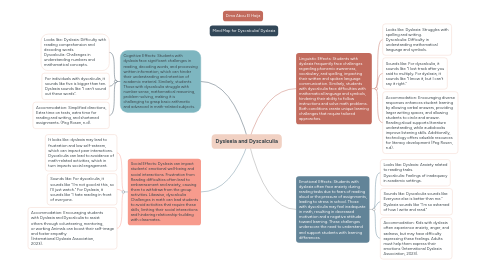
1. Cognitive Effects: Students with dyslexia face significant challenges in reading, decoding words, and processing written information, which can hinder their understanding and retention of academic material. Similarly, students Those with dyscalculia struggle with number sense, mathematical reasoning, problem-solving, making it is challenging to grasp basic arithmetic and advanced in math-related subjects.
1.1. Looks like: Dyslexia: Difficulty with reading comprehension and decoding words. Dyscalculia: Challenges in understanding numbers and mathematical concepts.
1.2. For individuals with dyscalculia, it sounds like five is bigger than ten. Dyslexia sounds like "I can't sound out these words".
1.3. Accommodation: Simplified directions, Extra time on tests, extra time for reading and writing, and shortened assignments. (Peg Rosen, n.d).
2. Social Effects: Dyslexia can impact students' emotional well-being and social interactions. Frustration from Reading difficulties often lead to embarrassment and anxiety, causing them to withdraw from the group activities. Likewise, dyscalculia Challenges in math can lead students to avoid activities that require these skills, limiting their social interactions and hindering relationship-building with classmates.
2.1. It looks like: dyslexia may lead to frustration and low self-esteem, which can impact peer interactions. Dyscalculia can lead to avoidance of math-related activities, which in turn impacts social engagement.
2.2. Sounds like: For dyscalculia, it sounds like "I'm not good at this, so I'll just watch." For Dyslexia, it sounds like "I hate reading in front of everyone.
2.3. Accommodation: Encouraging students with Dyslexia and Dyscalculia to assist others through volunteering, mentoring, or working Animals can boost their self-image and foster empathy (International Dyslexia Association, 2023).
3. Linguistic Effects: Students with dyslexia frequently face challenges regarding phonemic awareness, vocabulary, and spelling, impacting their written and spoken language communication. Similarly, students with dyscalculia face difficulties with mathematical language and symbols, hindering their ability to follow instructions and solve math problems. Both conditions create unique learning challenges that require tailored approaches.
3.1. Looks like: Dyslexia: Struggles with spelling and writing. Dyscalculia: Difficulty in understanding mathematical language and symbols.
3.2. Sounds like: For dyscalculia, it sounds like "I lost track after you said to multiply. For dyslexia, it sounds like "I know it, but I can't say it right.”
3.3. Accommodation: Encouraging diverse responses enhances student learning by allowing verbal answers, providing larger writing spaces, and allowing students to circle and answer. Reading aloud supports literature understanding, while audiobooks improve listening skills. Additionally, technology offers valuable resources for literacy development (Peg Rosen, n.d).
4. Emotional Effects: Students with dyslexia often face anxiety during reading tasks due to fears of reading aloud or the pressure of assignments, leading to stress in school. Those with dyscalculia may feel inadequate in math, resulting in decreased motivation and a negative attitude toward learning. These challenges underscore the need to understand and support students with learning differences.
4.1. Looks like: Dyslexia: Anxiety related to reading tasks. Dyscalculia: Feelings of inadequacy in academic settings.
4.2. Sounds like: Dyscalculia sounds like: Everyone else is better than me." Dyslexia sounds like "I'm so ashamed of how I write and read.”
4.3. Accommodation: Kids with dyslexia often experience anxiety, anger, and sadness, but may have difficulty expressing these feelings. Adults must help them express their emotions (International Dyslexia Association, 2023).