


1. III. SPECIFIC RELEVANCE
1.1. To the Program Enrolled
1.1.1. Concept mapping is particularly beneficial for future teachers (BEED students): - Understanding teaching methodologies. - Planning organized lessons. - Explaining complex topics clearly.
2. OBJECTIVES
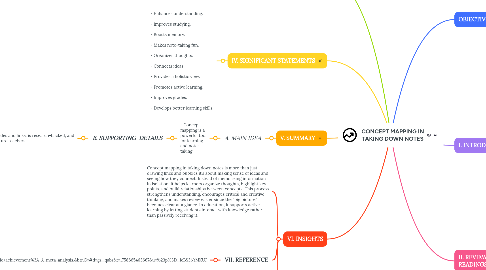
2.1. At the end of this lesson, the student will able to: - Demonstrate understanding of the relationships and interconnectedness between key concepts in the topic by constructing a clear concept map. - Analyze and organize information visually, linking new ideas to their prior knowledge to enhance comprehension. - Apply concept mapping as an effective tool to review, recall, and communicate complex ideas in a structured manner.
3. I. INTRODUCTION
3.1. Concept mapping is a visual learning tool that helps organize and connect ideas through nodes and links. Rooted in Ausubel’s theory of meaningful learning and popularized by Novak, it enables learners to relate new information to prior knowledge, improving comprehension and retention. Recent studies show that concept mapping enhances academic achievement across subjects and age groups, particularly when students actively construct their own maps (Izci, 2024; Wang et al., 2025).
3.1.1. A. GLOBAL CONTEXT
3.1.2. Concept Map note taking involves the graphical representation of ideas and their relationships. It allows students and professionals to visualize the structure of knowledge and identify the connections between different concepts. This method not only aids in learning and memorization but also supports critical thinking and problem-solving skills.
3.2. B. PERSPECTIVE
3.2.1. - Taking notes enhances attention. - Reviewing notes reinforces learning.
3.3. C. ISSUES & CHALLENGES
3.3.1. - Concept Map note taking involves the graphical representation of ideas and their relationships. It allows students and professionals to visualize the structure of knowledge and identify the connections between different concepts. This method not only aids in learning and memorization but also supports critical thinking and problem-solving skills.
4. II. REVIEW OF RELATED READINGS
4.1. A. RRL
4.1.1. According to Kitchenham and Charters (2007), A CM study gives an idea, in the early phases, of shortcomings in existing evidence, which becomes a basis for future studies Kitchenham and Charters (2007). This study presents a review of published literature on CMs initiatives in Computer Science in order to identify the state of the art. Seven research questions were defined and addressed investigating the following facets: (i) distribution of the selected studies over the years; (ii) purposes to employ CM in Computer Science; (iii) different subareas that CMs have been applied; (iv) resources used to support the development of CMs; (v) guidelines or mechanism used to evaluate the CMs; (vi) main benefits reported on the use of CMs; and (vii) main problems reported on the use of CMs.
4.1.1.1. B. RRS
4.1.1.1.1. According to Nesbit & Adescope (2006), concept maps and mind maps appears to be on the rise questions remain about how these maps are defined and differentiated, and how they can be used by researchers to identify themes and ultimately interpret meaning. In this paper we have presented the utility of mapping as a means of gathering data from research participants. Maps offer a means of gathering more unsolicited reflections, providing a visual snapshot of experience from which to ground theory within data, and thus can help researchers to refine subsequent data collection strategies.
5. IV. SIGNIFICANT STATEMENTS
5.1. - Enhances understanding. - Improves studying. - Boosts memory. - Makes note-taking fun. - Organizes thoughts. - Connects ideas. - Provides a holistic view. - Promotes active learning. - Improves grades. - Develops better learning skills.
6. V. SUMMARY
6.1. A. MAIN IDEA
6.1.1. - Concept mapping is a powerful tool for learning and note- taking.
6.1.1.1. B. SUPPORTING DETAILS
6.1.1.1.1. - It uses nodes and links, is research-backed, and benefits future teachers.
7. VI. INSIGHTS
7.1. Concept mapping in taking down notes is more than just drawing lines and bubbles it’s about making sense of ideas and seeing how they connect. Instead of memorizing information in isolation, it helps learners organize thoughts, highlight key points, and build relationships between concepts. This process strengthens understanding, encourages critical and creative thinking, and makes review easier since the “big picture” becomes clear at a glance. In education, it supports active learning by letting students interact with knowledge rather than passively receiving it.
7.2. VII. REFERENCE
7.2.1. Wheeldon, J., & Faubert, J. (2009). Framing experience: Concept maps, mind maps, and data collection in qualitative research. International journal of qualitative methods, 8(3), 68-83. https://doi.org/10.1177/160940690900800307 SANTOS, V. D., SOUZA, É. F. D., Felizardo, K. R., & Vijaykumar, N. L. (2017). Analyzing the use of concept maps in computer science: A systematic mapping study. Informatics in Education, 16(2), 257-288. https://doi.org/10.15388/infedu.2017.13 Izci, E., & Akkoc, E. A. (2024). The impact of concept maps on academic achievement: A meta-analysis. Heliyon, 10(1). DOI: https://doi.org/10.1016/j.heliyon.2023.e23290. Retrieved from: https://scholar.google.com/scholar?hl=en&as_sdt=0%2C5&q=The+impact+of+concept+maps+on+academic+achievement%3A+A+meta-analysis.&btnG=#d=gs_qabs&t=1758665463667&u=%23p%3D_leBS3NtMKUJ Retrieved on: September 16, 2025 Wang, X. M., Wang, J. L., Xu, S. Y., & Xu, S. J. (2025). Concept mapping in STEM education: a meta-analysis of its impact on students’ achievement (2004–2023). International Journal of STEM Education, 12(1), 30. DOI: https://doi.org/10.1186/s40594-025-00554-2. Retrieved from: https://scholar.google.com/scholar?hl=en&as_sdt=0%2C5&q=Concept+mapping+in+STEM+education%3A+a+meta-analysis+of+its+impact+on+students%E2%80%99+achievement+%282004-2023%29&btnG=#d=gs_qabs&t=1758665885632&u=%23p%3DMU-jG85qBb4J Retrieved on: September 16, 2025
7.3. PRESENTED BY:
7.3.1. IMPAS, HANNAH GAIL MARIE J.
7.3.1.1. THANK YOU FOR YOUR ATTENTION