


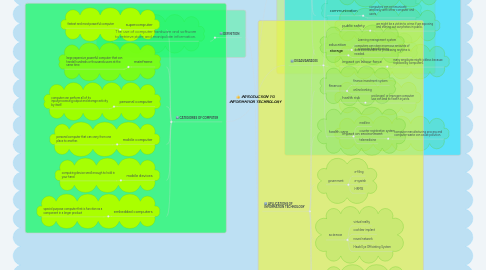
1. DEFINITION
1.1. The use of computer hardware and software to retrieve,store and manipulate information.
2. CATEGORIES OF COMPUTER
2.1. supercomputer
2.1.1. fastest and most powerful computer
2.2. mainframe
2.2.1. large,expensive,powerful computer that can handel hundreds or thousands users at the same time
2.3. personal computer
2.3.1. computer can perform all of its input,processing,output and storage activity by itself.
2.4. mobile computer
2.4.1. personal computer that can carry from one place to another.
2.5. mobile devices
2.5.1. computing device small enough to hold in your hand
2.6. embedded computers
2.6.1. special purpose computer that is function as a component in a larger product
3. ADVANTAGES
3.1. speed
3.1.1. computers can process trillions or billions of operations in a single second.
3.2. reliability
3.2.1. dependable and reliable because they are rarely break.
3.3. consistency
3.3.1. computer with the same input will produce the same results consistently.
3.4. communication
3.4.1. computers can communicate wirelessly with other computer and users.
3.5. storage
3.5.1. computers can store enormous amounts of data and available for processing anytime is needed.
4. DISADVANTAGES
4.1. violation of privacy
4.1.1. other person might steal our personal records.
4.2. public safety
4.2.1. we might be a victim to crime if we exposing and sharing out our photos in public.
4.3. impact on labour force
4.3.1. many employee might jobless because replaced by computers .
4.4. health risk
4.4.1. prolonged or improper computer use can lead to health injuries.
4.5. impact on environment
4.5.1. computer manufacturing process and computer waste can cause pollution.
5. APLLICATIONS OF INFORMATION TECHNOLOGY
5.1. education
5.1.1. Learning management system
5.1.2. computer based training
5.2. finance
5.2.1. finance investment system
5.2.2. online banking
5.3. health care
5.3.1. medline
5.3.2. counter registration system
5.3.3. telemedicine
5.4. government
5.4.1. e-filing
5.4.2. e-syariah
5.4.3. HRMIS
5.5. science
5.5.1. virtual reality
5.5.2. cochlear implant
5.5.3. neural network
5.5.4. Hawk Eye Officiating System
5.6. publishing
5.6.1. online newspaper and online magazine
5.7. travel
5.7.1. Global Positioning System (GPS)
5.7.2. online reservation system
5.7.3. E-ticketing
5.8. manufacturing
5.8.1. computer-aided design
5.8.2. computer aided manufacturing