

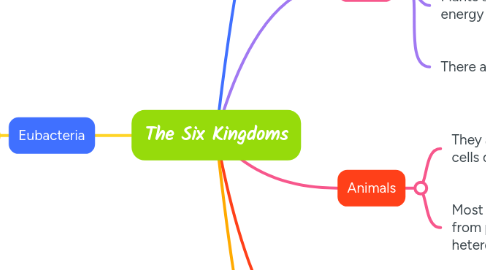
1. Eubacteria
1.1. They have strong walls.
1.2. Some are harmful, and many are helpful.
1.2.1. Some cause diseases, like strep throat and pneumonia.
1.3. They live in most habitats, except the most extreme.
1.4. They gain energy from different ways.
1.4.1. Some eat other organisms for energy; they are heterophs.
1.4.2. Others make their own energy; they are autotrophs.
1.4.3. Some make their own energy the way plants do; they are photosynthetic.
1.4.4. Others make energy by chemical reactions; they are chemosynthetic.
2. Archaebacteria
2.1. Have very different cell walls than eubacteria, but like it, archaebacteria make their own energy.
2.1.1. They are chemosynthetic and photosynthetic.
2.2. They live in extreme environments.
2.2.1. They live in such places as swamps, deep ocean, hot water vents, and seawater.
2.2.2. The environments in which they live often have no oxygen.
3. Plants
3.1. Plants are multicellular. Their cells have walls.
3.2. They don't move from place to place, they are stationary.
3.3. Plants are autotrophs; they make their own energy by photosynthesis.
3.3.1. Photosynthesis also provides oxygen in the atmosphere.
3.4. There are over 250,000 species of plants!
3.4.1. These include plants, mosses, ferns, and evergreens.
4. Animals
4.1. They are multicellular. But their cells don't have walls.
4.1.1. Their cells are organized into tissues, and tissues are organized into organ systems.
4.2. Most animals are able to move from place to place, they are heterotrophs.
5. Protists
5.1. They have simple organ systems, and can be unicellular or multicellular.
5.1.1. Some are autotrophs, similar to plants.
5.1.2. Others are heterotrophs similar to animals.
5.1.2.1. Still others are fungus like hetetotrophs that produce productive structures like fungi.
5.2. They live in moist environments.
6. Fungi
6.1. They can be either unicellular, or multicellular.
6.1.1. They are heterotrophs and don't make their own energy. Instead, theyabsorb nutrients from organic materials in their environment.