Unlock the full potential of your projects.
Try MeisterTask for free.
Non hai un account?
Iscriviti gratis
Naviga
Mappe in primo piano
Categorie
Gestione del progetto
Affari e obiettivi
Risorse umane
Brainstorming e analisi
Marketing e contenuti
Istruzione e note
Intrattenimento
Vita
ICT
Design
Sintesi
Altro
Lingue
English
Deutsch
Français
Español
Português
Nederlands
Dansk
Русский
日本語
Italiano
简体中文
한국어
Altro
Mostra mappa intera
Copia ed edita mappa
Copia
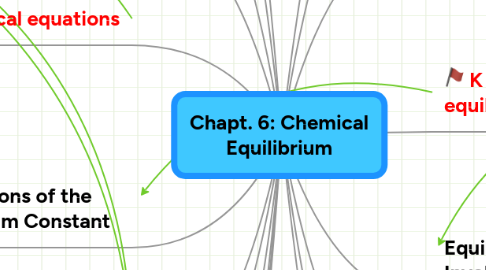
Chapt. 6: Chemical Equilibrium
Altro
AD
Aadarshi dave
Seguire
Concept map of textbook material (in black) and Key Concepts discussed in lecture (in red)
Iniziamo.
È gratuito!
Iscriviti con Google
o
registrati
con il tuo indirizzo email
Mappe mentali simili
Schema mappa mentale
Chapt. 6: Chemical Equilibrium
da
Aadarshi dave
1. Equilibria Involving Real Gases
1.1. Non-ideality
1.2. How to correct Kp for non-ideality
2. "Stress" on an equilibrium shifts reaction in direction that minimizes change
2.1. Add reactant (R) or product (P): rxn shifts to consume it Remove R or P: rxn shifts to replace it
2.2. Decrease the volume: rxn shifts to the side with the smallest n
2.3. Treat energy as R or P to predict effect of T on K
3. Le Châtelier's Principle
3.1. Effect of a change in conditions on equilibria
3.2. Effect of a change in concentration
3.3. Effect of a change in pressure
4. Solving Equilibrium Problems
5. You can do "math" with chemical equations
5.1. Adding c.e. means multiplying K
5.2. Multiplying c.e. by n means taking K^n
5.3. Reversing c.e. means taking 1/K
6. Applications of the Equilibrium Constant
6.1. Predictions based on the equilibrium constant
6.2. Extent of reaction
6.3. Reaction quotient (Q)
6.4. Calculating equilibrium pressures and concentrations
7. Try to make x in the ICE table small. This simplifies the math!
8. ICE tables help organize equilibrium problems
9. Heterogeneous Equilibria
9.1. Phases: gas, solid, liquid
9.2. Heterogeneous Equilibria: between multiple phases
9.3. Equilibrium constant for heterogeneous equilibria
9.4. Activity of pure phases (solids or liquids)
10. Q describes the position of a rxn not necessarily at equilibrium
11. Acitivity of pure solid or liquid = 1
12. Activity coefficients correct for interactions between species
13. The Equilibrium Condition
13.1. How a reaction reaches equilibrium
13.2. Characteristics of chemical equilibrium
13.3. Equilibria are dynamic
14. Equilibria are dynamic but may be so slow that []s appear not to change
15. The Equilibrium Constant
15.1. Law of mass action
15.2. Characteristics of the equilibrium expression
15.3. Equilibria in ammonia synthesis
15.4. Equilibrium position
16. K is meaningful only at equilibrium
16.1. Can't be = 0 or 1/0
16.2. Large K (>>1) means products favored
16.3. Small K (<<1) means reactants favored
17. Equilibrium Expressions Involving Pressures
17.1. Ideal gas law
17.2. Equilibrium partial pressures
17.3. Kp vs. K
18. Partial pressures sum to total pressure
19. Activity is a way to compare the amount of a reactant or product to their standard state and make K unit-less
20. The Concept of Activity
20.1. The reference state
20.2. For a gas, 1 atm
20.3. Definition of activity
Comincia. È gratis!
Connetti con Google
o
Registrati