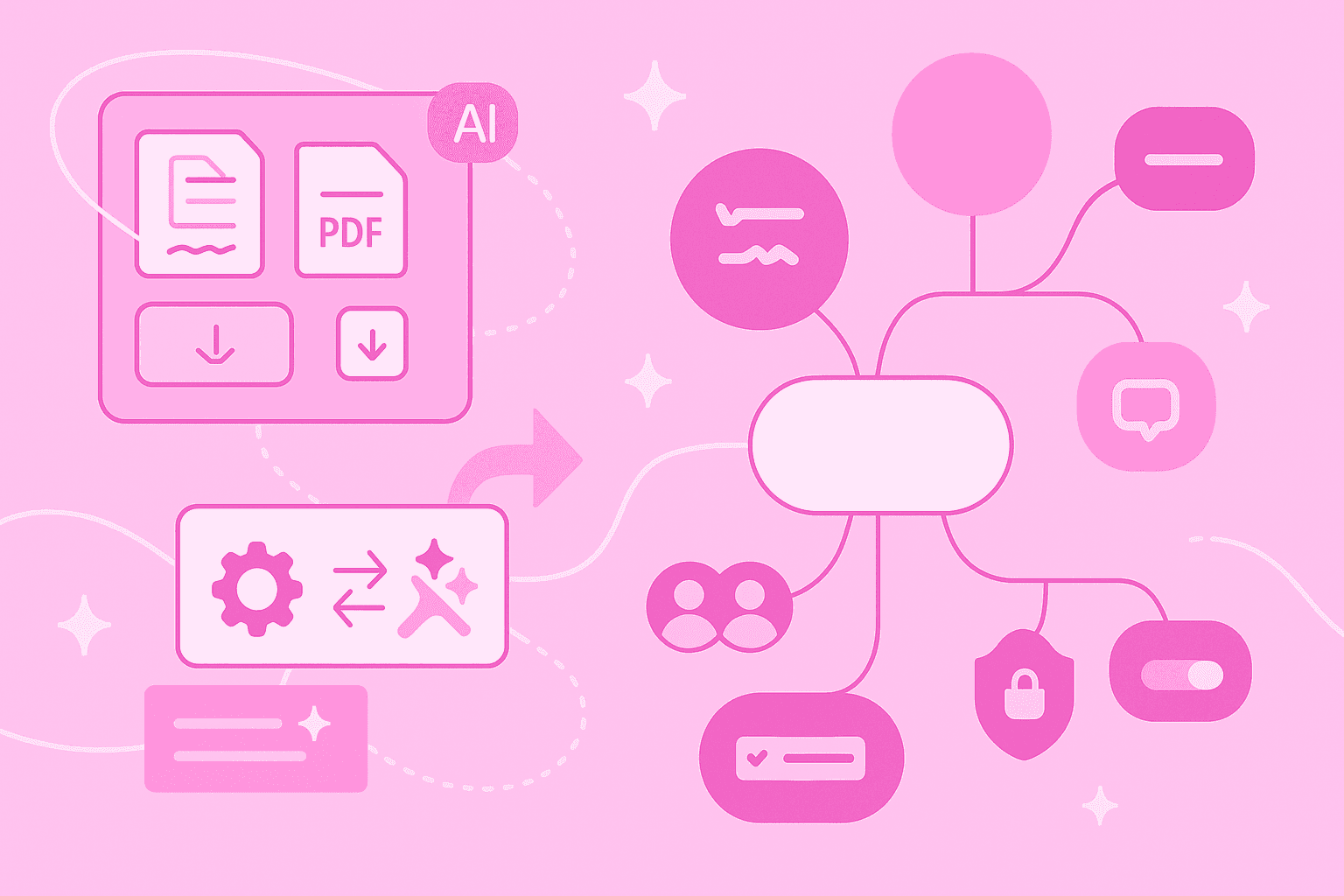


Why you should customize mind maps
The best mind map isn't necessarily the prettiest or most artistic – it's the one that works for you. When you personalize your mind map, you transform a generic template into a visual tool that organizes your ideas more clearly, helps you recognize connections faster, and often makes the work more enjoyable.
Why isn't a standard mind map enough? Simple: everyone thinks differently.
Through personalization, a general method becomes a tool that specifically supports you in your daily work.
Three reasons why a personalized mind map is worth it:
Thinking style: Some people think linearly from A to B, while others jump associatively between ideas. Your mind map should reflect this personal way of thinking.
Audience: A mind map for your team needs clear terms that everyone understands. One for your personal notes can use abbreviations and symbols that only you know.
Purpose: When brainstorming, you want room for spontaneous ideas. For a presentation, you need clear structures and a professional look.
With a mind mapping tool, you can design your mind map to match your work style and goal. This transforms a general method into a tool that truly moves you forward.
The benefits of a personalized mind map
A personalized mind map offers concrete advantages that go beyond standard mind mapping. These benefits show up directly in your daily work:
Better understanding: Your own colors and symbols function like mental shortcuts. If you always use red for urgent tasks, you grasp at a glance what has priority. Your personal visual codes help your brain process information 30% faster.
More effective communication: A mind map adapted to your audience conveys ideas more clearly. Technical details for developers, big-picture connections for management – you adjust the level of detail and language.
Flexibility for different use cases: With mind mapping software, you can switch between different layouts. A radial map for brainstorming, a tree structure for hierarchies, a timeline for project plans.
Foster creativity: Personal visual elements activate different brain areas simultaneously. A self-chosen symbol for "innovation" – perhaps a light bulb or lightning bolt – stimulates your creativity more than the word alone.
Modern brainstorm mind map creators make idea mapping even more effective. They combine the advantages of analog creativity with digital flexibility.
Create your very own mind map in 5 simple steps
The following five steps show you how to create a mind map that truly fits you. Personalization isn't an afterthought – it flows into every part of your mind map from the start. This way, your individual thought map develops step by step.
1. Define your main idea
Your central idea is the heart of your mind map. Personalization begins right here: the choice and presentation of your main idea reflects your personal goal.
Formulate your main idea as a clear question or concise topic. "How do I plan my marketing campaign?" works better than just "Marketing". Choose a central image or symbol with personal meaning – a rocket for growth, a target for focus.
Concrete examples of central ideas:
"Marketing Campaign Q2 2024"
"Biology Exam Prep – Cell Biology"
"Team Meeting April 15 – Project Update"
A mind map maker offers you various symbols and images to choose from. Experiment until you've found the perfect visual element for your mind map.
2. Create first branches with keywords
From your central idea, the main branches extend – the major categories of your topic. These branches show how you personally structure a topic.
Use individual keywords or short phrases that make sense to you. "Budget" might mean "Money", "Costs" or "€€€" to you – choose the term that best fits your way of thinking. The number of branches follows no fixed rule. Some topics need three main branches, others seven.
Practical tips for your branches:
Start with 3–7 main branches
Use verbs for actions: "plan", "implement", "review"
Use nouns for concepts: "Goals", "Resources", "Results"
Example project planning: "Goals", "Team", "Timeline", "Budget", "Risks"
With mind mapping, you can adjust your mind map at any time. A digital tool helps you quickly create a mind map and refine the structure.
3. Add personal colors and symbols
Now your mind map truly becomes your own. Visual elements make the difference between a functional and an inspiring mind map.
Colors: Develop your personal color system. Perhaps blue means "information" to you, green means "completed" and orange means "in progress". Your color choice should be intuitive.
Symbols and images: An airplane for business trips, a heart for favorite projects, a warning triangle for risks – choose symbols that are immediately understandable to you.
Fonts and formatting: Large font for main topics, small for details. Bold for important items, italics for ideas.
An online mind map tool or mind map maker offers you all the tools for visual mapping. Experiment with different styles until you find yours.
4. Connect related topics
Cross-connections show how different parts of your mind map relate to each other. These connections are your personal way of seeing relationships between ideas.
Use arrows or lines with short labels. "Influences", "requires", "leads to" – these connecting words show the type of relationship. Where others see separate topics, you recognize connections.
Examples of meaningful connections:
Project planning: "Budget" connects with "Resources"
Learning: Link similar concepts from different chapters
Brainstorming: One idea leads to the next
Mind mapping becomes your personal tool through these connections. This makes your way of thinking visible.
5. Review and refine your structure
A good mind map doesn't emerge on the first try. Take time for revision.
Ask yourself these questions: Will I still understand my mind map in a week? Does the structure follow my logic or theoretical guidelines? If I share the mind map: Does my audience understand the connections?
Concrete revision steps:
Check clarity: Are all keywords unambiguous to you?
Optimize structure: Do some branches belong elsewhere?
Visual balance: Does the mind map appear clear or cluttered?
Completeness: Are important aspects missing?
Mind map software like MindMeister makes revising easy. You can move branches, change colors and draw new connections. An online mind map tool gives you the flexibility that paper can't offer.
Tips for more structure and creativity
These advanced techniques help you make your mind maps even more personal and effective:
Use different layouts: A radial mind map isn't always the best choice. Try tree structures for hierarchies, org charts for teams or timeline formats for project timelines.
Use templates as a starting point: Many mind mapping tools offer templates for various purposes. Start with a template and adapt it to your needs. MindMeister, for example, offers templates for meetings, projects and brainstorming.
Integrate attachments and links: Add relevant documents, images or web links directly into your mind map. This turns it into a central information source.
Work with layers: Collapse and expand branches to switch between overview and detail. With complex topics, you maintain focus this way.
Combine structure with freedom: During initial brainstorming, let ideas flow freely. Structure only in the second step – this way you optimally use both ways of thinking.
Use keyboard shortcuts: MindMeister, for example, offers extensive shortcuts, so you work significantly faster with mind map software than on paper.
How to optimize your mind map for different audiences
A mind map is never just for you alone – often you share your thoughts with others. The art lies in adapting your personal mind map so others can understand it too.
For yourself: Here you can work completely freely. Use personal abbreviations like "MTG" for meeting or "W15" for week 15. Speed comes before beauty – scribble, use your favorite colors, add private notes.
For teams and collaboration: Switch to generally understandable terms. Explain your color logic in a small legend. Add context through notes or comments. Mind mapping software with real-time collaboration like MindMeister makes teamwork easy – everyone sees changes immediately.
For presentations: Reduce visual complexity. Use a maximum of 3–4 colors and clear, professional fonts. Presentation mode guides your audience step by step through the mind map. Less is more here.
For learning purposes: Structure particularly clearly according to main and subtopics. Use many images and symbols as memory aids – our brain remembers visuals better. Add concrete examples and short definitions directly into the mind map.
An online mind map tool makes these adjustments easy. You can create different versions of the same mind map for different audiences. Mind map software often also offers export options for various application examples.
How you can expand your ideas even further
Your mind map isn't a static document – it grows with your ideas. The true strength of a personalized mind map only shows itself over time.
Iterative work: Return to your mind map regularly. New insights, changed priorities, fresh ideas – all of this finds its place. Your mind map evolves with you.
Link with tasks: Transform ideas into concrete steps. MindMeister, for example, enables direct integration with MeisterTask for effective task management – this turns thoughts into actions.
Export and share: Use different formats depending on purpose. PDF for documentation, images for presentations, interactive formats for collaboration.
From analog to digital: Did you start on paper? No problem. Digitize your mind map for more flexibility and better shareability. Upload a photo or PDF of your handwritten notes to MindMeister and MindMeister AI transforms them into a digital mind map for you.
Every mind map is as unique as the person who creates it.
Create your personalized mind map now