

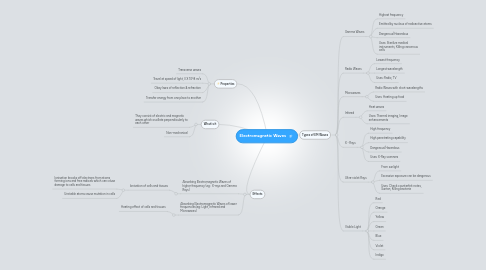
1. Properties
1.1. Transverse waves
1.2. Travel at speed of light, 3 X 10^8 m/s
1.3. Obey laws of reflection & refraction
1.4. Transfer energy from one place to another
2. Effects
2.1. Absorbing Electromagnetic Waves of higher frequency (eg: X-rays and Gamma Rays)
2.1.1. Ionisation of cells and tissues
2.1.1.1. Ionisation knocks off electrons from atoms, forming ions and free radicals which can cause damage to cells and tissues
2.1.1.2. Unstable atoms cause mutation in cells
2.2. Absorbing Electromagnetic Waves of lower frequencies(eg: Light, Infrared and Microwaves)
2.2.1. Heating effect of cells and tissues
3. What is it
3.1. They consist of electric and magnetic waves which oscillate perpendicularly to each other
3.2. Non-mechanical
4. Types of EM Waves
4.1. Gamma Waves
4.1.1. Highest frequency
4.1.2. Emitted by nucleus of radioactive atoms
4.1.3. Dangerous/Hazardous
4.1.4. Uses: Sterilize medical instruments, Killing cancerous cells
4.2. Radio Waves
4.2.1. Lowest frequency
4.2.2. Longest wavelength
4.2.3. Uses: Radio, TV
4.3. Microwaves
4.3.1. Radio Waves with short wavelengths
4.3.2. Uses: Heating up food
4.4. Infared
4.4.1. Heat waves
4.4.2. Uses: Thermal imaging, Image enhancements
4.5. X - Rays
4.5.1. High frequency
4.5.2. High penetrating capability
4.5.3. Dangerous/Hazardous
4.5.4. Uses: X-Ray scanners
4.6. Ultra-violet Rays
4.6.1. From sunlight
4.6.2. Excessive exposure can be dangerous
4.6.3. Uses: Check counterfeit notes, Suntan, Killing bacteria
4.7. Visible Light
4.7.1. Red
4.7.2. Orange
4.7.3. Yellow
4.7.4. Green
4.7.5. Blue
4.7.6. Violet
4.7.7. Indigo