


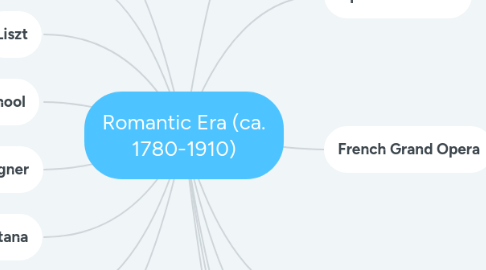
1. Schubert
1.1. Known for elevating the Lied
1.1.1. Lied= Song; Voice with piano accompaniment
1.1.2. Lieder became important for conveying national identity (German)
1.1.3. Poetic forms
1.1.3.1. Ballad
1.1.3.1.1. Through composed
1.1.3.1.2. "Der Erlkönig"
1.1.3.2. Lyric
1.1.3.2.1. Stanzas and refrains
1.1.3.2.2. "Der Heidenröslein"
1.2. Character pieces for piano
1.3. Unfinished symphony: Intended to follow in the footsteps of Beethoven
2. Paganini
2.1. Violin virtuoso
2.2. Set high standards for the instrument: colegno, trills, ornaments
2.3. Inspired Liszt
2.4. Caprices: featured complicated double stops and left hand pizzicato
3. Liszt
3.1. virtuoso pianist
3.2. concert etudes
3.2.1. hand crossing, trills, tremelos, etc.
4. New German School
4.1. Composers
4.1.1. Liszt
4.1.1.1. symphonic poems
4.1.2. Wagner
4.1.3. Berlioz
4.2. Franz Brendel: philosopher who led the movement
4.2.1. music history was a series of emancipations
4.3. Zukunftmusik
4.3.1. Future music
4.4. New German School opposed by Eduard Hanslick and the traditionalists
4.4.1. Traditionalist: Mendelssohn, Schumann, Brahms, Joachim
4.4.2. Hanslick valued music for its absolute and abstract character
4.4.3. Preferred traditional genres/formal structures (in opposition to views of the New German School).
5. Wagner
5.1. The Ring Cycle
5.1.1. Took over 25 years to write, 15 hours to perform
5.1.2. Wagner uses leitmotifs
5.1.2.1. motifs can signify many things, including characters, places, objects, emotions, or even abstract ideas
5.1.3. The action continually evolves
5.2. Gesamkuntswerk
5.2.1. Total or united artwork
5.3. Unendliche melodie
5.3.1. Unending melody
5.4. Tristan und Isolde
5.4.1. Features the Tristan chord
5.4.2. Represents a turn away from tonality
5.5. New theater
5.5.1. Built in Bayreuth
5.5.2. The orchestra was placed under the stage in the "pit"
6. Smetana
6.1. Czech Composer
6.2. Ma vlast
6.2.1. cycle of six symphonic poems
6.2.2. represents musical Czechness
6.2.3. Vltava (Die Moldau): main theme represents the river
6.2.3.1. Became the most popular theme Smetana ever composed
7. Tchaikovsky
7.1. Pupil of Rubinstein
7.2. Saw his style of composition existing somewhere between that of Western Europe and Russia
7.3. Supported for 13 years by patroness Nadezhda von Meck
7.4. Eugene Onegin
7.5. Fourth Symphony
7.5.1. Autobiographical
7.5.1.1. Associated with his marriage
8. Opera 1850-1900
8.1. Orientalism
8.1.1. musical representation of non-European (generally Asian) people
8.1.2. Bizet's Carmen
8.1.2.1. The arias performed by the exotic, main character often accompanied by Latin dance styles
8.2. Operetta
8.2.1. Started with Offenbach
8.2.1.1. Pioneered lighter style of opera that made fun of serious opera
8.2.2. Moved to Vienna, where Johan Strauss II composed operettas
8.2.3. Moved to England where Gilbert and Sullivan composed operrettas
8.2.3.1. Opened their own theater to stage operettas
8.2.3.2. Specialized in patter song
8.3. Verismo
8.3.1. Style of opera that is more relatable to the audience
8.3.2. Often features on-stage violence
8.3.3. Puccini
8.3.3.1. La boheme
8.3.3.2. Tosca
8.3.3.3. Madama Butterfly
9. Beethoven
9.1. Early
9.1.1. Known as a performer; Composed for piano
9.1.2. 1801: Acknowledges hearing loss
9.2. Middle
9.2.1. Eroica, Symphony No. 3
9.2.1.1. Almost dedicated to Napoleon
9.2.1.2. Heroic Theme
9.2.2. Symphony No. 5
9.2.2.1. Organicism: spinning out of a motive
9.2.3. Symphony No. 6
9.2.3.1. Pastoral: Vaguely programattic
9.3. Late
9.3.1. Composes for arts sake, isolates himself
9.3.2. Symphony No. 9 "Ode to Joy"
9.3.2.1. Sets the standard for all symphonies to come
10. Opera 1810-1850
10.1. Rossini
10.1.1. Composed very quickly at the beginning of his career
10.1.1.1. Formal structure
10.1.1.1.1. Cantabile
10.1.1.1.2. Cabaletta
10.1.1.1.3. Imbroglio
10.1.1.2. Aimed for commercial success
10.1.2. Barber of Seville
10.1.2.1. light, everescent style
10.2. Bellini
10.2.1. Defined the bel canto style
10.2.1.1. art of fine singing
10.2.2. Norma
10.3. Donizetti
10.3.1. Lucia di Lammermoor
10.3.1.1. The prototype for the "mad scene"
10.3.1.1.1. Coloratura singing
10.4. Weber
11. French Grand Opera
11.1. Paris: home of the largest theatrical spectacles
11.2. Associated with librettist Eugene Scribe
11.3. All aspects of production are expanded
11.4. Fewer arias, but still requires virtuoso singers
11.5. Meyerbeer
11.5.1. Les Huguenot
11.5.1.1. Set the standard for grand opera
11.5.1.2. Rarely performed today - too expensive
12. Outsiders, 1820-1860
12.1. Chopin
12.1.1. Polish pianist/composer
12.1.2. Cultivated salon music
12.1.3. Majority of his music was for solo piano
12.1.4. Mazurka
12.1.4.1. based on a traditional Polish dance form, triple meter, accent on 2 or 3
12.1.5. Ballades
12.1.5.1. expressed Polish nationalism
12.2. Gottschalk
12.2.1. first American composer to make his mark in European art music
12.2.2. commercially successful music based on exotic themes and places
12.2.3. Bamboula
12.2.3.1. evokes social dancing heard in NOLA's Congo square
12.3. Glinka
12.3.1. one of the first significant Russian composers
12.3.2. A Life for the Tsar
12.3.2.1. begins a long tradition of Russian nationalism
12.3.3. Studied in Italy
12.3.3.1. learned bel canto style
12.3.4. Studied in Berlin
12.3.4.1. counterpoint
13. Verdi
13.1. Saw a distinction between the North "Songs of Bach" and the South "Sons of Palestrina"
13.2. Operas were performed during the Risorgimento
13.2.1. Risorgimento: the period when Italy struggled for national unity
13.2.2. "Viva VERDI"
13.2.3. Verdi sought realism in his operas
13.2.3.1. Trio of masterworks
13.2.3.1.1. Rigoletto
13.2.3.1.2. Il trovatore
13.2.3.1.3. La traviata
13.2.3.2. Verdi merged elements of all existing dramatic genres into one single idiom: tragicomedy
14. The Mighty Five
14.1. Miliy Balakirev
14.1.1. Led the New Russian School
14.2. César Cui
14.3. Alexander Borodin
14.3.1. Composed symphonies
14.4. Modest Musorgsky
14.4.1. Boris Gudunov
14.4.1.1. Imitated conversational speech
14.4.1.2. Revised by Rimsky-Korsakov
14.5. Nikolai Rimsky-Korsakov
14.6. Promoted Russian music and disliked conservatory teaching and external influence
14.7. Opposed by Anton Rubinstein
14.7.1. Sought to raise Russian music training by importing teachers from Western Europe
15. Revival of the Symphony
15.1. Brahms
15.1.1. First symphony nickname Beethoven's Tenth symphony
15.1.2. Known for his technique Developing Variation
15.2. Bruckner
15.2.1. Symphonies sound similar to organ improvisation
15.3. Dvorak
15.3.1. New World Symphony
15.4. The Boston School
15.4.1. Edward MacDowell
15.4.2. Amy Beach
16. Music & Literature
16.1. H. Berlioz
16.1.1. Symphonie fantastiqe
16.1.1.1. Five-movement, programatic symphony
16.1.1.2. Uses idée fixe
16.1.1.2.1. Recurring melody that appears in all five movements
16.1.1.3. Parodies the Dies Irae
16.2. Felix Mendelssohn
16.2.1. A Midsummer Night's Dream
16.3. Robert Schumann
16.3.1. Carnaval
16.3.1.1. Collection of short piano pieces
16.3.1.2. Includes a large cast of characters including Eusebius and Florestan (Schumann's critical personas)
16.3.2. 1840: Year of Song
16.4. Fanny Mendelssohn
16.4.1. Coined the title "Song without Words"
16.4.2. Works published under brothers name
16.4.3. Not allowed to compose due to social standing
16.5. Clara Schumann
16.5.1. Published songs with her husband
16.5.2. Many of her compositions were for her own performance on the piano