


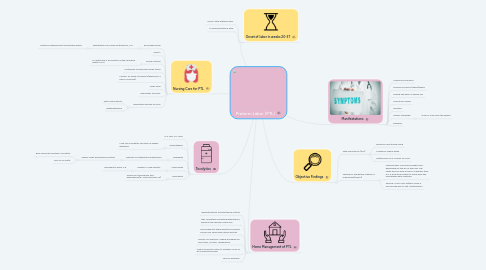
1. Onset of labor in weeks 20-37
1.1. Goal to stop preterm labor
1.2. To prevent preterm birth
2. Nursing Care for PTL
2.1. Encourage fluids
2.1.1. Dehydration can cause contractions, PTL
2.1.1.1. Oxytocin released from the pituitary gland
2.2. Oral/IV
2.3. Blood cultures
2.3.1. To determine if an infection is the causative agent of PTL
2.4. Continually monitor fetal heart tones
2.5. Monitor for signs of infection(especially if PROM occurred)
2.6. Delay birth
2.7. Administer Tocolytic
2.8. Administer steroids to mom
2.8.1. Fetal lung maturity
2.8.2. Betamethasone
3. Tocolytics
3.1. IT'S NOT MY TIME:
3.2. Indomethacin
3.2.1. Limit use in patients less than 32 weeks gestation
3.3. Nifedipine
3.3.1. Educate on orthostatic hypotension
3.3.1.1. Assess Heart and Kidney Function
3.3.1.1.1. BNP Should be less than 100 pg/ml
3.3.1.1.2. Bun: 8-22 mg/dl
3.4. Mag sulfate
3.4.1. Assess for Mag Toxicity
3.4.1.1. Therapeutic levels 4-8
3.5. Terbutaline
3.5.1. Assess for tachycardia, and hypokalemia(K+ level less than 3.5)
4. Home Management of PTL
4.1. Bedrest/restrict activity/sexual activity
4.2. Stay Hydrated! Preventing dehydration, prevents the release of oxytocin
4.3. Encourage left lateral position increases blood flow, decreases uterine activity
4.4. Monitor for infection: vaginal discharge for color/odor, Monitor Temperature
4.5. Instruct client to return to hospital if S&S of ptl continue/increase
4.6. Tips for boredom
5. Manifestations
5.1. Uterine contractions
5.2. Pressure in pelvic/vagina/thighs
5.3. Feeling like baby is “balling up”
5.4. Menstrual cramps
5.5. Diarrhea
5.6. Watery discharge
5.6.1. Gush of fluid from the vagina
5.7. Bleeding
6. Objective Findings
6.1. Fetal Fibronectin (fFN)
6.1.1. Binds sac and uterine lining
6.1.2. Tested by vaginal swab
6.1.3. Determines if PTL is likely to occur
6.2. Testing for premature rupture of membranes(PROM)
6.2.1. Nitrazine test: The strips change color depending on the pH of the fluid. The strips will turn blue if the pH is greater than 6.0. A blue strip means it's more likely the membranes have ruptured
6.2.2. Ferning: a “fern-like” pattern under a microscope due to salt crystallization