


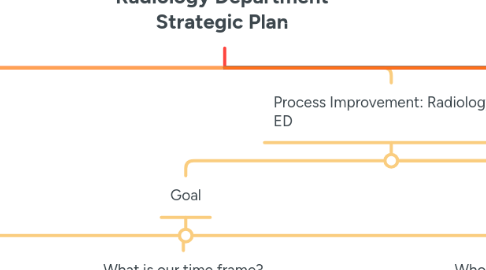
1. SWOT (mini version)
1.1. Top 3 Strengths
1.1.1. Access to new technology
1.1.2. Adaptable and agile to change/improvement
1.1.3. Leadership and frontline staff work together
1.2. Top 3 Opportunities
1.2.1. Recruitment
1.2.2. Expansion
1.2.3. Education
1.3. Top 3 Weaknesses
1.3.1. Department dispersed out throughout entire hospital
1.3.2. Staffing recruitment and retention
1.3.3. Lack of built in EMR technology to help with ordering, process flow, screening, and exam
1.4. Top 3 Threats
1.4.1. Reimbursements and Insurance Problems
1.4.2. COVID-19 Pandemic
1.4.3. Supply chain shortages
2. Recruitment
2.1. Goal
2.1.1. What do we want?
2.1.1.1. Hire graduating radiology techs from nearby schools.
2.1.1.2. Maintain relationship with nearby schools to learn, connect, and grow the radiology practice.
2.1.1.3. Grow and support education for current employees
2.1.2. What is our time frame?
2.1.2.1. 1. Start connecting with at least two nearby schools starting in Fall.
2.1.2.2. 2. In Spring, open new-hire applications for new grads starting prior to radiology school graduation.
2.1.2.3. Identify current non-licenced staff interested in pursuing radiology
2.1.3. Who is involved?
2.1.3.1. Radiology Leadership
2.1.3.2. Radiology Tech Educator
2.1.3.3. HR
2.1.3.4. Radiology Tech Experienced Preceptor of new graduates.
2.1.3.5. Dean/Director of Nearby School
2.1.3.5.1. Professor Representative
2.1.3.5.2. Clinical Site Educators
2.2. Metric
2.2.1. Quantitative
2.2.1.1. Minimum of 2 new hires in Spring start and Winter start
2.2.1.1.1. # of employees enrolled in program
2.2.2. Qualitative
2.2.2.1. Clinical Experience from students
2.2.2.1.1. # retained clinical students as new employees
2.2.2.1.2. Evaluations on different clinical sites
2.2.2.1.3. Evaluations on current staff and clinical site educators
2.3. Tactic
2.3.1. What schools are the best fit? What schools would provide value?
2.3.2. identify initial pilot group of employees interested in radiology- financially support them in attending radiology team
2.3.3. Marketing
2.3.3.1. School Job Fairs.
2.3.3.2. Representative to talk to students or be a SME for lecture classes. How many times a year?
2.3.3.2.1. content expert give lecture
2.3.3.3. Host an event.
3. Retention
3.1. Goal
3.1.1. What do we want?
3.1.1.1. Increase staff investment, representation, and voice in department.
3.1.1.2. Provide health and wellness initiatives to increase resiliance
3.1.1.3. Provide staff with retention bonuses/initiatives dependent on years of service
3.1.1.4. Build a culture of.....
3.1.2. What is our time frame?
3.1.2.1. Start new initiative every Spring and follow until year end. Repeat yearly. Ongoing goal.
3.1.2.2. At least each quarter, the department should plan an activity to bring awareness to staff's mental and/or physical health.
3.1.2.3. At the end of every fiscal year, apply retention bonus to those eligible
3.1.2.4. at least once a year, the department should plan a staff retreat or team building exercise to improve team morale and overall culture within the department
3.1.3. Who is involved?
3.1.3.1. Radiology Leadership
3.1.3.2. HR
3.1.3.3. Radiology Educator
3.1.3.4. Organization's Wellness Team
3.2. Metric
3.2.1. Qualitative
3.2.1.1. Present TIme:
3.2.1.1.1. What is the average retention?
3.2.1.1.2. Why are employees leaving?
3.2.1.1.3. Why do employees want to continue working here?
3.2.2. Quantitative
3.2.2.1. Present Time:
3.2.2.1.1. What is the average length of employment?
3.3. Tactic
3.3.1. Quarterly Surveys
3.3.2. Follow-up with HR to request feedback from exit interviews.
4. Process Improvement: Radiology in ED
4.1. Goal
4.1.1. What do we want?
4.1.1.1. Decrease the time, waste and variability within the process of Radiology performing exams in the ED.
4.1.1.2. Collaboration between multiple modalities and departments to provide the best patient care.
4.1.2. What is our time frame?
4.1.2.1. 6 month process change
4.1.2.1.1. 1
4.1.2.1.2. 2
4.1.2.1.3. 3
4.1.2.1.4. 4
4.1.2.1.5. 5-6
4.1.3. Who is involved?
4.1.3.1. ED
4.1.3.1.1. ED Leadership (manager)
4.1.3.1.2. ED Nurse (3 representatives from day shift, night shift, mid-shift)
4.1.3.2. Radiology
4.1.3.2.1. Radiology techs (work in the ED, minimum 2 representatives from each shift)
4.1.3.2.2. Radiology Leadership
4.2. Metric
4.2.1. Qualitative
4.2.1.1. Feedback from Staff
4.2.2. Quantitative
4.2.2.1. Time:
4.2.2.1.1. Xray Order - Start Time of Exam
4.3. Tactic
4.3.1. Create a process improvement team with key stakeholders
4.3.1.1. Builds momentum and creates buy in.
5. Service Line Expansion
5.1. Goal
5.1.1. Grow radiology services offered in the community- services conveniently offered- Focus on Mammograpy
5.1.2. Increase access to vascular and diagnostic US and MRI through expansion of coverage hours
5.1.2.1. New revenue programs
5.2. Metric
5.2.1. Qualitative
5.2.1.1. Patient satisfaction surveys
5.2.2. Quantitative
5.2.2.1. # of mammograms completed in community outreach locations
5.2.2.2. # of patinets transfered to larger facilities due to imaging unavailability
5.3. Tactic
5.3.1. 1. Secure funding for mobile mammography unit
5.3.2. 2. Identify two community based locations for mammography services
5.3.3. 3. Engage community partners to identify underserved areas and opportunities for service delivery
5.3.4. Staffing
5.3.4.1. Keeping staff in house 24/7 to provide imaging services
5.3.4.2. Creating a service line call team
5.3.4.2.1. Staff responds within a certain window of time to perform necessary imaging procedures after hours.
6. MISSION
6.1. [Company name]'s mission is to [primary purpose] by [how company achieves purpose].
7. VISION
7.1. A world where...
7.1.1. Every member of the radiology team feels empowered, appreciated, and supported by their leadership.
7.1.1.1. Every team members provides top of the line services to every patient.
7.1.1.1.1. All patient's have access to radiology services with minimal wait times