

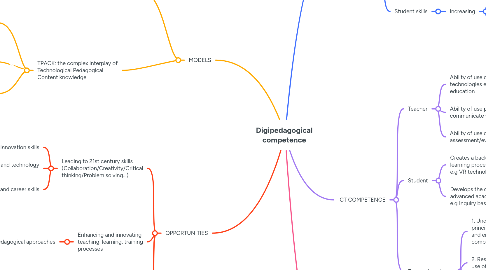
1. DEFINITIONS
1.1. Teacher skills
1.1.1. Be able to use
1.1.1.1. Technological tools
1.1.1.2. Devices
1.1.1.3. Applications
1.1.1.4. Software
1.1.1.5. Find meaningful use for them in planning, implementing, and assessing teaching and instruction
1.2. How and by which means these digital technologies can be utilized to enhance and innovate teaching, learning, and training
1.3. Student skills
1.3.1. increasing
1.3.1.1. security
1.3.1.2. communication
1.3.1.3. information
1.3.1.4. creativity of content
1.3.1.5. problem resolution
1.3.1.6. self esteem
2. ICT COMPETENCE
2.1. Teacher
2.1.1. Ability of use digital tools and technologies effectively in education
2.1.2. Ability of use platforms/tools to communicate with learners/parents/colleagues
2.1.3. Ability of use digital tools for assessment/evaluation
2.2. Student
2.2.1. Creates a background to be engaged in the learning process smartly and innovatively .. e.g VR technology/ Flipped classroom
2.2.2. Develops the critical thinking ability and manifest advanced academic performance e.g Inquiry based learning
2.3. Four main points
2.3.1. 1. Understanding of the operating principles, theoretical competence and enrichment of skills and compentences
2.3.2. 2. Responsible, safe, ergonomic use of technologies
2.3.3. 3. ICTs in information, management, creative and exploratory use
2.3.4. 4. Learning how to interact and network
3. CHALLENGES
3.1. Access to technology
3.1.1. Lack of funding/ Inequality to access different technology tools
3.2. Digital Literacy
3.2.1. Teachers/Students lack of digital skills
3.3. Ethical awareness
3.3.1. Cybersecurity and data privacy
3.4. Continuous learning
3.4.1. Personally attitude/ Opportunities for ongoing development
3.5. Quality of digital content
3.5.1. Resources accessibility/ Select high quality or relevant materials
4. Group 7
4.1. Beatrice Caldato
4.2. César Tojeiro
4.3. Siqi Hou
4.4. Anusha Panditharathna
5. MODELS
5.1. TPACK: the complex interplay of Technological Pedagogical Content knowledge
5.1.1. Content knowledge: what you understand and expertise of the subject area.
5.1.2. Pedagogical knowledge: methods of teaching and assessment.
5.1.3. Technological knowledge: about the tools and their use into the curriculum.
5.1.4. Pedagogical Content knowledge: the knowledge about how effectively engage students
5.1.5. Technological Pedagogical knowledge: how to choose and manage technology for students
5.1.6. Technological content knowledge: how technology is used in a subject area
5.2. DIGICOMPEDU: European framework for the Digital Competence of Educators
5.2.1. counts 22 competences divided in six areas
5.2.1.1. 1. Professional engagement
5.2.1.2. 2. Digital resources
5.2.1.3. 3. Teaching and learning
5.2.1.4. 4. Assessment
5.2.1.5. 5. Empowering learners
5.2.1.6. 6. Facilitating learners' digital competence
6. OPPORTUNITIES
6.1. Leading to 21st century skills (Collaboration/Creativity/Critical thinking/Problem solving...)
6.1.1. Learning and innovation skills
6.1.2. Information, media and technology skills
6.1.3. Life and career skills
6.2. Enhancing and innovating teaching, learning, training processes
6.2.1. Pedagogical approaches
6.2.1.1. Constructivist
6.2.1.2. Collaborative
6.2.1.3. Integrative
6.2.1.4. Reflective
6.2.1.5. Inquiery Based Learning
6.3. Enabling equal learning opportunities
6.4. Promoting self-efficacy
6.4.1. Academic achievement