


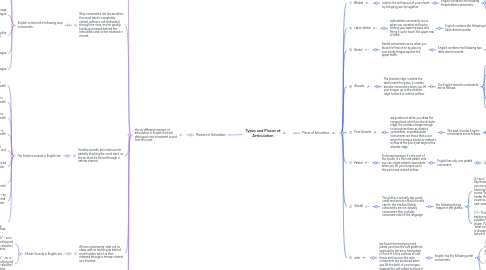
1. Manners of Articulation
1.1. the six different manners of articulation in English that will distinguish one consonant sound from the next.
1.1.1. Nasal consonants: are created whe you completely block the airflo through your mouth and let the ai pass through your nose.
1.1.1.1. There are three nasal consonants in English:
1.1.1.1.1. • /m/ – “crazy” and “clam” – the oral passage is blocked by closing the lips (bilabial).
1.1.1.1.2. • /n/ – “no” and “man‘ – the oral passage is blocked by pressing the tip of the tongue against the alveolar (alveolar) ridge.
1.1.1.1.3. • /ŋ/ – “going” and “funk” – The oral passage is blocked by pressing the back of the tongue against the soft palate (velar).
1.1.2. Stop consonants: are known when the vocal tract is completely closed, airflow is not redirected through the nose, and air quickly builds up pressure behind the articulators and is then released in a burst.
1.1.2.1. English contains the following stop consonants:
1.1.2.1.1. /p/ – purse and rap – oral passage is blocked by closing the lips (bilabial).
1.1.2.1.2. /b/ – “back” and “cab” – oral passage is blocked by closing the lips (bilabial).
1.1.2.1.3. /t/ – “tab” and “rat” – oral passage is blocked by pressing the tongue tip against the alveolar ridge (alveolar)
1.1.2.1.4. /d/ – “dip” and “bad” – oral passage is blocked by pressing the tongue tip against the alveolar ridge (alveolar)
1.1.2.1.5. /k/ – “kite” and “back” – block airflow with the back of the tongue against the soft palate (velar).
1.1.2.1.6. /g/ – “good” and “bug” – block airflow with the back of the tongue against the soft palate (velar).
1.1.3. fricative sounds: are notorious for partially blocking the vocal tract, so the air must be forced through a narrow channel.
1.1.3.1. The fricative sounds in English are:
1.1.3.1.1. /f/ – “cold” and “calf” - air is forced through the upper teeth and lower lip (labiodental)
1.1.3.1.2. /v/ – “vine” and “have” – air is forced through the upper teeth and lower lip (labiodental)
1.1.3.1.3. /θ/ – “thick” and “bath” – air is forced through the upper teeth and tongue (dental)
1.1.3.1.4. /ð/ – “the” and “rather” – air is forced through the upper teeth and tongue (dental)
1.1.3.1.5. /s/ – “suit” and “bus” – air is forced through the tongue and alveolar ridge (alveolar)
1.1.3.1.6. /z/ – “zit” and “jazz” – air is forced through the tongue and alveolar ridge (alveolar)
1.1.3.1.7. /ʃ/ – “shot” and “jet” – air is forced across the tongue and points just beyond the alveolar crest (post-alveolar)
1.1.3.1.8. /ʒ/ – “vision” and “measure” – air is forced across the tongue and points just beyond the alveolar crest (post-alveolar)
1.1.3.1.9. /h/ – “happy” and “hope” – actually /h/ is not a fricative. Technically, it's not even a real consonant sound, as there is no constriction/obstruction of airflow.
1.1.4. African consonants: start out as stops with air building up behind an articulator which is then released through a narrow channel as a fricative.
1.1.4.1. African Sounds in English are:
1.1.4.1.1. /tʃ/ – “chick” and “match” – air is blocked with tongue just beyond the alveolar ridge (post-alveolar), then released as a fricative.
1.1.4.1.2. /dʒ/ – “jam” and “badge” – air is blocked with tongue just beyond the alveolar ridge (post-alveolar), then released as a fricative
1.1.5. Approximant are when two articulators get close but not close enough to create turbulence in the air. The resulting sound is more like a fast vowel than anything else. For example, the approximation of /w/ is like a fast /u/ sound.
1.1.5.1. There are three approaches in English:
1.1.5.1.1. /w/ – “mojado” y “howard” – la parte posterior de la lengua se eleva hasta el velo (¡pero no demasiado cerca!) y los labios se redondean (velar)
1.1.5.1.2. /j/ – “sí” y “bayou” – la lengua sube hasta el paladar duro (¡pero no demasiado cerca!) (palatal)
1.1.5.1.3. /ɹ/ – “derecha” y “rugido” – lengua sube al paladar duro (pero no demasiado cerca) (alveolar/post-alveolar)
1.1.6. Lateral consonants: are when the tongue blocks the middle of the mouth so that air has to go past the sides.
1.1.6.1. There is a lateral consonant in English:
1.1.6.1.1. /l/ – “luck”- places the tip of the tongue on the alveolar (alveolar) crest
2. Places of Articulation
2.1. Bilabial
2.1.1. Bilabial consonants occur when you restrict the airflow out of your mouth by bringing your lip together.
2.1.1.1. English contains the following three bilabial consonants:
2.1.1.1.1. /p/ as in “purse” and “rap“
2.1.1.1.2. /b/ as in “back” and “cab“
2.1.1.1.3. /m/ as in “mad” and “clam
2.2. Labio–dental
2.2.1. Labiodental consonants occur when you constrict airflow by folding your lower lip back and lifting it up to touch the upper row of teeth.
2.2.1.1. English contains the following two labio-dental sounds:
2.2.1.1.1. /f/ as in “fro” and “calf“
2.2.1.1.2. /v/ as in “vine” and “have
2.3. Dental
2.3.1. Dental consonants occur when you block the flow of air by placing your sticky tongue against the upper teeth.
2.3.1.1. English contains the following two labio-dental sounds:
2.3.1.1.1. /θ/ as is “thick” and “bath“
2.3.1.1.2. /ð/ as in “the” and “rather
2.4. Alveolar
2.4.1. The alveolar ridge is where the teeth meet the gums, it creates alveolar consonants when you lift your tongue up to the alveolar ridge to block or restrict airflow.
2.4.1.1. The English alveolar consonants are as follows:
2.4.1.1.1. /n/ as in “no” and “man“
2.4.1.1.2. /t/ as in “tab” and “rat“
2.4.1.1.3. /d/ as in “dip” and “bad“
2.4.1.1.4. /s/ as in “suit” and “bus“
2.4.1.1.5. /z/ as in “zit” and “jazz“
2.4.1.1.6. /l/ as in “luck” and “fully”
2.5. Post-Alveolar
2.5.1. we produce it when you draw the tongue back a bit from the alveolar ridge, the sounds change enough to recognize them as distinct consonants, so postalveolar consonants are those that occur when the tongue blocks or restricts airflow at the point just beyond the alveolar ridge.
2.5.1.1. The post-alveolar English consonants are as follows:
2.5.1.1.1. /ʃ/ as in “shot” or “brash”
2.5.1.1.2. /ʒ/ as in “vision” or “measure”
2.5.1.1.3. /tʃ/ as in “chick” or “match”
2.5.1.1.4. /dʒ/ as in “jam” or “badge“
2.6. Palatal
2.6.1. It's known because it's the roof of the mouth, it's the hard palate, and you can create palatal consonants when you lift your tongue up to this point and restrict airflow.
2.6.1.1. English has only one palatal consonant:
2.6.1.1.1. /j/ as in “yes” and “bayou”
2.7. Glottal
2.7.1. The glottis is actually two vocal cords and acts as a kind of bottle cap for the trachea.Glottal consonants are not actually consonants they just play consonant roles in the language
2.7.1.1. the following things happen in the glottis:
2.7.1.1.1. /h/ as in “hello” and “Bahamas”. Say these words and notice how you are not actually restricting or blocking the flow of air for this /h/ sound. You're just exhaling a little harder than you would for a normal vowel sound in transition to the next vowel sound.
2.7.1.1.2. /?/ – This is actually the culprit behind many of the "silent syllables" we discussed in the first lesson. For example, in the phrase "what time is it?" the /t/ in “what” is dropped and the vowel sounds before it closes in the glottis.
2.8. velar
2.8.1. we found it behind your hard palate you have the soft palate as opposed to the bony hard palate in front of it this consists of soft tissue and mucous the velar consonants are produced when you lift the back of your tongue towards the soft palate to block or restrict the flow of air.
2.8.1.1. English has the following velar consonants:
2.8.1.1.1. /ŋ/ as in “going” and “uncle” (note that the 'n' sound in these words does NOT occur on the alveolar crest, so it is distinct from /n/).
2.8.1.1.2. /k/ as in “kite” and “back“
2.8.1.1.3. /g/ as in "good" and "bug"