


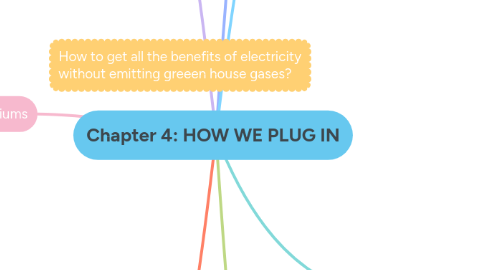
1. Sources of energy
1.1. Fossil fuels: 62%
1.1.1. more than 2/3 world electricity (coal: 36%; natural gas: 23%; Oil: 3%)
1.1.2. Reasons: Cheap
1.1.2.1. Fossil fuels are widely available
1.1.2.2. We’ve developed better and more efficient ways to extract and turn fossil fuels into electricity.
1.1.2.3. Governments take efford to keep fossil fuels cheap and encourage their production.
1.2. Hydropower: 16%
1.2.1. Advantage: cheap
1.2.2. Downfalls
1.2.2.1. reservoir displaces local communities and wildlife
1.2.2.2. a dam can actually be a worse emitter than coal
1.2.2.3. seasonally - the amount of elctricity generated heavily depends on the season
1.2.2.4. immobile - have to build dam where the rivers are
1.3. Nuclear: 10%
1.3.1. Nuclear fission: the process of getting energy by splitting atoms apart
1.3.2. Nuclear fusion: the process of getting energy by pushing atoms together
1.4. Renewables: 11%
1.4.1. Wind power: onshore and offshore wind farms
1.4.2. Solar power
1.4.3. Geothermal: heat from underground
1.5. Other: 1%
2. U.S's Green Premiums
2.1. the additional cost of getting all our power equipped with devices that capture the carbon they produce
2.2. Goal: get to zero emissions
2.3. cost: $18/month for the average home
2.3.1. pretty affordable for the majority
2.3.2. a challenge for low-income Americans
2.4. cannot applied for all, especially developing countries
2.4.1. Reason
2.4.1.1. not all countries have large supply of renewables
2.4.1.2. have low credit ratings
2.4.1.2.1. hard to finance big investments in new power plants
2.4.1.2.2. hard to jump-start economies
3. Why does it cost extra to go green?
3.1. Fossil fuel are so cheap
3.2. Not all regions have the opt to renewables
3.3. Our demand for reliability
3.3.1. we need elctricity all the time
3.3.2. we want to avoid major outages
3.4. Intermittency
3.4.1. The sun and the wind are intermittne sources - they don't genertate energy for all the time
3.4.1.1. store electricity in batteries
3.4.1.2. add other energy sources that use fossil fuels
3.4.2. Seasonal variation
3.4.2.1. e.g: solar power - overgeneration in the summer and undergeneration in the winter
3.4.3. External elements
3.4.3.1. extreme weather
3.4.3.2. accidents
3.4.4. Locations --> transmit energy over long distances is expensive and ineffective
4. Suggested solutions
4.1. Crisscrossing the country with special long-distance power lines
4.1.1. Involve several individuals and organizations
4.1.2. Take great time and effort
4.1.2.1. building a unified national grid, shipping energy to where needed
4.1.2.2. upgrade the electrical service to each household
4.1.3. Population's objection
4.2. Invest more in technology
4.3. Ultilize nuclear power
5. Making Carbon-free Electricity
5.1. Nuclear fission
5.1.1. Advantages
5.1.1.1. Reliable: can deliver power day and night, through every season, almost anywhere on earth
5.1.1.2. Effective
5.1.1.2.1. Can work on large scale
5.1.1.2.2. Efficiently using materials
5.1.2. Disadvantages
5.1.2.1. Expensive to build
5.1.2.2. Dangerous
5.1.2.2.1. Can be used in weapons
5.1.2.2.2. Storage and disposal of nuclear waste
5.1.3. Solution: traveling wave reactor
5.2. Nuclear fusion
5.2.1. Relied on the same basic process that power the sun
5.2.2. Advantages
5.2.2.1. Cheap and plentiful
5.2.2.1.1. Run on commonly available elements like hydrogen
5.2.2.1.2. Release a great deal of energy
5.2.2.2. Safer
5.2.2.2.1. As dangerous as radioactive hospital waste
5.2.2.2.2. No chain reaction to run out of control
5.2.3. Disadvantages
5.2.3.1. Very hard to do: take much energy to kick off the reaction
5.2.3.1.1. putting more into the process than you get out of it
5.2.3.2. Huge engineering challenge to build a reactor
5.2.4. Solution: high-temperature superconductors
5.2.4.1. stronger magnetic fields for containing the plasma
5.3. Offshore wind
5.3.1. Advantages
5.3.1.1. Not run into as many transmission problems
5.3.1.2. Offshore winds blow more steadily --> no intermittency
5.3.2. Disadvantages
5.3.2.1. Hard to place wind turbines out in the ocean
5.3.2.2. Expensive
5.4. Geothermal
5.4.1. Advantages
5.4.1.1. Plentiful - taking heat from underground
5.4.1.2. Carbon-free electricity
5.4.2. Disadvantages
5.4.2.1. Inefficient: the amount of energy we get per m2 is quite low
5.4.2.2. Unpredictable: hard to know whether the well produce the heat we need, or for how long
5.4.2.3. Available only in certain places
6. High cost of storage
7. Storing Electricity
7.1. Batteries
7.1.1. Hard to improve: unlikely that there are materials that will make better batteries than the ones we’re already building
7.1.2. New type of battery
7.1.2.1. Liquid metals batteries: store and deliver energy very quickly
7.1.2.2. Flow batteries: storing fluids in separate tanks and generating electricity by pumping the fluids together.
7.2. Pumped hydro
7.2.1. Can storing city-sized amounts of energy
7.2.2. Biggest form of grid-scale electricity storage in the world
7.2.3. Problems: Inefficient
7.3. Thermal storage
7.3.1. When electricity is cheap, you use it to heat up some material --> use the heat to generate power via a heat engine
7.3.2. Most promising approach: store the heat in molten salt
7.4. Cheap hydrogen
7.4.1. Hydrogen serves as a key ingredient in fuel cell batteries
7.4.2. Use electricity from a solar or wind farm to create hydrogen, store the hydrogen and put it in a fuel cell to generate electricity
7.4.3. Advantages
7.4.3.1. Use clean electricity to create a carbon-free fuel that could be stored for years
7.4.3.2. Solve the location problem
7.4.4. Disadvantages
7.4.4.1. Expensive to produce hydrogen without emitting carbon
7.4.4.2. Not as efficient as storing the electricity directly in a battery
7.4.4.3. Hard to be stored
7.4.4.4. The process of making hydrogen required various expensive materials
8. Other Innovations
8.1. Capturing carbon
8.1.1. Point capture
8.1.1.1. Suck up the CO2 before it hits the atmosphere
8.1.1.2. Involve installing special devices at fossil-fuel plants to absorb emissions.
8.1.1.3. Expensive to by and operate
8.1.1.4. Power companies don’t gain anything from installing “point capture” devices
8.1.2. Direct air capture (DAC)
8.1.2.1. Capturing carbon directly from the air
8.1.2.2. More plexible: you can do it anywhere
8.1.2.3. Technical challenge: the low concentration of CO2 in the air --> require a lot of energy
8.2. Ussing less
8.2.1. Reduce electricity demand wherever we can
8.2.2. Load shifting (demand shifting) : Use more electricity when it’s cheapest to generate
8.2.3. Shed demand: Prioritize the highest needs and shut down nonessential activities