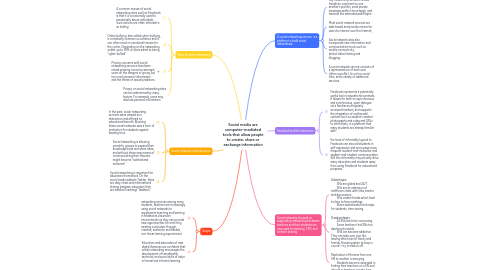
Social media are computer-mediated tools that allow people to create, share or exchange informationDoor Ева Тодорская
1. Risks of social networking
1.1. A common misuse of social networking sites such as Facebook is that it is occasionally used to emotionally abuse individuals. Such actions are often referred to as trolling
1.2. Online bullying, also called cyber-bullying, is a relatively common occurrence and it can often result in emotional trauma for the victim. Depending on the networking outlet, up to 39% of users admit to being “cyber-bullied”.
1.3. Privacy concerns with social networking services have been raised growing concerns amongst users on the dangers of giving out too much personal information and the threat of sexual predators.
1.4. Privacy on social networking sites can be undermined by many factors. For example, users may disclose personal information
2. Social networks and education
2.1. In the past, social networking services were viewed as a distraction and offered no educational benefit. Blocking these social networks was a form of protection for students against wasting time
2.2. Social networking is allowing scientific groups to expand their knowledge base and share ideas, and without these new means of communicating their theories might become "isolated and irrelevant".
2.3. Social networking is important for educators themselves. On the social media website Twitter, there are daily chats and informational sharing between educators that are labelled (hashtag) "#edtech".
3. Scope
3.1. networking services among many students, teachers are increasingly using social networks to supplement teaching and learning in traditional classroom environments as they can provide new opportunities for enriching existing curriculum through creative, authentic and flexible, non-linear learning experiences.I
3.2. Educators and advocates of new digital literacies are confident that social networking encourages the development of transferable, technical, and social skills of value in formal and informal learning.
4. A social networking service is a platform to build social networksew
4.1. Key networking software allows friends to comment on one another’s profiles, send private messages within the network, and traverse the extended webPeople
4.2. Most social network services are web-based and provide means for users to interact over the Internet,
4.3. Social network sites also incorporate new information and communication tools such as mobile connectivity, photo/video/sharing and blogging.
4.4. A social network service consists of a representation of each user (often a profile), his or her social links, and a variety of additional services.
5. Facebook and the classroom
5.1. Facebook represents a potentially useful tool in educational contexts. It allows for both an asynchronous and synchronous, open dialogue via a familiar and regularly accessed medium, and supports the integration of multimodal content such as student-created photographs and video and URLs to other texts, in a platform that many students are already familiar with.
5.2. the level of informality typical to Facebook can also aid students in self-expression and encourage more frequent student-and-instructor and student-and-student communication. Still this informality may actually drive many educators and students away from using Facebook for educational purposes.
6. Social networks focused on supporting relationships between teachers and their students are now used for learning, CPD, and content sharing.
6.1. Advantages: SNs are global and 24/7. SNs are an extension of staffroom chats with links, banter and discussions. SNs create friends which lead to face to face meetings. Share worksheets/mind maps for students, time-saving.
6.2. Disadvantages: All SNs are time-consuming. Some teachers find SNs too daunting to tackle. SNs can become addictive. They can take over your life, leaving little time for family and friends. Knowing when to stop is crucial – try to switch off.
6.3. Replication of themes from one SN to another is annoying. Students become obsessed in finding their teachers on a SN and intrude in teachers’ private lives.