

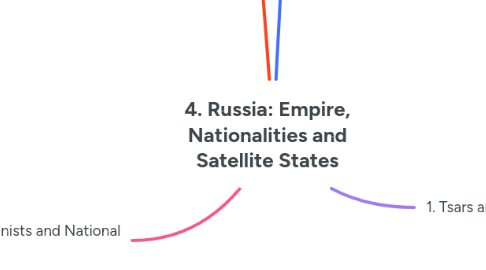
1. 2. The Provisional Government and National Minorities
1.1. Provisional governments attitudes to national minorities
1.1.1. Absense of central power after february revolution alloed minorities to form separatist movements and independant national institutions
1.1.1.1. The provisional government were actually united by the desire to maintain the empires borders
1.1.1.1.1. But they attempted to put the matter of national minorities off until they gained legitimacy through elections
1.2. Policies of the Provisional government towards national minorities
1.2.1. Ukraine
1.2.1.1. Formed their own parliament, the rada on the 4th March 1917 by a nationalist movement aiming for greater autonomy in the empire
1.2.1.1.1. Lvov was forced to comprimise with the rada and give it autonomy to prevent their full independance
1.2.2. Finland
1.2.2.1. On the 23rd June 1917 Finland unilaterally declared independence
1.2.2.1.1. In July the provisional government, like alexander II reactively sent troops to the border and forced the Finns to back down
2. 3. Communists and National Minorities
2.1. Communist attitudes towards national minorities
2.1.1. Tsars wanted to impose autocracy and russification on national minorities
2.1.1.1. Communists wanted to spread the communist revolution and wanted class interests to trascend the idea of nationality
2.1.1.1.1. Class would unite rather than nationalities, where instead the tsar would promote nationality
2.1.2. In order to spread communist ideology they needed to control national minorities, so in some ways were similar to the tsars
2.1.2.1. They adopt similar approaches but their intended outcomes are vastly different
2.2. Communist Policy towards national minorities
2.2.1. 1903-1917 Pre Power
2.2.1.1. Constitutional Rights
2.2.1.1.1. Lenin
2.2.1.2. Culture
2.2.1.2.1. Lenin
2.2.2. 1918-1924 The civil war and 1924 constitution
2.2.2.1. Constitutional Rights
2.2.2.1.1. Lenin
2.2.2.2. Culture
2.2.2.2.1. Lenin
2.2.3. 1928-1945 Sovietisation (Similar to the tsarist system, it aimed to make people more loyal to the soviet union by forcing people to adopt a way of life and culture modelled after the soviet union, tolerant leninist policies ended)
2.2.3.1. Constitutional Rights
2.2.3.1.1. Stalin
2.2.3.2. Repression
2.2.3.2.1. Stalin
2.2.3.3. Culture
2.2.3.3.1. Stalin
2.2.4. 1945-1964 Soviet Sphere of Influence
2.2.4.1. Constitutional Rights
2.2.4.1.1. Stalin
2.2.4.2. Repression
2.2.4.2.1. Stalin
2.2.4.2.2. Khrushchev
2.2.4.3. Culture
2.2.4.3.1. Stalin
3. Background
3.1. Over half of the people who lived in the empire were not russian, stemming from expansion of russian empire from grand duchy of moscovy
3.1.1. This meant that the empire was a diverse mixture of groups (russian, polish, finnish and tartars) most of which with differing religions
3.2. 1897 census revealed 44% of the population with russian, 70% orthodox, 10% catholic and 12% muslim
4. 1. Tsars and National Minorities
4.1. Tsarist attitudes towards national minorities
4.1.1. Tsars sought to preserve control of minorities and preserve the three pillars
4.1.1.1. Different nationalitiies had different relationships with the tsars, either loyal, disloyal or jewish
4.1.1.1.1. Loyals inclouded finns and blatic germans while the poles were disloyal
4.1.2. Overall Alexander II adopted a haphazard and reactive approach to national minorities
4.1.2.1. Alexander III and nicholas were much more proactive and adopted a harsher policy of russification through the influence of pobedonostev
4.2. Tsarist Policy of russification towards National Minorities
4.2.1. Constitutional Rights
4.2.1.1. Alexander II
4.2.1.1.1. Poland
4.2.1.1.2. Ukraine
4.2.1.1.3. Baltic States
4.2.1.1.4. Finland
4.2.1.2. Alexander III
4.2.1.2.1. Finland
4.2.1.2.2. Jews
4.2.1.3. Nicholas II
4.2.1.3.1. Finland
4.2.2. Repression
4.2.2.1. Alexander II
4.2.2.1.1. Poland
4.2.2.1.2. Ukraine
4.2.2.1.3. Baltic States
4.2.2.2. Alexander III
4.2.2.2.1. Ukraine
4.2.2.2.2. Baltic States
4.2.2.2.3. Jews
4.2.2.3. Nicholas II
4.2.2.3.1. Ukraine
4.2.2.3.2. Baltic States
4.2.3. Culture
4.2.3.1. Alexander II
4.2.3.1.1. Poland
4.2.3.2. Alexander III
4.2.3.2.1. Poland
4.2.3.2.2. Ukraine
4.2.3.2.3. Baltic States
4.2.3.2.4. Jews