


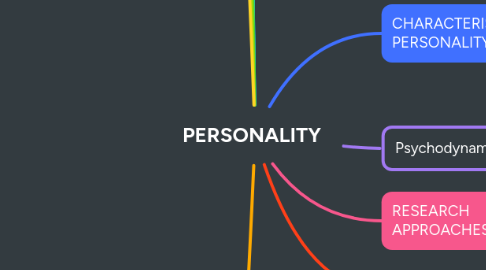
1. PERSONALITY ASSESSMENT
1.1. ABOUT
1.1.1. Definition
1.1.1.1. Includes any systematic attempt to measure
1.1.1.2. Identify differences in personality among subjects in a precise manner
1.1.2. Components to an Assessment Report
1.1.2.1. History and observations
1.1.2.2. Results
1.1.2.3. Interpretation
1.1.3. Goals of assessment
1.1.3.1. Precision
1.1.3.2. Communication
1.1.3.2.1. results have to be understandable
1.1.3.3. Prediction
1.1.4. Purpose
1.1.4.1. Clinical
1.1.4.2. Counselling
1.1.4.3. Legal
1.1.4.3.1. prove that someone is culpable
1.1.4.4. Educational and vocational
1.1.4.5. Corporate
1.1.4.5.1. screening employees
1.1.4.6. Research
1.1.4.6.1. coming up with theories for personality
1.2. TECHNIQUES
1.2.1. Objective self report
1.2.1.1. Definition
1.2.1.1.1. The subject, as objectively as possible, completes a standardized test about oneself
1.2.1.2. Pros & Cons
1.2.1.2.1. Cons
1.2.1.2.2. Pros
1.2.2. Projective techniques
1.2.2.1. Definition
1.2.2.1.1. The examiner rates the subjects responses to cues
1.2.2.2. Types
1.2.2.2.1. Association techniques
1.2.2.2.2. Completing techniques
1.2.2.2.3. Choice or ordering
1.2.2.2.4. Expressive
1.2.2.2.5. Constructive
1.2.2.3. Characteristics
1.2.2.3.1. Indirect assessment
1.2.2.3.2. Ambiguous test stimuli
1.2.2.3.3. Freedom of reponse
1.2.2.3.4. Subjective scoring procedures
1.2.2.4. Pros & Cons
1.2.2.4.1. Pros
1.2.2.4.2. Cons
1.2.3. Behavioural techniques
1.2.3.1. Definition
1.2.3.1.1. The examiner rates the subject's behaviour
1.2.3.1.2. Observation of behaviour
1.2.3.1.3. The observable actions and unobservable thoughts
1.2.3.2. Types
1.2.3.2.1. Direct observation
1.2.3.2.2. Self-monitoring
1.2.3.2.3. Self- Report behavioural inventories
1.2.3.2.4. Cognitive Behavioural
1.2.3.3. Pros & Cons
1.2.4. Psychophysiological techniques
1.2.4.1. Definition
1.2.4.1.1. The examiner measures the subject's physiological responses
1.2.4.2. Types
1.2.4.2.1. Electrophysiological
1.2.4.2.2. Biochemical
1.2.4.2.3. Cortical measures
1.2.4.3. Pros & Cons
1.2.4.3.1. Pros
1.2.4.3.2. Cons
1.3. MMPI
1.3.1. Most widely used clinical personality inventory
1.3.2. Multiple-dimension
1.3.3. For psychiatric disorders
1.3.4. 567 truth-false
1.3.5. Scales and Measurement
1.3.5.1. Principle subscales
1.3.5.1.1. 10 Major Personality Dimensions
1.3.5.2. Supplementary subscales
1.3.5.2.1. 12 for other aspects of personality
1.3.5.2.2. Anxiety, Ego-strength,...
1.3.5.2.3. #1. I like mechanics magazines. MfM, MfF F
1.3.5.2.4. #2. I have a good appetite. Hs, D, Hy F #16. I am sure I get a raw deal from life. Pd, Pa T #22. At times I have fits of laughing and crying that I cannot control. Pt, Sc, Ma T
1.3.5.2.5. #22. At times I have fits of laughing and crying that I cannot control. Pt, Sc, Ma T
1.3.5.2.6. #16. I am sure I get a raw deal from life. Pd, Pa T #22. At times I have fits of laughing and crying that I cannot control. Pt, Sc, Ma T
1.3.5.3. (4) Validity scales
1.3.5.3.1. Cannot Say
1.3.5.3.2. Lie (L)
1.3.5.3.3. Infrequency (F) (for faking it)
1.3.5.3.4. Correction (K)
1.4. RELIABILITY & VALIDITY
1.4.1. Reliability
1.4.1.1. Examiner reliability
1.4.1.1.1. Consistency across raters
1.4.1.2. Test-retest reliability
1.4.1.2.1. Consistency across time
1.4.1.3. Reliability coefficient
1.4.1.3.1. Consistency in assessment (r = ?)
1.4.2. Validity
1.4.2.1. Face validity
1.4.2.1.1. “look” like what it is measuring
1.4.2.2. Content validity
1.4.2.2.1. Represent all dimensions of target personality
1.4.2.3. Criterion validity
1.4.2.3.1. Correlation between test score and criterion
1.4.2.3.2. Predictive validity
1.4.2.3.3. Concurrent validity
1.4.2.4. Construct validity
1.4.2.4.1. Test scores correlation with associated construct
1.4.2.4.2. Taking what you are trying to assess, and breaking it down. is what you're testing a valid interpretation of what you are trying to assess. making sure your original definitions are correct and correctly assessing based on that.
1.4.2.4.3. Steps to ensure and test for:
1.4.2.5. Discriminate validity
1.4.2.5.1. Target measure is not the same as another measure
1.4.2.6. Generalizability
1.4.2.6.1. Extend findings to other settings, measures, behaviours
2. CHARACTERISTICS OF PERSONALITY
2.1. Uniqueness of the individual
2.1.1. - Can be explained from various theoretical viewpoints.
2.1.2. - Should be able to define a person’s thoughts, behaviours, and feelings to an extent
2.2. Consistency of behavior
2.2.1. - Accounts for consistency of behaviour across some span of time- personality can change over some period of time. (can even change from season to season)
2.2.2. Has to have some predictive power- If personality changes from time to time, whats the use of knowing it from moment to moment?
2.3. Content and process
2.3.1. ‘The content’ of personality can refer to the basic makeup of human personality, and the ‘process’ can refer to the behaviour of a person. The content and process features of personality are interrelated and the ‘content’, or the basic makeup of the human personality, directly influences how the personality operates, or the ‘process’.
2.3.2. - Describes the underlying operational elements that give rise to a consistency in behaviour and the uniqueness of the individual .
2.3.3. ◦Personality should have something consistent in its processing in how you got to be the way that you are, and be able to tell us something about your internal workings so that we can understand how your behaviour is consistent across a span of time and how you are different from somebody else.
3. Psychodynamic
3.1. Sigmund Freud (1856)
3.1.1. Practices
3.1.1.1. Free association
3.1.1.1.1. About
3.1.1.1.2. Method
3.1.1.2. Dream interpretation
3.1.1.2.1. About
3.1.1.3. PSYCHOANALYSIS
3.1.1.3.1. Process
3.1.1.3.2. Goal
3.1.1.3.3. Effectiveness
3.1.1.3.4. Barriers
3.1.1.3.5. Difference in focus
3.1.2. Theories
3.1.2.1. PSYCHOSEXUAL
3.1.2.1.1. STAGES
3.1.2.1.2. Regressive Tendencies
3.1.2.1.3. About
3.1.2.2. PSYCHOANALYTIC
3.1.2.2.1. Regions of the Mind
3.1.2.2.2. Psyche
3.1.3. Beliefs
3.1.3.1. Psychic determinism
3.1.3.1.1. Justified interpretation of dreams, “Freudian slips”,and reading deeper meaning from every action.
3.1.3.1.2. Psychic meaning underlie all thoughts, feelings, and behaviours
3.1.3.2. Unconscious mind
3.1.3.2.1. All thoughts, feelings, and behaviours are determined by unconscious forces
3.1.3.2.2. First to emphasize the unconscious and bring it to the forefront of the study
3.1.3.3. Instincts
3.1.3.3.1. Characteristics
3.1.3.3.2. Two natures
3.1.3.4. Personality
3.1.3.4.1. Nature of personality is dynamic
3.1.3.4.2. Personality is a closed system
3.1.4. Applications
3.1.4.1. Motivational research
3.1.4.1.1. Tapping into the unconscious to effect purchasing decisions
3.1.4.1.2. Deciphering the latent motives that underlie manifest motives
3.1.4.1.3. Use personal attitudes to understand purchasing decisions, then to develop marketing strategies
3.1.4.2. Subliminal advertising
3.1.4.2.1. Access the unconscious mind without knowledge by the conscious.
3.1.4.2.2. Exploits Subliminal Perception
3.1.4.2.3. Does it work?
3.1.5. Critiques
3.1.6. Strengths & Weaknesses
3.1.6.1. STRENGTHS
3.1.6.1.1. First to...
3.1.6.2. WEAKNESSES
3.1.6.2.1. SUBJECTIVITY
3.2. Object Relations Theory
3.2.1. Comparison with Freud's Psychosexual Development Theory
3.2.1.1. Focus on childhood focusing on social relationships rather than erogenous zones
3.2.1.2. Just as hard to develop an experimental study off of because they are correlational
3.2.1.3. Improvements
3.2.1.3.1. Not looking at sexual parts
3.2.1.3.2. Open to being studied cross-culturally, by non-stereotypical family structures
3.2.1.3.3. Closer than Freud to being able to develop scientifically
3.2.2. Motivational force is the desire for interpersonal relationships and human connection that are first expressed in childhood – an early mental representation of the self
4. Positive Psychology
4.1. Abraham Maslow (1908)
4.1.1. History
4.1.1.1. Being Jewish in a anti-Semitic climate (1900s NY)
4.1.1.2. Experienced childhood emotional difficulties
4.1.1.3. Studied with experimental psychologist Harry Harlow
4.1.1.4. Applied findings from monkeys to man
4.1.1.5. Began the humanistic movement in psych
4.1.2. Perspective
4.1.2.1. Negative vs. Positive
4.1.2.1.1. First Force- Freud's Psychodynamic
4.1.2.1.2. Second Force- Skinner's Behaviouralism
4.1.2.1.3. Third Force- focuses on the positive
4.1.2.2. Chose not to focus on abnormal personality
4.1.2.2.1. Psychodynamic vp focus on
4.1.2.2.2. Behaviouralists focus on
4.1.2.3. Positive view of the person
4.1.2.3.1. We are basically good, just not without weaknesses
4.1.2.3.2. Emphasizes that human nature focuses on seeking self-enhancement
4.1.2.4. Motivational nature of personality
4.1.2.4.1. Never completely satisfied
4.1.2.4.2. There is motivation to meet biological and psychological needs
4.1.3. Basic Concepts
4.1.3.1. Categories of needs
4.1.3.1.1. Deficiency needs
4.1.3.1.2. Being needs
4.1.3.2. Hierarchy of Needs
4.1.3.2.1. Complete satisfaction not necessary
4.1.3.2.2. Can be achieved alongside meeting other needs
4.1.3.2.3. Highest level but least powerful, yet can still supersede other needs
4.1.3.2.4. On-going process
4.1.3.2.5. Desire to develop full potential, limited by ability
4.1.3.2.6. Self Actualization
4.1.4. Peak Experiences
4.1.4.1. The “natural high”
4.1.4.1.1. Most occurs during athletic, artistic, religious, or natural experiences
4.1.4.1.2. Also intimate moments with friends or family, or achievement of personal or collective goals
4.1.4.1.3. The ultimate reward for self-actualization
4.1.4.2. Factors that characterize the experience
4.1.4.2.1. Fulfilment
4.1.4.2.2. Significance
4.1.4.2.3. Spirituality
4.1.4.3. State of flow
4.1.4.3.1. Clear sense of action
4.1.4.3.2. Blending of skill with challenge
4.1.4.3.3. Exclusion of distractions
4.1.4.3.4. Disappearance of self-consciousness
4.1.4.3.5. Distortion of time
5. Psychoanalysis
5.1. Karen Horney (1885)
5.1.1. Early psychoanalyst and feminist
5.1.2. Environmental/social basis for personality
5.1.3. Suggested men suffer from womb envy
5.1.3.1. Primary role in creating/sustaining life
5.1.3.2. Lead to claiming superiority in other field ex. work
5.1.3.2.1. motivation to dominate women because they cant create life
5.1.4. Childhood anxieties => adult neuroses
5.1.4.1. childhood experiences have a lasting impact
5.1.5. Pioneer of feminine psych
5.1.5.1. female development of personality seperate from male
5.1.6. Association for the Advancement of Psychoanalysis
5.1.6.1. free of the patriarchical psychoanalysis viewpoints
6. Pheonomenological
6.1. Carl Rogers (1902)
6.1.1. Pheonomenological
6.1.1.1. Father of Positive Psychology - Humanistic Movement
6.1.1.2. Agriculture, science, religion, and teaching
6.1.1.3. Questioned psychodynamic approaches
6.1.1.4. Focused on the person
6.1.1.4.1. persons subjective experience, you are what you feel
6.1.1.4.2. even though you could have some sort of basic truth, but the patient does not believe it or feel it, it doesnt matter
6.1.2. Basic Concepts
6.1.2.1. Self-concept
6.1.2.1.1. Creation of one's identity through meaningful interpretation of experiences
6.1.2.1.2. is something you create because you are what you feel - you create your own reality
6.1.2.1.3. what you believe of yourself (Ego)
6.1.2.2. Actualizing tendency
6.1.2.2.1. Individuals are motivated to maximize their unique potential for personal growth
6.1.2.2.2. people want to be better versions of themselves
6.1.2.2.3. we tend to do this for no good reason but to be better
6.1.2.3. The reality of subjective experience
6.1.2.3.1. Knowing how the person perceives experience matters!
6.1.3. Personality Development
6.1.3.1. Need for positive regard
6.1.3.1.1. Desire for acceptance of who you are from yourself and others
6.1.3.2. Personality Adjustment
6.1.3.2.1. Congruence
6.1.3.2.2. In-congruence
6.1.3.3. Conditions of worth
6.1.3.3.1. Conditional
6.1.3.3.2. Unconditional
6.1.4. Applications
6.1.4.1. Creating effective therapeutic conditions
6.1.4.1.1. Unconditional positive regard for the client
6.1.4.1.2. Incongruence is the motivation for visit
6.1.4.2. Person-centered therapy
6.1.4.2.1. Foster experiential freedom
6.1.4.2.2. Promote sense of congruence
6.1.4.2.3. Reintegration/ balance within the self-concept
6.1.4.2.4. Freely experience organismic valuing process
6.1.4.3. Use of systematic research
6.1.4.3.1. Investigations of therapeutic processes
6.1.4.3.2. Examination of the outcomes
6.1.5. Pros & Cons
7. Psychoanalytical
7.1. Carl Jung (1875)
7.1.1. Psychoanalytical
7.1.1.1. Unconscious mind
7.1.1.1.1. For understanding rather than diagnosis and treatment
7.1.1.1.2. Focused on self analysis, non-clinical
7.1.1.1.3. Less focus on ID and Super Ego
7.1.1.1.4. Icebergs are shared, not individual
7.1.1.1.5. Conscious ego
7.1.1.1.6. Personal unconscious
7.1.1.1.7. Collective unconscious
7.1.1.2. Goal
7.1.1.2.1. Balance
7.1.1.3. Myers Briggs Type Indicator (MBTI)
7.1.1.3.1. E/I
7.1.1.3.2. S/N
7.1.1.3.3. T/F
7.1.1.3.4. J/P
8. Psychosocial
8.1. Erik Erikson (1902)
8.1.1. Personal identity crises, family troubles
8.1.2. Worked with Anna Freud in Children's analyst with
8.1.3. Focused on the ego
8.1.4. Extended personality development theories to include the entire lifespan
8.1.5. Theories
8.1.5.1. Psychosocial
8.1.5.1.1. Applications
8.1.5.1.2. Pros & Cons
8.1.5.1.3. Features
9. RESEARCH APPROACHES
9.1. Clinical
9.1.1. Case Studies
9.1.1.1. Comprehensive investigation of past and present factors contributing the behaviour of an individual (or limited group of individuals)
9.1.1.2. e.g. there is a hospital of nurses who have a high rate of turnover, even though they are different people, they each share a common characteristic
9.1.2. Individual interview
9.1.2.1. Obtaining personal and vital information about an individual by systematically asking the person
9.1.2.2. e.g. interviewing the subject, talking to the person qualitatively
9.1.3. Analysis of Personal documents
9.1.3.1. Using systematic analysis of information found in personal documents, including letters, diaries, speeches, or recordings
9.1.3.2. e.g. analyzing journals, behaviours, other peoples interpretations of them
9.1.4. Strengths & Weaknesses
9.1.4.1. Comprehensive understanding of the subject
9.1.4.1.1. However, lose the ability to generalize to the population
9.1.4.2. Reveals development over time
9.1.4.2.1. However, with longitudinal studies, it becomes harder to do. Requires dedication of a lot of resources to a small group of individuals- more money and time commitment.
9.1.4.3. Suuitable for investigating the extreme and rare events (need a small n)
9.1.4.3.1. However, lose generalizability
9.1.4.4. Prone to bias
9.1.4.4.1. Experimental bias, subject bias, etc.
9.2. Correlational
9.2.1. Identifying the relationship between 2 variables: if the relationship exists, strength, and direction
9.2.1.1. Scatter plot
9.2.1.2. Correlation direction
9.2.1.2.1. Negative correlation: when one increases, the other decreases
9.2.1.2.2. Positive correlation: when one increases, the other increases
9.2.1.3. Correlation strength
9.2.1.3.1. Correlation coefficient: -1 to 0 to +1
9.2.2. Strengths & Weaknesses:
9.2.2.1. Allows for observational research- less hindered by ethics (no manipulation)
9.2.2.2. Causation can not be assigned from correlation
9.3. Experimental
9.3.1. Systematic intervention
9.3.1.1. vary levels of one variable to determine its effect on another variable
9.3.1.2. Attempts to eliminate outside influence
9.3.2. Establish independent variables
9.3.2.1. Factors/variables that when manipulated to change is proposed to cause change in another variable
9.3.2.2. Use to suggest causal relationship
9.3.3. Experimental tools
9.3.3.1. Random assignment of subjects
9.3.3.2. Standardized procedures (ex. control group)
9.3.3.3. Independent verificatio
9.3.4. Strengths & weaknesses:
9.3.4.1. – Controlled observations
9.3.4.1.1. Gets rid of confounding variables, however it might change the behaviour itself
9.3.4.2. – Manipulation of variables
9.3.4.2.1. Ethical concerns
9.3.4.3. – Study of a group, not of an individual
9.3.4.3.1. Ignoring outliers of individuals
9.3.4.4. – The ability to provide causal explanations
9.3.4.4.1. Cannot be 100% causality because of the possibility on confounding variables
9.3.4.5. – Generalizability
9.3.4.5.1. Manipulation of variables can cause a loss of generalizability
9.3.4.6. – Experimenter bias
9.3.4.6.1. Prone to experimenter bias because someone has to manipulate the variables
9.3.5. Inferential Statistics
9.3.5.1. Comparing distributions
9.3.5.1.1. If two groups we measure show some data with some degree of variance, how do infer one is different from the othe
9.3.5.2. Statistical Significane
9.3.5.2.1. Type 1 / alpha error ( p < 0.05 )
9.3.5.3. Effect Size
9.3.5.3.1. Measure of strenght of relationship between 2 variables
9.3.5.3.2. Practical significance of a research outcome.
10. ETHICS
10.1. Ethical Standards
10.1.1. Levels of ethical standards
10.1.1.1. Institutional standards and procedures
10.1.1.2. Tri-Council principles
10.1.1.3. Canadian Psychological Association principles
10.1.2. Key components
10.1.2.1. Informed consent
10.1.2.1.1. Told in advance all features that may affect willingness to participate
10.1.2.1.2. Told may decline or discontinue at anytime
10.1.2.1.3. Exceptions to need for informed consent?
10.1.2.2. Debriefing
10.1.2.2.1. Explanation of purpose, methods
10.1.2.2.2. Probe for problems
10.1.2.2.3. Inform of results
10.1.2.3. Safety of subjects
10.1.2.3.1. Both physical and mental/cognitive considerations
10.1.2.3.2. Benefit to society considered last