
Belbins Team Roles

Take a deep dive into Belbins team roles with our comprehensive mindmap. Understand the origins of this impressive model by Dr. Meredith Belbin, formed on the basis of behavioral study of team members in professional settings. Discover how identifying individual strengths and weaknesses can optimize team performance through balanced role distribution. Our mindmap concisely outlines all nine roles - Plant, Resource Investigator, Co-ordinator, Shaper, Monitor Evaluator, Teamworker, Implementer,...

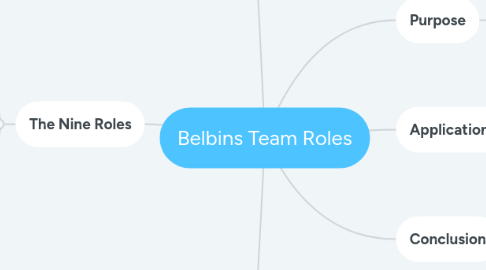
1. Introduction
1.1. Originated by Dr. Meredith Belbin
1.2. Based on behavior study of team-members in a work environment
2. The Nine Roles
2.1. Plant
2.1.1. Characteristics
2.1.1.1. Creative, imaginative, free-thinking
2.1.1.2. Generates ideas and solves difficult problems
2.1.2. Strengths
2.1.2.1. Innovative and inventive
2.1.2.2. Solves difficult problems
2.1.3. Allowable Weaknesses
2.1.3.1. Might ignore incidental subjects
2.1.3.2. Too preoccupied to communicate effectively
2.2. Resource Investigator
2.2.1. Characteristics
2.2.1.1. Extroverted, enthusiastic, communicative
2.2.1.2. Explores opportunities and develops contacts
2.2.2. Strengths
2.2.2.1. Outgoing, enthusiastic
2.2.2.2. Explores opportunities
2.2.3. Allowable Weaknesses
2.2.3.1. Over-optimistic
2.2.3.2. Loses interest once initial enthusiasm has passed
2.3. Co-ordinator
2.3.1. Characteristics
2.3.1.1. Confident, sets objectives, outlines group objectives
2.3.1.2. Includes everyone in team decision making
2.3.2. Strengths
2.3.2.1. Mature, confident
2.3.2.2. Identifies talent
2.3.3. Allowable Weaknesses
2.3.3.1. Can be seen as manipulative
2.3.3.2. May offload their own share of work
2.4. Shaper
2.4.1. Characteristics
2.4.1.1. Challenges the team to improve
2.4.1.2. Dynamic and driven
2.4.2. Strengths
2.4.2.1. Challenging
2.4.2.2. Dynamic
2.4.3. Allowable Weaknesses
2.4.3.1. Sometimes offends people's feelings
2.4.3.2. Prone to provocation
2.5. Monitor Evaluator
2.5.1. Characteristics
2.5.1.1. Rational and objective
2.5.1.2. Judges all options fairly
2.5.2. Strengths
2.5.2.1. Strategical thinker
2.5.2.2. Sees all options
2.5.3. Allowable Weaknesses
2.5.3.1. Lacks drive and ability to inspire others
2.5.3.2. Overly critical
2.6. Teamworker
2.6.1. Characteristics
2.6.1.1. Cooperative, perceptive, diplomatic
2.6.1.2. Listens and averts friction
2.6.2. Strengths
2.6.2.1. Co-operative
2.6.2.2. Relationship-oriented
2.6.3. Allowable Weaknesses
2.6.3.1. Indecisive in crunch situations
2.6.3.2. Can be easily influenced
2.7. Implementer
2.7.1. Characteristics
2.7.1.1. Practical, reliable, efficient
2.7.1.2. Puts plans into action tasks
2.7.2. Strengths
2.7.2.1. Practical, systematic
2.7.2.2. Turns ideas into action
2.7.3. Allowable Weaknesses
2.7.3.1. Somewhat inflexible
2.7.3.2. Slow to respond to new possibilities
2.8. Completer Finisher
2.8.1. Characteristics
2.8.1.1. Attention to detail, meets deadlines
2.8.1.2. Ensures there are no errors or omissions
2.8.2. Strengths
2.8.2.1. Painstaking, conscientious
2.8.2.2. Searches out errors
2.8.3. Allowable Weaknesses
2.8.3.1. Can be overly worried
2.8.3.2. Unlikely to delegate
2.9. Specialist
2.9.1. Characteristics
2.9.1.1. Expert in their field, dedicated
2.9.1.2. Provides knowledge and technical skills
2.9.2. Strengths
2.9.2.1. Single-minded, self-starting
2.9.2.2. Provides specialist knowledge
2.9.3. Allowable Weaknesses
2.9.3.1. Over thinks small issues
2.9.3.2. Limited in contributory interest