


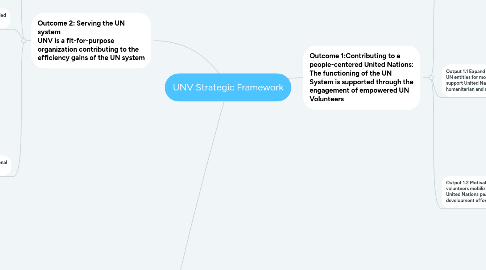
1. Outcome 2: Serving the UN system UNV is a fit-for-purpose organization contributing to the efficiency gains of the UN system
1.1. Outcome 2 indicators
1.1.1. 2.1 Number of calendar days (median) for national UN Volunteer deployment lead time
1.1.1.1. Indicator Description
1.1.1.1.1. This indicator is a proxy for the efficiency (i.e. speed) of UNV’s ability to deploy national and international UN-Volunteer.
1.1.2. 2.2 Number of calendar days (median) for international UN Volunteer deployment lead time
1.1.2.1. Indicator Description
1.1.2.1.1. This indicator is a proxy for the efficiency (i.e. speed) of UNV’s ability to deploy international UN-Volunteer.
1.1.3. 2.3 Percentage of UN partners reporting that UNV recruitment processes were conducted in an efficient and timely manner
1.1.3.1. Indicator Description
1.1.3.1.1. This indicator is a qualitative proxy to measure the efficiency of UNV recruitment services in support of “United Nations system to deliver on the 2030 Agenda through the engagement of UN-Volunteers and integration of volunteerism.”
1.2. Output 2.1 UN partners are provided with more efficient services
1.2.1. Output 2.1 indicators
1.2.1.1. 2.1.1 Recurrent cost-recovery
1.2.1.1.1. Indicator Description
1.3. Output 2.2 UNV’s institutional effectiveness is enhanced
1.3.1. Output 2.2 indicators
1.3.1.1. 2.2.1 Cumulative SVF, FF revenue (in million United States dollars)
1.3.1.1.1. Indicator Description
1.3.1.2. 2.2.2 Cumulative Number of donors to Special Voluntary Fund
1.3.1.2.1. Indicator Description
1.3.1.3. 2.2.3 UNV workforce diversity as percentage% of women in UNV staff
1.3.1.3.1. Indicator Description
1.3.1.4. 2.2.4 Percentage of staff from Global South
1.3.1.4.1. Indicator Description
2. Outcome 3: Promote volunteerism Member States and United Nations system efforts to integrate volunteerism as cross-cutting means of implementation into the 2030 Agenda are supported.
2.1. Outcome 3 indicators
2.1.1. 3.1 Percentage of countries reporting the integration of volunteering into development plans, policies and strategies in voluntary national reviews on progress towards the Sustainable Development Goals.
2.1.1.1. Indicator Description
2.1.1.1.1. This indicator tracks the expressed integration of volunteering into development plans, policies and strategies related to the SDGs from the perspective of Member States as a proxy for the value added of volunteerism to Agenda 2030
2.1.2. 3.2 Percentage of UNSDCFs results frameworks that reference volunteers and/ or volunteerism as a means of implementation of the 2030 Agenda for Sustainable Development.
2.1.2.1. Indicator Description
2.1.2.1.1. This indicator tracks the reference volunteers and/ or volunteerism as a means of implementation of the 2030 Agenda for Sustainable Development in UNSDCFs results frameworks
2.2. Output 3.1 Brokering of data, research, evidence, and knowledge on volunteerism for the SDGS is enhanced
2.2.1. Output 3.1 indicators
2.2.1.1. 3.1.1 Cumulative number of new knowledge products on volunteerism for the 2030 Agenda published by UNV
2.2.1.1.1. Indicator Description
2.2.1.2. 3.1.2 Cumulative number of Member States, UN entities, Civil Society Organizations, and private sector partners contributing knowledge products to the UNV Knowledge Portal
2.2.1.2.1. Indicator Description
2.3. Output 3.2 Integration of data and evidence on volunteerism for the SDGs is strengthened among Member States and UN entities
2.3.1. Output 3.2 indicators
2.3.1.1. 3.2.1 Cumulative number of UN Country Teams and UN entities provided with technical support to integrate volunteerism evidence in CCA and UNSDCF processes
2.3.1.1.1. Indicator Description
2.3.1.2. 3.2.2 Cumulative number of Member States provided with technical support to integrate volunteerism evidence in national policies and plans
2.3.1.2.1. Indicator Description
3. Outcome 1:Contributing to a people-centered United Nations: The functioning of the UN System is supported through the engagement of empowered UN Volunteers
3.1. Outcome 1 indicators
3.1.1. 1.1 Number of United Nations entities engaging UN-Volunteers.
3.1.1.1. Indicator Description
3.1.1.1.1. This indicator is a proxy to measure the scale on UNV support to the “United Nations system [..] to deliver on the 2030 Agenda through the engagement of UN-Volunteers and integration of volunteerism.”
3.1.2. 1.2 Percentage of United Nations partners satisfied with UN-Volunteers
3.1.2.1. Indicator Description
3.1.2.1.1. This indicator is a qualitative proxy to measure the satisfaction of “United Nations system being supported to deliver on the 2030 Agenda through the engagement of UN-Volunteers and integration of volunteerism.”
3.2. Output 1.1 Expand the opportunities with UN entities for more and diverse people to support United Nations peace, humanitarian and development efforts
3.2.1. Output 1.1 indicators
3.2.1.1. 1.1.1 Number of nationalities represented among UN Volunteers
3.2.1.1.1. Indicator Description
3.2.1.2. 1.1.2 Number of people volunteered per year through UNV
3.2.1.2.1. Indicator Description
3.2.1.3. 1.1.3 Number of online volunteers requested per year through UNV
3.2.1.3.1. Indicator Description
3.3. Output 1.2 Motivated, well-equipped volunteers mobilized to contribute to United Nations peace, humanitarian and development efforts.
3.3.1. Output 1.2 indicators
3.3.1.1. 1.2.1 Percentage of UN-Volunteers satisfied with their volunteering experience.
3.3.1.1.1. Indicator Description
3.3.1.2. 1.2.2 Percentage of UN-Volunteers reporting that their assignment enhanced their personal and professional development
3.3.1.2.1. Indicator Description