


1. Instructional Design
1.1. Seels and Richey (1994) suggest that the field of educational technology has developed and continues to evolve through a combination of various influences, such as foundational research and theory, as well as the characteristics and capabilities of current technologies. In other words, educational technology is shaped not only by theoretical knowledge but also by practical experience.
1.1.1. Instructional design (ID) is essential for teachers as it enables them to develop organized, effective, and engaging learning experiences. It ensures that lessons are aligned with educational goals, optimizes student outcomes, and integrates technology in relevant ways. Additionally, ID helps teachers make efficient use of their time and resources, while encouraging active student participation.
1.1.1.1. Some examples of Instructional desıgn
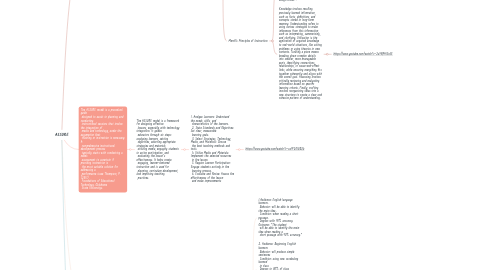
1.1.1.1.1. The ABCD Model is a popular framework used in instructional design to help create clear and measurable learning objectives. It provides a structured approach to defining what learners should achieve by the end of a lesson or training session. The ABCD model stands for:
1.1.1.2. Merrill's Principles of Instruction
1.1.1.2.1. Merrill's Principles of instruction (MPI) is a task centered approach that focuses on ways to facilitate learning The five MPI principles involved in this instructional design model .
1.1.1.2.2. Knowledge involves recalling previously learned information, such as facts, definitions, and concepts stored in long-term memory. Understanding refers to using various strategies to make inferences from this information, such as interpreting, summarizing, and clarifying. Utilization is the application of acquired knowledge to real-world situations, like solving problems or using theories in new contexts. Tackling a piece means breaking down complex details into smaller, more manageable parts, identifying connections, relationships, or cause-and-effect links, while ensuring everything fits together coherently and aligns with the overall goal. Assessing involves critically reviewing and evaluating information based on specific learning criteria. Finally, crafting involves reorganizing ideas into a new structure to create a clear and cohesive pattern of understanding.
2. The ASSURE model is a procedural guide designed to assist in planning and conducting instructional sessions that involve the integration of media and technology, under the assumption that tRaining or instruction is necessary. A comprehensive instructional development process typically starts with conducting a needs assessment to ascertain if providing instruction is the most suitable solution for addressing a performance issue Thompson, P. (2017). Foundations of Educational Technology. Oklahoma State Universitys.
2.1. The ASSURE model is a framework for designing effective lessons, especially with technology integration. It guides educators through six steps: analyzing learners, setting objectives, selecting appropriate strategies and materials, utilizing media, engaging students in active participation, and evaluating the lesson’s effectiveness. It helps create engaging, learner-centered instruction and is used for planning, curriculum development, and improving teaching practices.
2.1.1. 1. Analyze Learners: Understand the needs, skills, and characteristics of the learners. 2. State Standards and Objectives: Set clear, measurable learning goals. 3. Select Strategies, Technology, Media, and Materials: Choose the best teaching methods and tools. 4. Utilize Media and Materials: Implement the selected resources in the lesson. 5. Require Learner Participation: Engage students actively in the learning process. 6. Evaluate and Revise: Assess the effectiveness of the lesson and make improvements
2.1.1.1. https://www.youtube.com/watch?v=as9F201ZQ2k
3. Learning Outcomes
3.1. Learning outcomes are the skills and knowledge that a student will be able to demonstrate upon completion of the learning process.
3.1.1. To write effective learning outcomes, the ABCD formula is commonly used. This formula ensures that the outcome is clear, measurable, and focused on student performance. Here’s a breakdown of the ABCD formula: • A (Audience): Who is the learner or group of learners? • B (Behavior): What should the learner be able to do? This describes the observable action. • C (Condition): Under what conditions or context will the learner perform the behavior? This can include tools, resources, or constraints. • D (Degree): What is the level of proficiency or standard expected? This often describes the accuracy, speed, or quality of the performance.
3.1.1.1. 1.Audience: English language learners. Behavior: will be able to identify the main idea . Condition: when reading a short passage. Degree: with 90% accuracy. Outcome: “The student will be able to identify the main idea when reading a short passage with 90% accuracy.”
3.1.1.2. 2. Audience: Beginning English learners Behavior: will produce simple sentences Condition: using new vocabulary learned in class Degree: in 80% of class exercises. Outcome: “The student will be able to produce simple sentences using new vocabulary learned in class in 80% of class exercises.”
3.1.1.3. 3.Audience: Intermediate EL learners Behavior: will demonstrate understanding of key grammatical rules Condition: through a written quiz. Degree: with 85% accuracy. Outcome: “The student will be able to demonstrate understanding of key grammatical rules through a written quiz with 85% accuracy.”
3.1.1.4. 4.Audience: Advanced English learners Behavior: will engage in a discussion Condition: using appropriate academic language Degree: for at least 5 minutes Outcome: “The student will be able to engage in a discussion using appropriate academic language for at least 5 minutes.”