
Standard: 4.OA.A.3. Solve multi-step whole-number word problems using the four operations, includ...


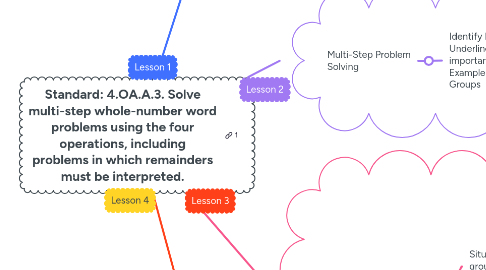
1. Four Operations: Addition Subtraction Multiplication Division
1.1. Addition: Combine Quantities. Example: Total number of objects in multiple groups
1.1.1. Subtraction: Finding the Difference. Example: Comparing quantities. "How much more/less"
1.1.1.1. Multiplication: Repeated Addition. Example: Total in equal groups
1.1.1.1.1. Division: Equal Sharing or Grouping. Example: Divide items into equal groups
1.1.1.1.2. Problem: A bakery has 127 cupcakes to pack into boxes. Each box holds 12 cupcakes. How many full boxes can the bakery make, and how many cupcakes will be left unpacked? Solution: 127/12= 10 R 7
1.1.1.2. Problem: A farmer plants 28 rows of apple trees. Each row has 15 trees. How many apple trees did the farmer plant in total? Solution: 28 x 15 = 420
1.1.2. Problem: A toy factory produced 1,250 toys in a week. Out of these, 738 toys were sold to stores. How many toys are left in the factory? Solution: 1,250-738=512
1.2. Problem: Sarah is organizing a book drive. On Monday, she collects 132 books, and on Tuesday, she collects 145 books. On Wednesday, she collects 89 books. How many books did Sarah collect in total? Solution: 132+145+89=366
2. Multi-Step Problem Solving
2.1. Identify Key Information: Underline or highlight important numbers/words. Example: Total Number or Groups
2.1.1. Understand the Question: What is being asked? Example: How many in total? How many groups are possible?
2.1.1.1. Plan the Steps: Choose the operations in order to then solve. Example: Solve for part A before part B
3. Interpreting Remainders
3.1. Situational Context: Round-up: Need a whole group Drop the Remainder: Only count full groups Keep as Fraction/Decimal: Precision required
3.1.1. Real-Life Application: Packing items into boxes Splitting costs Determining additional resources needed
3.1.2. Encourage students to come up with their own real-life word problems. Have students exchange problems and solve.
3.2. Example: If 25 students are divided into groups of 4, the remainder tells how many are "leftover."
4. Strategies
4.1. Visual Representation: Bar Models Number lines Diagrams
4.1.1. Estimation and Checking: Approximate First Check using inverse operation
4.1.1.1. Problem Solving Steps: 1. Read the Problem 2. Identify the Operations 3. Solve Step-By-Step 4. Interpret the Remainder if applicable
4.1.1.2. Use this worksheet to practice these steps.
4.1.2. A bakery baked 345 cookies in the morning and 278 cookies in the afternoon. How many cookies did they bake in total? Solution: 345+278=623 Inverse Operation: 623-345=278 The answer is correct