Unlock the full potential of your projects.
Try MeisterTask for free.
Heb je nog geen account?
Meld je Gratis aan
Browse
Aanbevolen kaarten
Rubrieken
Project management
Zakelijke doelen
Personeelszaken
Brainstormen en analyseren
Marketing & Inhoud
Onderwijs en notities
Entertainment
Leven
Technologie
Ontwerp
Samenvattingen
Andere
Talen
English
Deutsch
Français
Español
Português
Nederlands
Dansk
Русский
日本語
Italiano
简体中文
한국어
Andere
Toon volledige map
Kopieer en bewerk map
Kopieer
Computational Thinking in a Science Classroom
Andere
James Kofskie
Volg
Laten we beginnen.
Het is Gratis
Login met Google
of
registreren
met je e-mailadres
Vergelijkbare mind mappen
Overzicht van map
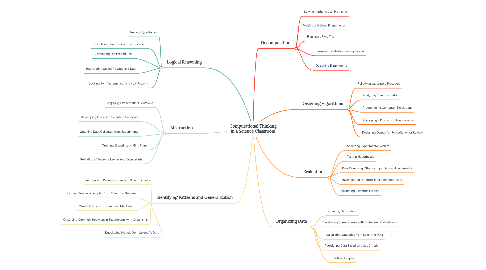
Computational Thinking in a Science Classroom
Door
James Kofskie
1. Logical Reasoning
1.1. Testing Hypotheses
1.2. Developing Lab Procedures
1.3. Interpreting Scientific Graphs & Data
1.4. Looking For Mathematical or Visual Patterns
1.5. Troubleshooting Laboratory Equipment
2. Decomposition
2.1. Designing Experiments
2.2. Solving Mathematical Problems
2.3. Modeling a Natural Phenomenon
2.4. Planning a Field Trip
2.5. Repairing a Malfunctioning Device
3. Designing Algorithms
3.1. Following Laboratory Protocols
3.2. Analyzing Scientific Data
3.3. Programming Computer Simulations
3.4. Developing a Problem-Solving Routine
3.5. Designing Games for Remediation or Review
4. Abstraction
4.1. Developing Models of Scientific Concepts
4.2. Graphing Data Collected from Experiments
4.3. Applying Mathematical Equations
4.4. Creating Blueprints or Mind Maps
4.5. Restating a Theory or Law in Your Own Words
5. Evaluation
5.1. Analyzing Experimental Results
5.2. Testing Hypotheses
5.3. Peer Reviewing Other Groups' Data and Lab Results
5.4. Investigating for Errors in Experimental Data
5.5. Validating Scientific Models
6. Organizing Data
6.1. Creating Data Tables
6.2. Plotting Graphs
6.3. Developing Spreadsheets with Embedded Calculations
6.4. Calculating Statistics from Scientific Data
6.5. Reordering Data Based on a Set Criteria
7. Identifying Patterns and Generalization
7.1. Recognizing Recurring Trends in Scientific Data
7.2. Forming Broader Principles from Scientific Theories
7.3. Making Predictions from Scientific Data
7.4. Observing Common Behaviors in Experiments with Organisms
7.5. Developing Models from Scientific Data
Begin. Het is gratis!
Verbind met Google
of
Registreren