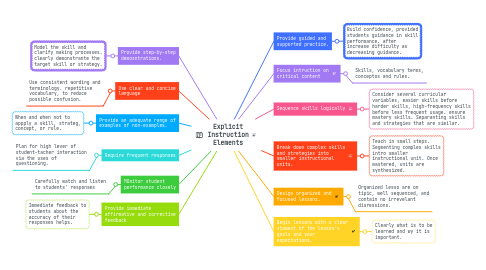
1.1. Model the skill and clarify making processes. clearly demonstrante the target skill or strategy.
2. Use clear and concise language
2.1. Use consistent wording and terminology. repetitive vocabulary, to reduce possible confusion.
3. Provide an adequate range of examples of non-examples.
3.1. When and when not to appply a skill, strateg, concept, or rule.
4. Require frequent responses
4.1. Plan for high lever of student-tacher interaction via the uses of questioning.
5. MOnitor student performance closely
5.1. Carefully watch and listen to students' responses
6. Provide immediate affirmative and corrective feedback
6.1. Immediate feedback to students about the accuracy of their responses helps.
7. Provide guided and supported practice.
7.1. Build confidence, provided students guidance in skill performance. after increase difficulty as decreasing guidance.
8. Focus intruction on critical content
8.1. Skills, vocabulary terms, conceptos and rules.
9. Sequence skills logically
9.1. Consider several curricular variables, easier skills before harder skills, high-frequency skills before less frequent usage. ensure mastery skills. Separanting skills and strategies that are similar.
10. Break down complex skills and stretegies into smaller instructional units.
10.1. Teach in small steps. Segmenting complex skills intro smaller instructional unit. Once mastered, units are synthesized.
11. Design organized and focused lessons.
11.1. Organized lesso are on tipic, well sequenced, and contain no irrevelant disressions.
12. Begin lessons with a clear stament of the lesson's goals and your expectations.
12.1. Clearly what is to be learned and wy it is important.