


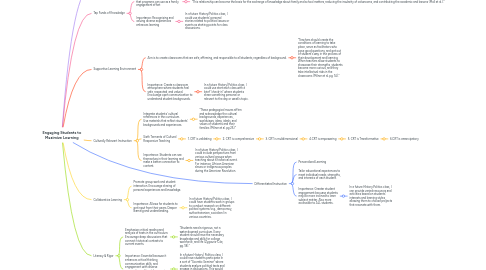
1. Differentiated Instruction
1.1. Personalized Learning
1.2. Tailor educational experiences to meet individual needs, strengths, and interests of each student.
1.3. Importance: Greater student engagement becuase students may be more inclined to learn subject matter. Also more accessible to ALL students.
1.3.1. In a future HIstory.Politics class, I can provide varied resources and activities based on students’ interests and learning styles, allowing them to choose projects that resonate with them.
2. Differentiated Instruction
3. Tap Funds of Knowledge
3.1. Families have abundant knowledge that programs can use as a family engagement effort
3.1.1. "This relationship can become the basis for the exchange of knowledge about family and school matters, reducing the insularity of calssrooms, and contributing the academic and lessons (Moll et al.)."
3.2. Importance: Recognizing and valuing diverse experiences enhances learning
3.2.1. In a future History/Politics class, I could use students' personal stories related to political issues or events as starting points for class discussions.
4. Supportive Learning Environment
4.1. Aim is to create classrooms that are safe, affirming, and responsible to all students, regardless of background.
4.1.1. "Teachers should create the conditions of learning to take place, serve as facilitators who pose good questions, and get out of student's way in the process of their development and learning. When teachers allow students to showcase their strengths, students become more curious, and they take intellectual risks in the classrooms (Milner et al. pg. 14)."
4.2. Importance: Create a classroom atmosphere where students feel safe, respected, and valued. Encourage open communication to understand student backgrounds.
4.2.1. In a future History/Politics class, I could use start each class with a brief "check-in" where students share something personal or relevant to the day or week's topic.
5. Culturally Relevant Instruction
5.1. Integrate students' cultural references in the curriculum. Use materials that reflect students’ backgrounds and experiences.
5.1.1. "These pedagogical moves affirm and acknowledge the cultural backgrounds, experiences, worldviews, ideas, ideals, and values of students and their families (Milner et al. pg 25)."
5.2. Sixth Tennents of Cultural Responsive Teaching
5.2.1. 1. CRT is validating
5.2.1.1. 2. CRT is comprehensive
5.2.1.1.1. 3. CRT is mulidimensional
5.3. Importance: Students can see themselves in their learning and make a better connection to content.
5.3.1. In a future History/Politics class, I could include perspectives from various cultural groups when teaching about a historical event. For instance, African American slaves or indigenous peoples during the American Revolution.
6. Collaborative Learning
6.1. Promote group work and student interaction. Encourage sharing of personal experiences and knowledge.
6.2. Importance: Allows for students to get input from their peers. Deeper learning and understanding.
6.2.1. In a future History/Politics class, I could have students work in groups to conduct research on different politcal systems (e.g., democracy, authoritarianism, socialism) in various countries.
7. Literacy & Rigor
7.1. Emphasize critical reading and analysis of texts in the curriculum. Encourage deep discussions that connect historical contexts to current events.
7.1.1. "Students need a rigorous, not a water downed curriculum. Every student should have the necessary knowledge and skills for college, workforce, and life (Zygouris-Coe, pg. 18)."
7.2. Importance: Essential because it enhances critical thinking, communication skills, and engagement with diverse perspectives, ultimately preparing students for academic success, informed citizenship, and lifelong learning.
7.2.1. In a future History/ Politics class, I could have students participate in a sort of "Socratic Seminar" where students analyze political texts and engage in discussions. This would allow for students to engage their critical thinking skills and require that they express their learning verbally.