

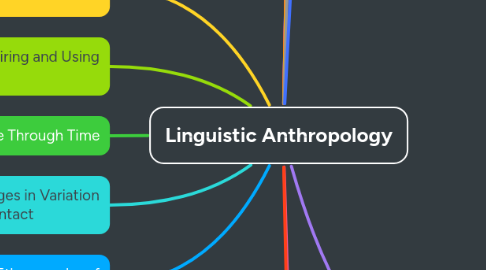
1. Chapter 6: Development & Evolution
1.1. Animals
1.1.1. 1940's communication model
1.1.1.1. The sender
1.1.1.2. The message
1.1.1.3. The channel
1.1.1.3.1. Acoustic
1.1.1.3.2. Optical
1.1.1.3.3. Tactile
1.1.1.3.4. Olfactory
1.1.1.4. The receiver
1.1.1.5. The effect
1.1.2. "Communication ... is universal because it is important to survival" (117)
1.2. Development of Language
1.2.1. Prelanguage: communication system
1.2.2. Design Features of Language
1.2.2.1. Charles F. Hockett
1.2.2.2. Underlying set of prominent characteristics governing the functioning of speech
1.2.2.2.1. Originally 7, then 16, potentially 20
1.2.2.3. 70s & 80s: General agreement that lang is strictly the domain of humans
1.2.3. Evolution
1.2.3.1. VIDEO: When We First Talked
1.2.3.2. Eric H. Lenneberg (1967)
1.2.3.2.1. Continuity theory
1.2.3.2.2. Discontinuity theory:
1.2.3.3. Spandrel v. adaptation
1.2.3.3.1. Spadrel: by-products, rather than the direct result of survival of the fittest
1.2.3.3.2. Adaptation: evolution specifically selected for
1.2.3.4. Monogenesis v. polygenesis
1.2.3.4.1. Polygenesis: Traits originate in separate places; languages spoken today come from sev unrelated sources
1.2.3.4.2. Monogenesis: Traits required for development of language come into being once
1.3. Language Death
1.3.1. Dif than language change
1.3.1.1. EX: Old English is technically dead, but not considered truely extinct b/c it lives on in knowledge of Middle & Early Modern English
1.3.2. Process & Endangerment
1.3.2.1. Small societies die out naturally, take language with them
1.3.2.2. Colonialsim & ethnic cleansing
1.3.2.2.1. EX: Native Americans
1.3.2.3. Economic & cult. influence
1.3.2.3.1. Often phase of bilingualism before extinction
1.3.3. Why it matters:
1.3.3.1. [1] Diversity & cultural wealth
1.3.3.2. [2] Ethnic identity
1.3.3.3. [3] History repositories
1.3.3.3.1. "'To fight to preserve the smaller cultures and languages may turn out to be the struggle to preserve the most precious things that make us human before we end up in the landfill of history' (Cited in Crystal 2000:67)" (133)
1.3.3.4. [4] Sum of hum knowledge
1.3.3.5. [5] Interesting
2. Chapter 7: Acquiring and Using Language(s)
2.1. Childhood acquisition
2.1.1. Language gen not taught to children, but picked up through exposure
2.1.2. 1st 8-10 weeks - Discover phonological system; only reflexiv noises (basic biological; burping, crying, ets) made
2.1.3. Next ~12 weeks - cooing & laughing
2.1.4. ~6 mo - vocal play: "production of a fairly wide range of sounds resembling consonants and vowels" (146)
2.1.5. 6-12 mo - Babbling: less varied & closer to lang being acquired; prior to this step eagerness to communicate alread observed
2.1.5.1. largely instinctive; deaf babies still babble
2.1.5.2. regaurdless of lang, most distinct vowels & consonants pronounced w/ lips & teeth learned b4 other vowels & consonants
2.1.6. ~1 yo: Intonal contors (indicating questions &c) & one-word stage
2.1.7. ~2 yo: multiword stage; vocab typ >200 wrds
2.1.8. ~5 yo - "ask questions, make negative statements. produce complex sentences, talk about things removed in time and space" (147) etc
2.2. Thories
2.2.1. Behaviorists Psychology Theory
2.2.1.1. B.F. Skinner
2.2.1.2. Stimulous-response-reward
2.2.2. Innatist Theory
2.2.2.1. some aspects of language present @ birth
2.2.2.2. Chomsky
2.2.2.3. Language acquisition device
2.2.2.4. supported by critical-age hypothesis
2.2.3. Sociocultural Theory
2.2.3.1. "The process of acquiring language is deeply affected by the process of becoming a competent member of a society [and] the process of becoming a competent member of society is realized to a large extenent through language, through acquiring knowledge of its functions ... i.e., through exchanges of language in particular social situations" (Ochs and Schieffelin qtd in Stanlaw et al 149)
2.3. Neurolinguistics: "which parts of the brain conrol language and speech; how the brain encodes and decodes speech; and whether the controls of such aspects of language as sounds, grammar, and meaning are neuroanatomically distinct or joint" (151)
2.3.1. Human brain both largest relative to body mass & most complexly organized
2.3.2. Cerebrum: largest part of the human brain; typically the right side is responsible for most of langauge
2.3.2.1. Other parts of the brain (eg left thalamus &c) also contribute to lang processing
2.3.3. Broca's area: damage causes "faulty word order and distortions of sounds" (152) & prevents the use of "function words ... and past-tense and plural endings" (151), called Broca's / expressive / motor aphasia
2.3.4. Wernicke's area: damage causes trouble understanding writen and spoken lang, circumlocutions, inappropriate word substitutions, and smtimes nonsensical utterances, called Wernicke's / sensory / receptive aphasia
2.4. Multilingual Brains
2.4.1. Childhood bilingual acquisition
2.4.1.1. 1 - builds vocabulary for both langs but typically doesn't translate / connect them to each other
2.4.1.2. 2 - Sentences w/ mixed vocab; mixing typ ends by end of 3rd year; vocab grows but sing gram pattern used
2.4.1.3. 3 - Distinct syntax of each lang; typ by yr 4; "becomes aware of the sociolinguistic power of each language" (154)
2.4.2. Code-switching: use of unintegrated words from two different languages
2.4.3. Diglossia: "use of two distinct varieties of language for two different sets of functions" (155); colloquial (L) variety v formal (H) variety
3. Chapter 8: Language Through Time
3.1. Language families: group of languages w/ a common ancestor
3.1.1. EX: Indo-European
3.1.2. Lable used conservatively; only w/ strong evidence of connection
3.1.3. Language isolates: langs that appear to be completely divorced from other langs
3.2. Language typologies: "based on structuraal similarities ... regaurdless of their history" (161)
3.2.1. Semantic Relationships: langs compared by specificity required in lang
3.2.1.1. Isolating languages: langs prim use word order to indicate grammatical relationship
3.2.1.2. Some langs use inflections to indicate gram relationship
3.2.1.3. Agglutinative languages: grammatical meaning expressed by separate morphemic structures, typ affixes
3.2.1.4. Fusional languages: individual affixes disappear or are fused together; often morphemes encode mult meanings
3.2.2. Many dif ways to divide; which vowels & consonants used, whether tone is used, word order (subject, verb, object)
3.2.3. Words or concepts
3.2.3.1. Analytic: words consist of 1 morpheme
3.2.3.2. Synthetic: words consist of >/=1 morphemes
3.2.3.3. Polysynthetic: words consiste of many bound morphemes
3.2.3.3.1. Typ fusional
3.2.3.3.2. Typ considered to be both agglutinative & inflectional
3.2.3.3.3. words long & morphologically complex
3.3. Changes
3.3.1. Sound
3.3.1.1. Assimilation
3.3.1.2. Dissimilation
3.3.1.3. Metathesis: "transposition of sound or larger units" (164)
3.3.1.3.1. eg Old English "bridd" --> Modern English "bird"
3.3.2. Vocabulary
3.3.2.1. Loanwords
3.3.2.2. Neologisms: new words coined from native resources
3.3.2.2.1. eg "brunch" or "wannabe"
3.3.2.3. Semantic extension: extending meanings of pre-existing words
3.3.3. Why
3.3.3.1. Lexical diffusion: current theory of sound change; "gradually spread, or diffuse, through the words (the lexicon) of a language" (166)
3.3.3.1.1. William Labov
3.3.3.2. New invetions / concepts need new names / vocab
3.3.3.3. More easily articulated sound replacing more difficult
3.3.3.4. Analogy
3.3.3.5. Hypercorrection:
3.3.3.5.1. Often in attempt to signal social prestige
3.3.3.5.2. Adjustment to grammar
3.3.3.5.3. Adjestment to phonetics; singer pronouncing two words similarly bc they're orthographically similar
3.4. Protolanguages
3.4.1. EX; Proto-Indo-European
4. Chapter 9: Languages in Variation & Languages in Contact
4.1. Variation
4.1.1. Dialect: speech patterns of regional, ethnic, or social groups
4.1.1.1. Mutual intelligibilty = same language
4.1.2. Idolect: individual speech
4.1.2.1. Changes w/ age
4.1.2.2. Most use mult. depending on circumstances
4.1.2.3. Contains unchangeable (vocal tract) & changeable features
4.1.3. Standard speech: formal style or dialect; carries social prestige; in contrast to nonstandard or substandard speech
4.2. Contact
4.2.1. Pidgin
4.2.1.1. Characteristics:
4.2.1.1.1. Used to cross language barriers; arises suddenly and may last for only a short while
4.2.1.1.2. Narrower range of function; designed to be learned quickly
4.2.1.1.3. Limited vocab & grammar structure
4.2.1.1.4. "does not serve as the native, or first, language of any particular group" (185).
4.2.1.2. Euro colonialism
4.2.2. Creole: "a pidgen that has become the first language of a speech community" (187)
4.2.2.1. Decreolization: When creoles move towards the standard language
4.2.2.1.1. Ex: English based Jamacian Creole
4.2.2.1.2. "some speakers of creoles, especially those who live in cities and hold semiprofessional jobs, try to 'improve' their speech my using the standard language model" (188)
4.2.2.2. Creolization: The process of a pidgin expanding into a creole
4.2.3. Lingua franca: "a language afreed upon as a medium of communication by people who speak different languages" (190)
4.2.4. Artificial / auxiliary language: a language made specifically for bridging language barries
4.2.4.1. eg Esperanto
5. Chapter 10: The Ethnography of Communication
5.1. Communicative competence: "the knowledge fo what is and what is not appropriate to say in any specific cultural context" (199)
5.1.1. "action oriented; what you do is emphasied more then what you theoretically know" (199)
5.1.2. Emphasis on communicative competence among anthropogists is in contrast to the emphasis on linguistic competence among autonomous linguists like Chomsky
5.2. Speech community: "All those who share specific rules for speaking and interpreting speech" (200)
5.2.1. "no society's culture is uniform for all its members" (200) & "no language is ever unifrom for all speakers of a society" (200)
5.2.2. same language =/= same speech community
5.2.2.1. Monolingual speakers of 2 dif langs smtimes belong to same speech community
5.2.2.1.1. eg Paraguay (Spanish and Guarani)
5.2.2.1.2. Speech area: "an area in which speakers of different languages share speaking rules"
5.2.2.2. Different regions that speak the same language
5.2.3. Most ppl belong to multiple speech communities
5.2.4. Language field, speech field, speech network
5.3. Ethnography of communcation: the study of "the nature and function of communicative behavior in the context of culture" (200)
5.3.1. "combination of the techniques of linguistic anthropology and classical sociolinguistics" (199)
5.3.2. John Gumperz
5.3.2.1. Interactional sociolinguistics
5.3.3. Dell Hymes
5.3.3.1. S P E A K I N G
5.3.4. Components:
5.3.4.1. Purpose, channels, codes, message content & form
5.3.4.1.1. Purpose can be to share knowledge and ideas, or to foster a sociable atmosphere (phatic communion)
5.3.4.1.2. Channels: acoustic, visual
5.3.4.1.3. Human lang can be considered a general language code w/ thousands of subcodes (each language)
5.3.4.1.4. Message content & form "closely related" (205)
5.3.4.2. Participants & setting
5.3.4.2.1. Participants: speaker, intended receiver, and audience
5.3.4.2.2. Setting: time, place, circumstances
5.3.4.3. Genres, key, rules of interaction, and norms of interpretation
5.3.4.3.1. Genres: association of specific situations and syle, form, &/or content of speech act or event
5.3.4.3.2. Keys: "'tone, manner, or spirit in which an act is done'" (Hymes qtd in Stanlaw et al 206)
5.3.4.3.3. Rules of Interaction: guides communicative activity; determines what is & isn't appropriate
5.3.4.3.4. Norms of interpretation: how communicative acts are interpreted w/in a culture
5.4. Hymes' units of speech behabior
5.4.1. Speech situation: circumstances / context of the use / absence of speech behaviour
5.4.2. Speech act: minimal unit of speech for purposes of ethnographic analysis" (202)
5.4.2.1. eg apology, introduction, compliment, etc
5.4.3. Speech event: combined "speech acts that follow each other in a recognized sequence and re governed by social rules" (202)
5.4.3.1. "basic unit of verbal interaction" (202)
5.4.3.2. eg conversation, interview, etc
5.4.4. (Replace 'speech' for 'communicative' to include nonverval com)
6. Chapter 1: Introduction
6.1. Myths
6.1.1. "Primitive languages"
6.1.1.1. No persons, peoples, or cultures are today "primitive"
6.1.2. "Simpler" societies have less grammar than "civilized" societies
6.1.2.1. Wide variety of grammatical complexity in "simple" societies
6.1.2.2. grammatical complexity =/= effectiveness
6.1.3. Vocabulary deficiencies
6.1.3.1. Language serves its speakers
6.1.3.2. Different subjects have different amounts of words across cultures due to significance / importance
6.1.4. All languages the same
6.1.4.1. Dell Hymes - role of speech varies from one society to the next, and thus are not funtionally equivilent
6.2. Anthropology
6.2.1. "the holistic study of humankind" (7)
6.2.1.1. Biological / physical
6.2.1.2. Archaeology
6.2.1.3. Cultural
6.2.1.4. Linguistic Anthropology
6.2.1.4.1. The study of human lang past & present
6.2.1.4.2. Descriptive linguistics:
6.2.1.4.3. Historic linguistics:
6.2.1.4.4. Sociolinguistics:
6.2.1.4.5. Edward Sapir
6.2.2. Franz Boas
6.2.2.1. Created 4 field approach
6.2.2.2. Advocated for study of language & culture to be among subfeilds
6.2.2.3. Americanist assumptions
6.2.3. Feildwork
7. Chapter 2: Methods
7.1. Paradigms
7.1.1. Autononomous Linguistics:
7.1.1.1. [1] Structuralism (WWI - 1950s)
7.1.1.1.1. "Language is an agreed-upon set of arbitrary signs people use unconsciously" (19)
7.1.1.2. [2] Chomsky's generative grammar (1960 - pres)
7.1.1.2.1. "Language reflects innate conditions of the human mind; universal grammar" (19)
7.1.2. Linguistic Anthropology:
7.1.2.1. [1] Anthropological linguistics
7.1.2.1.1. "Language 'as lexicon and grammar, that is, rule governed structures'" (20)
7.1.2.1.2. Sapir-Whorf hypothesis
7.1.2.2. [2] Linguistic Anthropology / Sociolinguistics
7.1.2.2.1. "Language 'as a culturally organized and culturally organizing domain'" (20)
7.1.2.3. [3] Social Constructivism
7.1.2.3.1. "Language 'as an interactional achievement filled with indexical values'" (20)
7.1.2.4. [?4] Cognitive linguistic anthropology
7.1.2.4.1. "Language is not innate but is embodied and situated in specific cultural and physical environments" (20)
7.2. Feildwork
7.2.1. Participant observation:
7.2.1.1. Bronislaw Malinowski
7.2.1.2. Extended immersion in day-to-day activities
7.2.2. Consultants (FKA Informants)
7.2.2.1. Kenneth L. Hale
7.2.2.1.1. Mutually beneficial: exchange information abt anth & linguistics in exchange for knowledge abt lang & cultural context
7.2.2.2. "native speaker for whom researcher collects linguistic (or cultural) information" (27)
8. Chapter 3: Sound
8.1. Anatomy & Physiology of Speech
8.1.1. Speech apparatus: amount of varying bodily movements to create thousands of sounds b/w the diaphragm & the lips
8.1.2. Articulation of Speech sounds
8.1.2.1. Vowels: articulated w/ no sig constriction of breath channel
8.1.2.1.1. Dipthong: change in vowel quality
8.1.2.2. Consonants: vocal tract is blocked or constricted enough to produce audible friction
8.1.2.3. Articulatory phonetics: study of the production of speech sounds by the vocal organs
8.1.2.4. Acoustic phonetics: the study of the physical properties of speech sounds
8.1.2.4.1. Spectrographs
8.2. Phones to Phonemes
8.2.1. Phone: smallest segment of speech
8.2.1.1. Utterance: syllable; collection of phones
8.2.2. Phonemes: smallest distinctive sound unit of a language
8.2.2.1. Allophone: a variant form of a phoneme
8.2.2.2. Phonemics: "the study of determining the phonemes of language" (54)
8.2.3. Phonology: "study of the sound systems of languages - and of the sound changes that take place over time in a language or in several related languages" (54)
8.3. Prosodic features
8.3.1. features other than vowels & consonants that are essential for an utterance to sound natural & be fully meaningful
8.3.1.1. Stress: degree of force / prominence of syllable
8.3.1.2. Pitch (tone): tonal height of a syllable; relative
8.3.1.3. Length: relative duration
8.3.1.4. Accents: articulatory prominence given a syllable
9. Chapter 4: Structure
9.1. Morphemes: smallest meaningful segments / contrastive unit of grammar
9.1.1. EX: Un-happy (2)
9.1.2. Bound morphemes: typ do not occur on their own
9.1.2.1. Affixes (some but not all)
9.1.2.1.1. Prefix
9.1.2.1.2. Suffix
9.1.2.1.3. Infix
9.1.2.2. EX: Un-
9.1.3. Free morphemes: occur unattached
9.1.3.1. EX: happy
9.1.4. Morphology: study of word struct, incl classification of and interrelationships among morphemes
9.1.5. Allomorph: varient form of a particular morpheme
9.1.5.1. EX: Plural morpheme; maps, watches, teeth, oxen, all contain different allomorphs of the same (plural) morpheme
9.1.5.2. Morphophonemics: study of relations b/w morphology & phonology / differences among allomorphs of the same morpheme
9.2. Morphological Processes
9.2.1. Derivation: means of which new words are formed from existing ones
9.2.2. Inflection: use of affixes to indicate grammatical relationships (quantity, tense, &c.)
9.3. Transformational-Generative Grammar
9.3.1. Limited set of rules capable of generating an infinite # of correct & well-informed grammatical sentences in that lang
9.3.1.1. Transformational rules: used to take a basic sentence and derive some other kind of sentence
9.3.1.2. Rewrite rules: based on categories such as nouns, verbs, and articles
9.3.2. "assumes the existence of several basic categories and conventions to modify and change them" (78)
10. Chapter 5: Nonverbal Communication
10.1. Semiotics
10.1.1. "The study of the properties of signs and symbols and their functions in communication" (90)
10.2. Paralinguistics
10.2.1. Paralanguage: "vocal communication considered marginal or optional and therefore excludable from linguistic analysis" (90)
10.2.1.1. Voice qualifies: volume, intensity, pitch, tone, tempo, & articulation
10.2.1.2. Voice characterizers: accompany speech, eg laughing, crying, moaning, etc.
10.2.1.3. Vocal segregates: extralinguistic sounds (not part of phonetic system)
10.3. Bodies
10.3.1. Kinesics: study of body language & gestures
10.3.1.1. Kineme: "smallest discriminable contastive unit of body motions" (91); analogous to the phoneme
10.3.1.1.1. "no body movement or facial expression is likely to lack meaning" (91)
10.3.1.2. Ray L. Birdwhistell
10.3.1.2.1. Influenced by structural linguists; kinesic analysis parrallel to linguistic analysis
10.3.2. Proxemics: study of the cultural patterning of the spacial separation individuals maintain in face-to-face encounters
10.3.2.1. Proxemic zones: distances maintained by individuals depending on mutual involvement and culture
10.3.2.2. Edward Hall
10.3.3. Haptic behavior: touch
10.4. Writing
10.4.1. "visible speech" (97)
10.4.1.1. Definition controversal & to some degree arbitrary
10.4.1.1.1. Inclusivists: any system of graphic symbols that conveys some thought
10.4.1.1.2. Exclusivists: must be a set of symbols that can convey any and all thought
10.4.2. Protowriting: doodles, scratches, knots, scribbles, marks that could be used as mnemonic devices
10.4.2.1. Rebus: "device in which picrues are used to represent words or their parts" (98)
10.4.2.1.1. Alphabets: "each different distinct sound of a lange is represented by a single separate sign" (106)
10.4.2.1.2. Logographs: (kinda) a system where one word corresponds to one idea, concept or spoken form
10.4.2.1.3. Syllabaries: make use of signs representing syllables rather than idea or single sounds
10.5. Sign languages
10.5.1. Primary: used to the exlusion of spoken lang
10.5.2. Alternate: regular or occasional substitute for speech
10.5.3. Iconic: can be interpreted by those who have not first learned their meanings; most signs are NOT iconic
10.5.4. Cheremes: small set of contrastive units meaningless in themselves; analogous to phonemes
11. Chapter 11: Cognition & Categorization
11.1. Semantics: the study of meaning
11.2. Concepts & Categories
11.2.1. Signs and Symbols
11.2.1.1. Referents: things in the world
11.2.1.2. Symbols: things that refer to referents (eg words)
11.2.1.3. Thought: "concepts of the mind that underlie" (216) and mediate the relationship b/w referents and symbols
11.2.1.4. thought/symbol/referent & concept/word/category triangles
11.2.2. Categories and Concepts
11.2.2.1. Categorization only useful insofar as knowledge about the category can be practically applied
11.2.2.2. Relates to classes of referents
11.2.2.3. Not always linguistic
11.3. Ethnoscience
11.3.1. "Focused on lexical classification of the social and physical environments of speakers of a language by means of its vocabulary rather than the relationships of grammatical categories" (219)
11.3.2. Tried to address issues of validity and reliablilty of feildwork
11.3.3. Folk taxonomies
11.3.3.1. Relied on the (problematic) assumption that "in general the words in a language reflect the mental categories and the cultural elements held by the speakers" (219)
11.3.4. Compnential analysis
11.3.4.1. "focus is on the necessary and sufficient features that are used to distinguish all the terms in the domain" (220)
11.4. Discourse
11.4.1. Denotation: referent
11.4.2. Connotation: associated emotions or feelings
11.4.3. Semantic presuppositions: "concerned with certain kinds of presuppositions among sentences" (222)
11.4.3.1. King of France example
11.4.4. Pragmatic presuppositions: "deal with the relationships between speakers and the appropriateness of their statements in context" (222)
11.4.4.1. "Do you still beat your wife?" (222) - establishes them as a wife beater w/in the discourse
11.4.5. Speach act theory
11.4.5.1. Illocutionary force: speaker's intention
11.4.5.2. Perlocutionary effect: listener's response
11.4.6. Conversational analysis v. discourse analysis
11.4.7. Conversational implicature
12. Chapter 12: Culture & Thought
12.1. Sapir-Whorf hypothesis
12.1.1. Liguistic determinism
12.1.2. Linguistic relativity: Different languages shape thought differently, leading to differing world views or unique "linguistic worlds" (Stanlaw et al. 232)
12.2. Challenges to Linguistic Relativity
12.2.1. Color
12.2.1.1. Brent Berlin & Paul Kay
12.2.1.2. Basic color terms
12.3. Theoretical Alternatives
12.3.1. Chomsky's Universalism
12.3.2. Cultural determinism: "culture determines to a large degree grammatical patters and modes of thinking" (247)
12.3.2.1. Navajo
12.3.2.2. Piraha of S America
13. 13: Gender
13.1. Grammatical Gender: classes or categories that words fall under based off of some property assigned to them
13.1.1. Not limited to masculine, feminine, and neutral
13.1.1.1. eg Dyirbal: "bayi (human males and animals), balan (women, fire, dangerous things, water, fighting), balam (nonflesh foods), and bala (all other nouns)" (259)
13.1.1.2. Can (rarely) have >12 classes
13.1.2. Often arbitrary
13.2. Differences in speech
13.2.1. America
13.2.1.1. Vocabulary
13.2.1.1.1. Women typically use less coarse language compared to men
13.2.1.1.2. Women typically use more expressive adjectives compared to men
13.2.1.2. Tag questions: questions attached to statemetns to obtain assent
13.2.1.2.1. eg "..., don't you think?" "..., isn't it?" "..., would you?"
13.2.1.2.2. More commonly used by (older) women
13.2.1.2.3. "may indicate the speaker's desire to aboid assertiveness" (261)
13.2.1.3. Hedges: words or phrases that make a statement less definitive
13.2.1.3.1. eg "maybe, rather, perhaps, I guess..." (261)
13.2.1.3.2. Also used more by women to avoid assertiveness
13.2.2. Japan
13.2.2.1. Sentence-final particles: "markers that come at the end of sentences to indicate things like mood, intent, and identity" (263)
13.2.2.1.1. Some are similar to tag questions, and are used more often by women
13.2.2.1.2. Some are assertive and are used more commonly by men
13.2.2.1.3. Some only serve to denote a female speaker
13.2.2.2. Honorifics & politeness
13.2.2.2.1. Women are expected to use more polite language in most circumstances; will be considered unfeminine if they fail to
13.2.2.2.2. Different terms sometimes used
13.2.2.2.3. Some terms and Sino-Chinese character compounds carry connotations about women
13.2.3. Native America
13.2.3.1. Koasati
13.2.3.1.1. "certain morphemes have a different phonemic shape depending on whether women or men are speaking" (265)
13.2.3.2. Atsina
13.2.3.2.1. Differences in lexicon and pronunciation
13.3. Theoretical Movements
13.3.1. Dominance/Social Power Theory
13.3.1.1. "Language differences ... are manifestations of an unequal social structure" (270)
13.3.1.2. Focus on the patriarchy
13.3.2. Difference/Subcultrue Theory
13.3.2.1. (Men & Women being in) different subcultures = different linguistic worlds
13.3.2.2. Genderlects: "gender associated varieties of language" (269)
13.3.2.2.1. Deborah Tannen
13.3.3. Deficit Theory
13.3.3.1. "women's language as deficient or innefective" (268)
13.3.4. Communicative Strategy Theory
13.3.4.1. Language changes motivated by concious or unconcious strategy
13.3.4.2. eg women's Najuatl changing to be more heavily influenced by Spanish pronunciation in order to simultaneously preserve their language and change with the times
13.3.4.3. eg English being used as a tool for career development among Japanese women
13.3.4.4. eg English loan words being adopted because they lack stigma that was hindering social progress
13.3.5. Identity Theory
13.3.6. Community of Practice Theory
13.3.6.1. "entails examining the social relations among members, as well as being cognizant of the differences among members" (273)
13.3.7. Agency Theory
13.4. Thought & Ideology
13.4.1. Spanish and German; different adjectives used to describe the same word, gendered differently
13.4.2. Gender neutral pronouns
13.4.3. Marking gender; female varients of certain English words carry derogatory/ less serious connotations than male counterparts
13.4.4. LGBT issues; reclamation of slurs
14. 14: Class, Ethnicity, Nationality
14.1. Class
14.1.1. Sociolinguistic change: "linguistic change understood in the context of the society in which it occurs" (299)
14.1.2. William Labov
14.1.2.1. New York City, differential use of (r)
14.1.3. English social stratification
14.1.4. Social network: the network of all the people a speaker interacts with
14.1.5. Restricted code: informal speach with little variatin b/c of tight social network
14.1.6. Elaborated code: "variety of language use characteristic of relatively formal speech situations" (302)
14.2. Race/Ethnicity
14.2.1. socail constructs
14.2.2. AAVE
14.2.2.1. Copula deletion: "dropping a form of the verb 'to be'" (304)
14.2.2.2. Code-switching
14.2.2.3. Origins:
14.2.3. Asians Americans
14.2.3.1. Heritage languages: "the language of the family or natal household where one has grown up" (316)
14.2.4. Latin (US) Americans
14.2.4.1. Ethnonyms
14.2.4.2. Calques: "direct translations of a word or phrase from one language to another" (319)
14.2.4.3. Folk theory
14.3. Nationality
14.3.1. India
14.3.1.1. Linguistic diversity, Hindi or Urdu common
14.3.2. Czech
14.3.3. Canada, Quebec
14.3.3.1. Fench v English
15. 15: Globalization & a Digital World
15.1. Language Planning: "a deliberate attempt, usually at the level of the state, to affect language use to prevent or solve some problem of communication" (335)
15.1.1. Applied sociolinguistics
15.1.2. Reasons:
15.1.2.1. Mass dislocations
15.1.2.2. Emergence of new multiethnic states
15.2. Literacy & Education
15.3. Intercultural communication
15.3.1. Problems of translations
15.4. Online Global World
15.4.1. Phatic communication: "small talk for its own sake" (344)
15.4.2. Dominence of English
15.4.3. Emojis & Visual language
15.4.4. Hashtags; "'"searchable talk"'" (Dickinson qtd in Stanlaw et al 355)
15.4.5. Sentiment analysis: "public opinion mining" (357)
15.4.6. Asynchronous/asynchronic communication: messages left in the world to be received at convenience
15.5. Ethics
15.5.1. Asymmetrical relationship of fieldwork abroad