


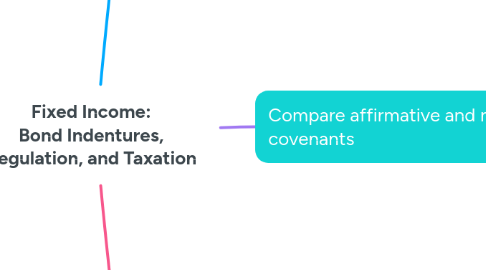
1. Basic features of a fixed-income security
1.1. Issuers of Bonds
1.1.1. Sovereign national governments
1.1.1.1. • Have the power to make and enforce laws. •Can collect taxes, issue currency, and manage national defense and foreign policy. •Operate independently without external interference.
1.1.2. Non-sovereign governments
1.1.2.1. •They do not have full independence or sovereignty. •Their powers are often limited to local or regional governance. •They typically cannot conduct foreign policy or issue sovereign debt independently.
1.1.3. Quasi-government entities
1.1.3.1. •Partially owned, funded, or regulated by the government. •May perform public functions (e.g., infrastructure, finance, social services). •Often created to increase efficiency or operate in competitive markets while serving public interests. •Not fully part of the official government, but not entirely private either.
1.1.4. Corporations
1.1.5. Supranational entities
1.1.5.1. • Created by treaties or international agreements. •Member countries voluntarily give up some control to pursue shared interests. •Focus on issues like economic development, financial stability, regional integration, or humanitarian aid. •Have legal standing and may provide funding, loans, or technical support.
1.1.6. Special purpose entities (SPEs)
1.1.6.1. • Legally separate from the sponsoring (parent) company. • Used to hold specific assets, manage risk, or carry out complex financial transactions. • Helps keep certain activities off the parent company’s balance sheet (off-balance-sheet financing). • Often used in structured finance, securitization, and project finance.
1.2. Bond Maturity
1.2.1. • Maturity date: The date on which the principal is to be repaid • Tenor: Time remaining until maturity • Perpetual bonds: Have no maturity date • < 1 year : Money market securities • > 1 year : Capital market securities
1.3. Par value
1.3.1. • Principal amount that will be repaid at maturity • Premium: Selling more than Par • Discount: Selling less than Par • At par: Selling same as Par
1.4. Coupon Payments
1.4.1. • Coupon rate: Annual percentage of par value that will be paid to bondholders • Frequency: Annually, semiannual, quarterly, monthly, ... • Plain vanilla: Bond with fixed coupon rate • Pure discount: Sold at discount to par value
1.5. Currencies
1.5.1. • Single-currency bond: interest payments and principal payment in same currency • Dual-currency bond: interest payments in one currency, and principal payment in another currency • Currency option bond: Option to choose currency of payments
2. Compare affirmative and negative covenants
2.1. Affirmative covenants (Actions the borrower promises to perform)
2.1.1. • Make timely interest & principal payments,insure and maintain assets, comply with laws • Examples: cross-default and pari passu
2.2. Negative covenants (Prohibitions on the borrower)
2.2.1. • Restrictions on asset sales • Negative pledge of collateral • Restrictions on additional borrowings
3. Legal, regulatory, and tax effect on the issuance and trading
3.1. Issuing entities
3.1.1. • Legal information about the issuer • SPEs / SPVs => Securitized bonds
3.2. Sources of repayment
3.2.1. • Sovereign Gov bonds: Tax • Non-Sovereign Gov bonds: Tax, Fees, Specific projects • Corporate bonds: Cash Flows from Operations • SPEs: Cash Flows from Financial assets
3.3. Collateral
3.3.1. Unsecured bonds /Debenture (No collateral)
3.3.2. Equipment trust certificates (Equipment)
3.3.3. Collateral trust bonds (Stock, other bonds)
3.3.4. Mortgage-backed security (Mortgages)
3.3.5. Covered bonds (Loans (no SPE created))
3.4. Credit enhancements
3.4.1. Internal
3.4.1.1. • Overcollateralization: The value of the underlying assets is higher than the value of the securities issued.
3.4.1.2. • Cash reserve fund: A fund set aside in cash at the start of the deal to cover short-term shortfalls or delays in payments.
3.4.1.3. • Excess spread account: The difference between the income generated by the underlying assets and the payments owed to bondholders.
3.4.1.4. • Tranches (waterfall structure): Payments are made in a “waterfall” sequence: top-priority tranches (senior) are paid first, and lower-priority tranches are paid later
3.4.2. External
3.4.2.1. • Surety bonds: A three-party agreement where a surety (usually an insurance company) guarantees that a borrower (principal) will fulfill their obligation to the lender (obligee).
3.4.2.2. • Bank guarantees: A promise by a bank to cover a borrower’s debt or obligations if they fail to pay
3.4.2.3. • Letter of credit: A document issued by a bank guaranteeing that a seller will receive payment from a buyer on time and for the correct amount.