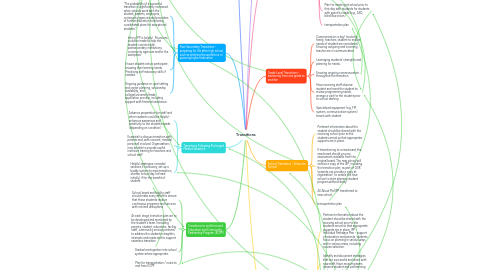
1. Post Secondary Transitions - preparing for life after high school, such as entering the workforce or pursuing higher education
1.1. "The probability of a sucessful transition is significantly increased when schools work with the student, parents, employers, community agencies and providers of further education to develop, coordinated plans for exceptional students."
1.2. Info in IPP is helpful. Provisions could be made to help the student connect with postsecondary institutions, community agencies and/or the workplace.
1.3. Ensure student active participant, knowing their learning needs. Practicing self-advocacy skills if needed.
1.4. Ongoing guidance re: goal setting and career planning, scholarship availability, and college/university/trade application process, including support with financial assistance.
2. Transitions Following Prolonged Medical Absence
2.1. Advance preparation for staff and other students could be helpful - enhances awareness and sensitivity to the students needs (depending on condition)
2.2. Essential to discuss transition with parents and, with consent, medical personell involved. Organizations may be able to provide useful inservice training for teachers and school staff
2.3. Helpful strategies: remedial sessions if necessary, set up a buddy system to ease transition, shorten school day (at least initially) if for the benefit of student
3. Transitions to and from and Education and Community Partnership Program (ECPP)
3.1. School board and facility staff should make every effort to ensure that these students receive continuous programs and services with minimal disruptions
3.2. At each stage, transition plan are to be developed and monitored by the student's team (including parents, student, educators, facility staff, community service partners) to address the students stregnths, interests and needs and to support seamless transition
3.3. Gradual reintegration into school system where appropriate.
3.4. Plan for transportation / route to and from ECPP
4. Parental Supports
4.1. Provide translated documents for important resources.
4.2. Esnuring appropriate community partners and supports are available for meetings with families (e.g., translator, personal support worker, settlement worker, etc.)
4.3. Esnure all events are inclusive and accessible to all students and families
5. OVERALL
5.1. Transition plans are the responsibility of the principal, and must be developed with paretns/caregiviers, student (where appropriate), post secondary (where appropriate), and community agencies or partnerships (where appropriate)
5.2. They will identify specific goals, support needs, actions to achieve the goals, roles, responsibilities and timelines.
5.3. Transition plans must be developed for all students who have an IEP, whether they are formall identified or not, as part of the IEP iteself.
5.4. Inform parents/caregivers of any significant change in transition.
6. Daily Transitions - moving between activities, classes or environments throughout the day
6.1. supports can include visual schedule, visual or auditory reminders, transition tools/comfort objects,additional adult supports, practice route/routine
6.2. School boards must plan for transition between various activites and settings involving students with ASD, incoroporating principles of ABA.
7. Entry to School - transitioning from home life or daycare to school
7.1. Plan early! Communication is key! Case conference in spring to ensure support and programmings needs are ready for fall.
7.2. Parents gather detailed information of child's strengths, needs and developmental stage will be useful in establishing records (if possible).
7.3. Teachers, ECEs, community members and families work together.
7.4. Prepare visuals to assist with transition: school photo book or video, map of school
7.5. Plan for meeting at school prior to first day with students for students with specific needs (e.g., ASD, blind/low vision)
7.6. transportation plan
8. Grade Level Transitions - advancing from one grade to another
8.1. Communication is key! Involving family, teachers, student to ensure needs of student are considered. Ensuring outgoing and incoming teacher are in communication.
8.2. Leveraging students' strengths and planning for needs.
8.3. Ensuring ongoing communication throughout the transition.
8.4. Have receiving staff observe student and meet the student to review programming needs; arrange a visit for the student prior to school starting
8.5. Specialized equipment (e.g, FM system, communication system) travels with student
9. School Transitions - School to School
9.1. Pertinent information about the student should be shared with the receiving school prior to the students arrival so that appropriate supports are in place.
9.2. If transitioning to a new board, the new board should you any assessment available from the original board. The new school will receive a copy of the IEP, including the transition plan, as part of OSR (parents can provide a copy at registration), to enable the new school to start planning student program without delay
9.3. All About Me/IPP transferred to new school
9.4. transportation plan
10. School Transitions - Elementary to High School
10.1. Pertinent information about the student shoud be shared with the receving school prior to the students arrival so that appropriate supports are in place. IPP - Individual Pathways Plan - support of educators and parents, students focus on planning in various ways and in various areas, including course selection.
10.2. Identify and document strategies that are successful and share with new staff. Have receiving team observe student and proramming in elemntary school.
10.3. Organize a visit to receiving environment.
10.4. Buddy system where appropriate to support with transition
10.5. Plan for transportation / route to and from school
10.6. Educators need to provide Special Edcucation students some key information including OSSD requirements, OSSC or Certificate of Accomplishment, where appropriate, Ontario Student Transcript, types of courses offered and how test to design courseload based on interests, strengths, needs, aspirations; specilalized programs and board-wide programs, extracurricular activities and additional support programs; strategies for completing community involvement requirement; the full range of post-secondary opportunities; the education and career/life planning process and strategies for the effective use of education and career/life planning resources