

1. M
1.1. Motivation crowding
1.1.1. small monetary incentives may crowd out other types of incentives.
1.1.2. video
1.1.2.1. Monetary Incentives and Motivation explained by Bruno Frey
2. R
2.1. Reciprocity
2.1.1. we feel we owe something in return whenever we accept a favour or free item.
2.1.2. video
2.1.2.1. Bureau Influence Tip by Robert Cialdini – Reciprocity
2.2. Regression to the mean
2.2.1. average values will fluctuate around a mean. Decreased or increased performance may simply be these random fluctuations, not due to an identifiable cause.
2.2.2. video
2.2.2.1. Regression To Mean Bias
2.2.2.2. Regression to the Mean
2.2.2.3. Galton Board and the Regression to the Mean
2.2.2.4. Galton Board
3. O
3.1. Overconfidence effect
3.1.1. we systematically overestimate our knowledge and our ability to predict.
3.1.2. more information
3.1.2.1. Dunning–Kruger effect - Wikipedia
3.1.3. video
3.1.3.1. Overconfidence Bias
3.1.3.2. Overconfidence Bias | Concepts Unwrapped
3.2. Outcome bias
3.2.1. we tend to evaluate decisions based on the result, instead of the process.
3.2.2. video
3.2.2.1. Outcome Bias
3.3. Overthinking
3.3.1. if you think too much, you will lose the wisdom of your emotional response.
3.3.2. Video
3.3.2.1. overthinking the hell out of overthinking
3.4. Omission bias
3.4.1. we tend to prefer inaction whenever both action and inaction lead to cruel consequences.
3.4.2. video
3.4.2.1. Omission Bias
4. T
4.1. Twaddle tendency
4.1.1. reams of words used to disguise intellectual laziness, stupidity, misunderstanding or underdeveloped ideas. Often used in conjunction with authority bias.
4.1.2. Video
4.1.2.1. The Twaddle Tendency (25 cognitive biases - part 12)
4.2. Tragedy of commons
4.2.1. Tragedy Of The Commons Definition
4.2.2. What is the tragedy of the commons? - Nicholas Amendolare
4.2.3. 🐄 The Tragedy of the Commons | How to Avoid It?
4.2.4. Governing The Commons in Six Minutes
5. V
5.1. Volunteer’s folly
5.1.1. volunteering our time is less efficient (because we do these jobs less effectively) than contributing our earnings for the equivalent amount of time. Exception: celebrities.
6. N
6.1. News illusion
6.1.1. we believe news is important, when in reality it is not, and is specifically designed to attract us, despite this.
6.2. Not-invented-here syndrome
6.2.1. when we think anything we create ourselves is unbeatable.
6.2.2. video
6.2.2.1. Dan Ariely & The Not Invented Here Bias
6.2.3. ideas are like tooth brush
6.2.3.1. The idea is that everyone wants a toothbrush, everyone needs one, everyone has one, but no one wants to use anyone else’s.”
6.3. Neomania
6.3.1. when we prioritize things that are new and novel over their actual benefits.
6.4. Neglect of probability
6.4.1. we lack an intuitive grasp of probability, and instead tend to respond to the expected magnitude of an event, instead of its likelihood.
6.4.2. Video
6.4.2.1. Neglect of Probability
7. Z
7.1. Zeigarnik effect
7.1.1. we forget uncompleted tasks unless we have a clear idea of how to deal with them.
7.1.2. video
7.1.2.1. Zeigarnik Effect
7.1.2.2. The Zeigarnik Effect Can Help You Become More Persuasive
8. W
8.1. Will Rogers phenomenon
8.1.1. the effect of changing the average in two groups (positively) by moving something from one category to another.
8.1.2. if you move the lowest net worth individual from a higher group to a lower group, the average net worth of both groups increases.
8.1.3. Video
8.1.3.1. Calling Bullshit 4.4: The Will Rogers Effect
8.2. Winner’s curse
8.2.1. the winner of an auction often turns out to be the loser.
8.2.2. Video
8.2.2.1. Game Theory 101 (#72): The Winner's Curse, Part 1
8.2.2.2. The Ideal Auction - Numberphile
9. S
9.1. Sleeper effect
9.1.1. if propaganda/advertising strikes a chord with someone, the influence will only increase over time.
9.1.2. video
9.1.2.1. The Sleeper Effect – How the Media Manipulates You
9.2. Social comparison bias
9.2.1. we tend to withhold assistance for people who might outdo us, even if you look like the fool in the long run.
9.2.2. video
9.2.2.1. Social Comparison: Downward and Upward
9.2.2.2. Social Comparison Bias
9.2.2.3. Social Comparison Thoery
9.3. Salience effect
9.3.1. outstanding features has an undue influence on how we think and act. We neglect hidden, slow-to-develop factors.
9.4. Strategic misrepresentation
9.4.1. the more at stake, the more exaggerated your assertions become.
9.5. Survivorship bias
9.5.1. we tend to only hear about the successes or “survivors” - we don’t hear the stories of the failures, and thus overestimate the chances of success.
9.5.2. video
9.5.2.1. Survivorship Bias
9.5.2.2. You are missing something! - Survivorship bias
9.5.2.3. Why you shouldn't trust successful people's advice
9.6. Social proof
9.6.1. we feel we are behaving correctly when we act the same as other people.
9.6.2. video
9.6.2.1. Social Proof
9.6.2.2. Bureau Influence Tip by Robert Cialdini - Social Proof
9.7. Sunk cost fallacy
9.7.1. when we consider the costs incurred to date as a factor in our decision-making. Only your assessment of the future costs and benefits should count.
9.7.2. video
9.7.2.1. Sunk Cost Fallacy
9.7.2.2. Julia Galef: The Sunk Costs Fallacy | Big Think
9.7.2.3. What is a Sunk Cost?
9.8. Story bias / Narrative fallacy
9.8.1. we try and shape everything into stories.
9.8.2. video
9.8.2.1. Books - Episode 5 // The Narrative Fallacy
9.9. Social loafing
9.9.1. when people work together (and individual performance is not directly visible), their individual performance decreases.
9.9.2. video
9.9.2.1. Social Loafing
9.9.2.2. Social loafing
9.9.2.3. Sport Psychology | The Ringelmann Effect
9.9.2.4. "Ringelmann Effect" aka "Social Loafing"
9.10. Self-serving bias
9.10.1. we attribute success to ourselves and failure to external circumstances.
9.10.2. Video
9.10.2.1. Self Serving Bias
9.10.2.2. Self-serving Bias | Concepts Unwrapped
9.11. Self-selection bias
9.11.1. we change the outcome of something by poorly selecting our sample.
9.11.2. More content
9.11.2.1. Do Not Marvel at Your Existence -
9.11.3. video
9.11.3.1. Selection Bias: Will You Make More Going to a Private University?
9.12. Simple logic
9.12.1. we tend to default to intuition because it is less taxing.
9.12.2. video
9.12.2.1. Why You Can Never Argue with Conspiracy Theorists | Argument Clinic | WIRED
9.13. Swimmer’s body illusion
9.13.1. confusing the factor for selection with the result (ex: swimming gives you a great frame; actually, great swimmers are born with a good frame for swimming).
9.13.2. video
9.13.2.1. Swimmers Body illusion by Rolf Dobelli
9.14. Strawman fallacy
9.14.1. video
9.14.1.1. The "Straw Man" Fallacy
10. P
10.1. Planning fallacy
10.1.1. we overestimate benefits, and underestimate the risks, costs and duration of a project.
10.1.2. Video
10.1.2.1. OFI - Behavioural Economics Bites 5 - The Planning Fallacy
10.1.2.2. The Planning Fallacy: Getting Things Done
10.1.2.3. Why Everything Takes Longer Than You Expect
10.2. Procrastination
10.2.1. the tendency to delay unpleasant but important acts.
10.2.2. video
10.2.2.1. Inside the mind of a master procrastinator | Tim Urban
10.2.2.2. How to Stop Procrastinating
10.3. Personification
10.3.1. we empathize with other people when the human aspect is visible.
10.4. Platonification
10.4.1. We cut the world up into crisp categories, and then assume that the world matches our model precisely. (If it's not in my model, it doesn't exist.)
10.5. Primacy and recency effects
10.5.1. the first trait, or more recent information, hold larger sway over us.
10.5.2. video
10.5.2.1. Primacy and Recency Effect
10.6. Priming
10.6.1. Video
10.6.1.1. How psychology affects your decision-making | Priming & Loss Aversion
10.6.1.2. Daniel Kahneman on Studies on Priming People to The Idea of Money
10.6.1.3. PRIMING by Daniel Kahneman | Thinking, Fast and Slow
10.7. Paradox of choice
10.7.1. an abundance of choice leads to inner paralysis, poorer decisions, and unhappiness with our decisions.
10.7.2. video
10.7.2.1. The Paradox of Choice, Barry Schwartz
10.7.2.2. The Paradox of Choice Explained: Why You're Unhappy With Your Decisions
10.7.2.3. The paradox of choice | Barry Schwartz
10.8. Problems with averages
10.8.1. averages often mask the underlying distribution.
10.8.2. video
10.8.2.1. The Problem With Averages
10.8.3. Never cross a river that is “on average” four feet deep.
10.8.4. The Bill Gates phenomenon.
11. A
11.1. Ambiguity aversion
11.1.1. we favour known probabilities over unknown ones.
11.1.2. Elsberg Paradox
11.1.2.1. Video
11.1.2.1.1. Are you afraid of uncertainty?
11.1.2.1.2. The Ellsberg Paradox and the Neural Foundations of Decision-Making under Uncertainty
11.2. Affect heuristic
11.2.1. when we make complex decisions by consulting our emotions, instead of considering the risks and benefits independently.
11.2.2. video
11.2.2.1. Affect Heuristic
11.3. Alternative paths
11.3.1. we fail to consider all the outcomes which could have happened, and therefore underestimate risk.
11.3.2. additional material
11.3.2.1. Nassim Taleb on the Notion of Alternative Histories
11.3.2.2. Nassim Nicholas Taleb Russian roulette example
11.4. Association bias
11.4.1. we make false connections between things that are not linked.
11.4.2. additional material
11.4.2.1. Bias from Association: Why We Shoot the Messenger
11.4.3. we condemn the bearers of bad news, due to the negative nature of the message.
11.5. Anchors (Anchoring Bias)
11.5.1. when we guess something, we start from something we are sure of, and go from there.
11.5.2. video
11.5.2.1. Anchoring bias
11.6. Action bias
11.6.1. we feel compelled to do something, particularly in new or shaky circumstances, even if we have made things worse by acting too quickly or too often.
11.6.2. video
11.6.2.1. Action Bias
11.7. Alternative blindness
11.7.1. we systematically forget to compare an existing offer with the next-best alternative.
11.7.2. Barry Shwartz Paradox of Choice
11.7.2.1. Barry Shwartz Paradox of Choice
11.8. Authority bias
11.8.1. we tend to defer to authority, and consider the opinions of supposedly authoritative people too strongly.
11.8.2. additional material
11.8.2.1. Iatrogenesis
11.8.2.1.1. NNT
11.8.2.2. Stanley Miligram Obedience to authority
11.8.2.2.1. Stanley Miligram Obedience to authority
11.9. Availability bias
11.9.1. we create a picture of the world, or construct arguments, based on examples and evidence that most easily come to mind.
11.9.2. Counter by spending time with people who think differently than you do.
11.9.3. Video
11.9.3.1. Availability Bias
11.10. Ad honimen
11.10.1. video
11.10.1.1. The Ad Hominem Fallacy
11.10.1.2. What is an Ad Hominem Attack? | Argument Clinic | WIRED
12. B
12.1. Beginner’s luck
12.1.1. we create a false link with early, past results.
12.1.2. Silent evidence. We only hear those who lived to tell the story. For example, "beginner's luck" in gambling is explained like this: Those who had bad luck at the beginning did not take up gambling; therefore a disproportionate fraction of gamblers did, in fact, have luck at the start. Silent evidence gives us an illusion of stability and safety: We underestimate the risks we took in the past, because we survived them all. If we hadn't, we wouldn't be here to contemplate the question. So we compute odds from the point of view of the winning gambler, and not based on everyone who started in our cohort.
12.2. Base-rate neglect
12.2.1. we disregard the basic distribution levels for a given outcome.
12.2.2. Also made worse by survivorship bias.
12.2.3. Often exacerbated by giving more detail (narrative fallacy contributes).
12.3. “Because” justification
12.3.1. introduction of a reason (any reason) increases our compliance.
12.3.2. Link
12.3.2.1. Any Lame Excuse -
12.4. The Black Swan
12.4.1. an unthinkable event that massively affects your life, career, company, country.
13. L
13.1. Loss aversion
13.1.1. the fear of losing something motivates people more than the prospect of gaining something of equal value.
13.1.2. Video
13.1.2.1. Daniel Kahneman - Stick With Your Winners - Insights for Entrepreneurs - Amazon
13.1.2.2. Loss Aversion bias
13.1.2.3. 2.6 Loss Aversion and The Endowment Effect
13.1.2.4. Daniel Kahneman: Thinking Fast vs. Thinking Slow | Inc. Magazine
13.2. Law of small numbers
13.2.1. when we assume characteristics of the overall population can be assumed from a small sample, when in fact small samples are much more subject to random variation.
13.2.2. video
13.2.2.1. The Law of Small Numbers
13.2.2.2. The Small Sample Fallacy
13.2.2.3. The reason casinos always win: meet the law of large numbers
13.3. Liking bias
13.3.1. the more we like someone, the more we want to buy from or help that person.
13.3.2. video
13.3.2.1. Bureau Influence Tip by Robert Cialdini – Liking
13.3.2.2. Blinded by Liking: Bias Wins.
14. G
14.1. Groupthink
14.1.1. in groups, we tend to avoid contradiction, and we tend to agree with the majority conclusion.
14.1.2. video
14.1.2.1. Groupthink - A short introduction
14.2. Gambler’s fallacy
14.2.1. we tend to mix up events that are independent and dependent (ie. this ball has landed on black 10 times, it must be red soon).
14.2.2. “What goes around comes around” is just false.
14.2.3. Video
14.2.3.1. Critical Thinking Part 5: The Gambler's Fallacy
15. C
15.1. Fear of regret
15.1.1. when we fail to act to avoid potentially feeling regret.
15.1.2. Video
15.1.2.1. The BIGGEST Thing You Should FEAR is REGRET! | Gary Vaynerchuk | #Entspresso
15.2. Cherry picking
15.2.1. selecting and showcasing the most attractive features and hiding the rest.
15.3. Clustering illusion
15.3.1. we tend to see patterns where there aren’t any.
15.3.2. Videos
15.3.2.1. Clustering Illusion
15.3.2.2. What is Clustering Illusion | Explained in 2 min
15.3.3. More info
15.3.3.1. forgetomori » Seeing Patterns
15.3.3.2. BOMB
15.4. Chauffeur knowledge
15.4.1. the knowledge required to make it appear as though someone understands something, when in fact they do not.
15.5. Coincidence
15.5.1. we tend to see unlikely events as causal, when in reality they are likely random.
15.6. Cognitive dissonance
15.6.1. when inconsistencies in our thoughts, beliefs, or attitudes cause us to reinterpret events to keep things consistent.
15.6.2. videos
15.6.2.1. Cognitive Dissonance Theory: A Crash Course
15.6.2.2. Cognitive Dissonance | Concepts Unwrapped
15.6.2.3. A Lesson In Cognitive Dissonance
15.7. Contagion bias
15.7.1. we are incapable of ignoring the connection we feel to certain items, even if from long ago or of indirect relation.
15.8. Confirmation bias
15.8.1. we interpret evidence to support our existing beliefs.
15.8.2. video
15.8.2.1. Confirmation Bias
15.8.2.2. The Confirmation Bias
15.8.2.3. Confirmation Bias in 5 Minutes
15.8.3. To counter, set out to find disconfirming evidence for your hypothesis.
15.9. Contrast effect
15.9.1. we judge things in relation to other things. We also don’t notice small, gradual changes.
15.9.2. Video
15.9.2.1. What is Contrast Effect | Explained in 2 min
15.10. Conjunction fallacy
15.10.1. when a subset seems larger than the entire set.
15.10.2. A result of our attraction to plausible stories.
15.10.3. Linda problem
15.10.4. Video
15.10.4.1. The Conjunction Fallacy
16. I
16.1. Illusion of skill
16.1.1. luck plays a larger role than skill in many domains, like entrepreneurship and leadership. Skill is necessary but not sufficient.
16.1.2. more information
16.1.2.1. Rolf Dobelli: Illusion of Skill
16.2. Intention-to-treat error
16.2.1. when failed projects or statistics show up in the wrong category.
16.2.2. Video
16.2.2.1. Intention to Treat
16.3. Illusion of attention
16.3.1. we are confident that we notice everything in front of us, despite only seeing what we are focused on.
16.3.2. video
16.3.2.1. The Monkey Business Illusion
16.4. Information bias
16.4.1. the delusion that more information guarantees better decisions.
16.4.2. video
16.4.2.1. Information Bias
16.4.2.2. Information Bias
16.5. Inability to close doors
16.5.1. we tend to prefer leaving options open, thinking they are free, when in reality they have a cost in distracting us.
16.6. In-group out-group bias
16.6.1. groups form based on minor criteria. You perceive people outside your group to be more similar than they actually are (stereotypes start here). Group members lead to disproportionate perceived support within the group.
16.6.2. video
16.6.2.1. How Our Brains Respond to People Who Aren't Like Us
16.6.2.2. In-out groups
16.6.2.3. Prejudice and Discrimination: Crash Course Psychology #39
16.6.2.4. 60 Minutes- Ingroup Bias in Babies
16.7. Illusion of control
16.7.1. we believe we influence far more than we actually do.
16.7.2. video
16.7.2.1. 6 Buttons That Actually Do Nothing
16.8. Induction
16.8.1. the inclination to draw universal certainties from individual (typically past) observations.
16.8.2. Video
16.8.2.1. Induction Bias
16.8.3. The turkey problem - he lives a great life until Thanksgiving.
16.9. Incentive super-response tendency
16.9.1. people respond to incentives by doing what is in their best interests.
16.9.2. video
16.9.2.1. Freakonomics and the Power of Incentives
16.9.2.2. Charlie Munger : The power of incentives
16.9.3. More information
16.9.3.1. Incentives: The Hidden Forces That Shape Behavior
16.10. Introspection illusion
16.10.1. the belief that reflection leads to truth or accuracy.
16.11. It’ll-get-worse-before-it-gets-better fallacy
16.11.1. a variation of confirmation bias. If the problem persists, the prediction is confirmed. If it improves, the expert can attribute it to his prowess.
17. D
17.1. Déformation professionnelle
17.1.1. experts will tend to solve problems using their expertise, not necessarily the best method.
17.1.2. “To the man with a hammer, every problem is a nail."
17.2. Default effect
17.2.1. we prefer the status quo.
17.2.2. video
17.2.2.1. Default Effect and Status Quo Bias
17.3. Domain dependence
17.3.1. insights from one field do not pass well to another.
17.3.2. Additional information
17.3.2.1. Knowledge Is Nontransferable -
17.4. Decision fatigue
17.4.1. willpower erodes throughout the day, particularly when we haven’t eaten or slept.
17.4.2. Video
17.4.2.1. Willpower: Self-control, decision fatigue, and energy
18. F
18.1. Feature-positive effect
18.1.1. we place a greater emphasis on what is present than what is absent.
18.1.2. Additional material
18.1.2.1. The Feature-Positive Effect *
18.2. Fallacy of the single cause
18.2.1. the belief that a single factor caused an event or phenomenon.
18.2.2. Video
18.2.2.1. Single Cause Fallacy (Fallacy of the Week)
18.3. False-consensus effect
18.3.1. we overestimate the unanimity of others, believing they think and feel exactly like we do.
18.3.2. video
18.3.2.1. PSYCH: THE FALSE CONSENSUS EFFECT
18.4. Falsification of history
18.4.1. our memories are riddled with inaccuracy.
18.4.2. video
18.4.2.1. Karl Popper's Falsification
18.4.2.2. Chapter 1.4: Karl Popper and the logic of falsification
18.5. Framing
18.5.1. we react differently to identical situations, depending on how they are presented.
18.5.2. Videp
18.5.2.1. Daniel Kahneman: Why We Make Bad Decisions About Money (And What We Can Do About It)
18.5.2.2. Framing Bias
18.5.2.3. Framing | Concepts Unwrapped
18.6. Forer effect (aka Barnum effect)
18.6.1. we tend to identify with positive traits in general descriptions, believing pseudosciences as a result.
18.6.2. video
18.6.2.1. Forer (or Barnum) Effect
18.6.2.2. The Barnum Effect
18.6.2.3. The Barnum Effect - Why People Believe In Astrology And Psychics
18.7. Forecast illusion
18.7.1. we tend to believe forecasts, despite the poor predictability and low downside for being wrong.
18.7.2. Video
18.7.2.1. Forecast Illusion - Do you blindly follow the experts?
18.8. False causality
18.8.1. when we mix up correlation with causation.
18.8.2. Video
18.8.2.1. Can you outsmart the fallacy that fooled a generation of doctors? - Elizabeth Cox
19. E
19.1. Envy
19.1.1. when we compare ourselves on the basis of ownership, status, health, youth, talent, popularity or beauty. The subject of envy is a thing, where as the subject of jealousy is the behaviour of a third person.
19.2. Expectations
19.2.1. expectations form our reaction to various events, and contribute to our happiness. Set expectations high for yourself and the people you love, and lower them for things you cannot control.
19.3. Effort justification
19.3.1. if you put a lot of effort into a task, you tend to overvalue the result.
19.4. Endowment effect
19.4.1. we consider things to be more valuable the moment we own them.
19.4.2. video
19.4.2.1. Endowment Effect
19.4.2.2. The Endowment Effect
19.4.2.3. 2.6 Loss Aversion and The Endowment Effect
19.5. Exponential growth
19.5.1. we do not have a good intuitive feel for exponential growth (vs. Linear growth).
19.5.2. video
19.5.2.1. Exponential Growth
20. H
20.1. House-money effect
20.1.1. we treat money that we win, discover, or inherit much more frivolously than hard-earned cash.
20.1.2. Video
20.1.2.1. Bad habits: House Money Effect
20.2. Hedonic treadmill
20.2.1. we adjust to new circumstances, and are unable to correctly predict our own emotions in response to new circumstances.
20.2.2. Video
20.2.2.1. Would winning the lottery make you happier? - Raj Raghunathan
20.3. Hyperbolic discounting
20.3.1. the introduction of “now”, causing us to make inconsistent decisions.
20.3.2. Video
20.3.2.1. Hyperbolic Discounting
20.3.2.2. Hyperbolic Discounting: Why You Make Terrible Life Choices - Nir&Far - Episode#31
20.4. Hindsight bias
20.4.1. in retrospect, everything seems clear and inevitable.
20.4.2. video
20.4.2.1. Why Psychology Tells Us What We Already Know
20.5. Halo effect
20.5.1. when a single aspect dazzles us, and we fail to see the larger picture or evaluate other factors objectively.
20.5.2. video
20.5.2.1. The Halo Effect
20.5.2.2. The Halo Effect
20.5.2.3. Halo Effect - Nike Marketing Strategy
20.5.2.4. Brain Games - Halo Effect
21. Other
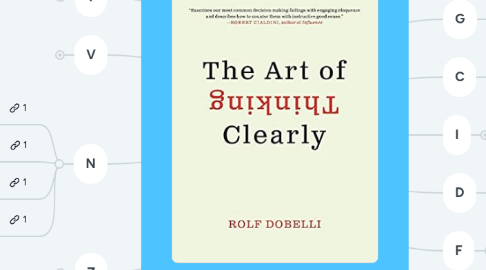
21.1. The Art of Thinking Clearly More content
21.1.1. http://xqdoc.imedao.com/166eb7278f3556e3fe9dc3ef.pdf
21.1.2. The Art of Thinking Clearly by Rolf Dobelli - Summary & Note
21.2. Scientists and authors to fallow
21.2.1. Paul Slovic
21.2.1.1. HUMAN TRAGEDIES: THE MORE WHO DIE, THE LESS WE CARE | Paul Slovic | TEDxKakumaCamp
21.2.2. Nassim Nicholas Taleb
21.2.3. Scout Plous
21.2.3.1. Social Psychology : Scott Plous, Wesleyan University
21.2.4. Bruno Frey
21.2.5. David brooks social annimal
21.2.5.1. David Brooks: The social animal
21.2.6. Leon Festinger
21.2.6.1. Videos
21.2.6.1.1. A Lesson In Cognitive Dissonance
21.2.6.1.2. Firing Line with William F. Buckley Jr.: The Mechanism of Moral Development
21.2.7. Daniel Kahneman
21.2.8. Dan Ariely
21.2.9. Roy Baumeister
21.2.10. Albert Bandura
21.2.11. Robert Cialdini
21.2.12. Philip Zimbardo
21.2.13. Abraham Maslow
21.2.14. Amos Tversky
21.2.15. Richard Thaler
21.2.16. Cass Sunstein
21.2.17. Milton Friedman
21.2.18. Stanley Milgram
21.2.19. Daniel Gilbert
21.2.20. Philip Tetlock
21.2.21. Theodore Levitt
21.2.22. PHIL ROSENZWEIG
21.2.23. Sir Francis Galton
21.2.24. Elinor Ostrom
21.2.25. John C. Hershey
21.2.26. Jonathan Miller Baron
21.2.27. Robyn Dawes
21.2.28. Max Planck
21.2.29. Christopher J. Mayer
21.2.30. Robert Trivers
21.2.31. Thomas Gilovich
21.2.32. Ulrich Hoffrage
21.2.33. Martin Gruber
21.3. Web pages
21.3.1. The Black Swan - Taleb
21.3.2. 220 Fallacies
21.3.2.1. Fallacies | Internet Encyclopedia of Philosophy
21.3.3. A/B Testing Ideas for definitions
21.3.4. Courses – Carneades
21.4. More videos from UT Austin
21.4.1. Concepts Unwrapped - Ethics Unwrapped - UT Austin
21.5. Must read Books
21.5.1. Heuristics under Biases amazon
21.5.1.1. http://perso.ens-lyon.fr/jacques.jayez/Cours/LogRais/ProbRais/Heuristics_and_Biases.pdf
21.5.2. Dance with chance amazon
21.5.2.1. Video
21.5.2.1.1. 'Black Swan' author Nassim Taleb meets 'Dance with Chance' co-authors
21.5.3. Poor Charlie's Almanack amazon
21.5.4. Black Swan amazon
21.6. Organizaions
21.6.1. Public Choice Society.
21.6.2. Society for Judgment and Decision Making
21.6.3. Society for Medical Decision Making
21.6.3.1. Society for Medical Decision Making
21.6.4. Multiple Criteria Decision Making
21.6.5. SJDM Archives - Decision Science News
21.6.6. EADM
21.6.7. DMDU Society
21.6.7.1. DMDU Society
21.7. Courses
21.7.1. Problem Solving
21.7.1.1. Creative Problem Solving
21.7.1.2. Design Thinking for the Greater Good: Innovation in the Social Sector
21.7.1.3. Methods for Solving Problems
21.7.1.4. Cracking the Creativity Code: Discovering Ideas