


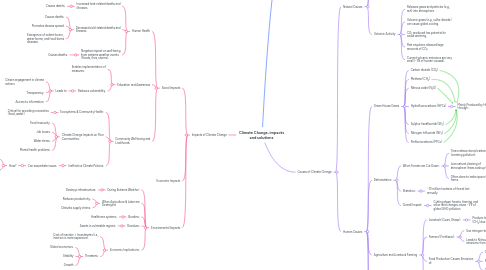
1. Solutions to Climate Change
1.1. Renewable Energy
1.2. Changing at a Personal Level
1.3. Changing at a National Level
1.4. Changing at a Global Level
1.5. Rewnewable energy
1.5.1. Solar
1.5.2. Wind
1.5.3. Hydro
1.5.4. Geothermal
2. Impacts of Climate Change
2.1. Social Impacts
2.1.1. Human Health
2.1.1.1. Increased heat-related deaths and illnesses.
2.1.1.1.1. Causes deaths.
2.1.1.2. Decreased cold-related deaths and illnesses.
2.1.1.2.1. Causes deaths.
2.1.1.2.2. Promotes disease spread.
2.1.1.2.3. Emergence of rodent-borne, water-borne, and food-borne diseases.
2.1.1.3. Negative impact on well-being from extreme weather events (floods, fires, storms).
2.1.1.3.1. Causes deaths.
2.1.2. Education and Awareness
2.1.2.1. Enables implementation of measures.
2.1.2.2. Reduces vulnerability.
2.1.2.2.1. Leads to
2.1.3. Community Well-being and Livelihoods
2.1.3.1. Ecosystems & Community Health:
2.1.3.1.1. Critical for providing necessities (food, water).
2.1.3.2. Climate Change Impacts on Poor Communities:
2.1.3.2.1. Food insecurity.
2.1.3.2.2. Job losses.
2.1.3.2.3. Water stress.
2.1.3.2.4. Mental health problems.
2.1.3.3. Ineffective Climate Policies:
2.1.3.3.1. Can exacerbate issues.
2.2. Economic Impacts
2.3. Environmental Impacts
2.3.1. During Extreme Weather:
2.3.1.1. Destroys infrastructure.
2.3.2. When Agriculture & Labor are Destroyed:
2.3.2.1. Reduces productivity.
2.3.2.2. Disturbs supply chains.
2.3.3. Burdens:
2.3.3.1. Healthcare systems.
2.3.4. Devalues:
2.3.4.1. Assets in vulnerable regions.
2.3.5. Economic Implications:
2.3.5.1. Cost of inaction > Investments (i.e., inaction is more expensive).
2.3.5.2. Threatens:
2.3.5.2.1. Global economics.
2.3.5.2.2. Stability
2.3.5.2.3. Growth
3. Causes of Climate Change
3.1. Natural Causes
3.1.1. Ocean Currents and Carbon Dioxide Content
3.1.1.1. Ocean currents carry heat globally.
3.1.1.2. Warmer oceans absorb less CO₂.
3.1.1.3. Warmer oceans can release more water vapor (a GHG).
3.1.2. Meteorite Impacts
3.1.2.1. Ejected dust and aerosols (causing cooling).
3.1.2.2. Later released GHGs (CO₂, water, methane).
3.1.3. Volcanic Activity
3.1.3.1. Releases gases and particles (e.g., ash) into atmosphere.
3.1.3.2. Volcanic gases (e.g., sulfur dioxide) can cause global cooling.
3.1.3.3. CO₂ produced has potential to cause warming.
3.1.3.4. Past eruptions released large amounts of CO₂.
3.1.3.5. Current volcanic emissions are very small (~1% of human-caused).
3.2. Human Causes
3.2.1. Green House Gases
3.2.1.1. Carbon dioxide (CO₂)
3.2.1.2. Methane (CH₄)
3.2.1.3. Nitrous oxide (N₂O)
3.2.1.4. Hydrofluorocarbons (HFCs)
3.2.1.4.1. Mainly Produced by Humans through:
3.2.1.5. Sulphur hexafluoride (SF₆)
3.2.1.6. Nitrogen trifluoride (NF₃)
3.2.1.7. Perfluorocarbons (PFCs)
3.2.2. Deforestation
3.2.2.1. When Forests are Cut Down:
3.2.2.1.1. Trees release stored carbon (creating pollution).
3.2.2.1.2. Less natural cleaning of atmosphere (trees soak up CO₂).
3.2.2.1.3. Often done to make space for farms.
3.2.2.2. Statistics:
3.2.2.2.1. ~10 million hectares of forest lost annually.
3.2.2.3. Overall Impact:
3.2.2.3.1. Cutting down forests, farming, and other land changes cause ~1/3 of global GHG pollution.
3.2.3. Agriculture and Livestock Farming
3.2.3.1. Livestock (Cows, Sheep):
3.2.3.1.1. Produce large amounts of Methane (CH₄) due to digestion.
3.2.3.2. Farmers (Fertilizers):
3.2.3.2.1. Use nitrogen-based fertilizers.
3.2.3.2.2. Leads to Nitrous Oxide (N₂O) emissions from soils.
3.2.3.3. Food Production Causes Emissions of:
3.2.3.3.1. CO₂
3.2.3.3.2. Methane
3.2.3.3.3. Other GHGs
3.2.3.4. Specific Activities:
3.2.3.4.1. Clearing land for agriculture.
3.2.3.4.2. Fossil fuel use for farming equipment and fishing boats.
3.2.4. Waste Management
3.2.4.1. Disposal of Organic Waste (Landfills):
3.2.4.1.1. Food scraps, yard waste, paper.
3.2.4.1.2. Generates Methane (CH₄) due to anaerobic decomposition (breakdown without oxygen).
3.2.4.2. Incineration of Waste (especially plastics):
3.2.4.2.1. Releases a ton of CO₂.
3.2.5. Powering Buildings
3.2.5.1. Energy Consumption:
3.2.5.1.1. Residential and commercial buildings consume large amounts of electricity.
3.2.5.2. Reliance on:
3.2.5.2.1. Coal, oil, natural gases for heating and cooling.
3.2.5.3. Emissions:
3.2.5.3.1. Great quantities of GHGs.
3.2.5.4. Growing Energy Demand for:
3.2.5.4.1. Heating, cooling, lighting, appliances, connected devices.
3.2.5.4.2. Causes rising CO₂ emissions from buildings.