Unlock the full potential of your projects.
Try MeisterTask for free.
Heb je nog geen account?
Meld je Gratis aan
Browse
Aanbevolen kaarten
Rubrieken
Project management
Zakelijke doelen
Personeelszaken
Brainstormen en analyseren
Marketing & Inhoud
Onderwijs en notities
Entertainment
Leven
Technologie
Ontwerp
Samenvattingen
Andere
Talen
English
Deutsch
Français
Español
Português
Nederlands
Dansk
Русский
日本語
Italiano
简体中文
한국어
Andere
Toon volledige map
Kopieer en bewerk map
Kopieer
Impact of Emotions
Zakelijke doelen
DP
Dana Patton
Volg
Laten we beginnen.
Het is Gratis
Login met Google
of
registreren
met je e-mailadres
Vergelijkbare mind mappen
Overzicht van map
Impact of Emotions
Door
Dana Patton
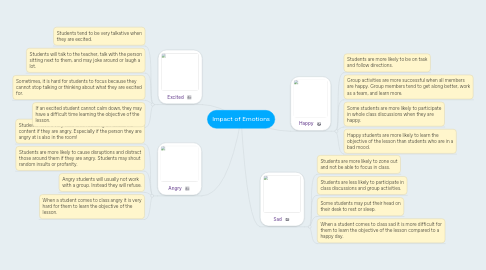
1. Angry
1.1. Students have a very hard time focusing on academic content if they are angry. Especially if the person they are angry at is also in the room!
1.2. Students are more likely to cause disruptions and distract those around them if they are angry. Students may shout random insults or profanity.
1.3. Angry students will usually not work with a group. Instead they will refuse.
1.4. When a student comes to class angry it is very hard for them to learn the objective of the lesson.
2. Excited
2.1. Students tend to be very talkative when they are excited.
2.2. Students will talk to the teacher, talk with the person sitting next to them, and may joke around or laugh a lot.
2.3. Sometimes, it is hard for students to focus because they cannot stop talking or thinking about what they are excited for.
2.4. If an excited student cannot calm down, they may have a difficult time learning the objective of the lesson.
3. Happy
3.1. Students are more likely to be on task and follow directions.
3.2. Group activities are more successful when all members are happy. Group members tend to get along better, work as a team, and learn more.
3.3. Some students are more likely to participate in whole class discussions when they are happy.
3.4. Happy students are more likely to learn the objective of the lesson than students who are in a bad mood.
4. Sad
4.1. Students are more likely to zone out and not be able to focus in class.
4.2. Students are less likely to participate in class discussions and group activities.
4.3. Some students may put their head on their desk to rest or sleep.
4.4. When a student comes to class sad it is more difficult for them to learn the objective of the lesson compared to a happy day.
Begin. Het is gratis!
Verbind met Google
of
Registreren