

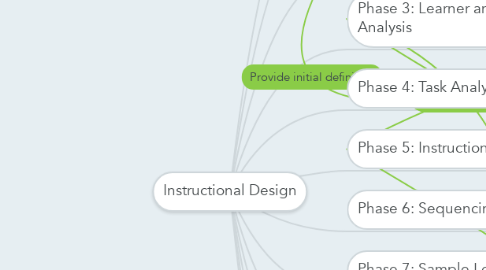
1. Before You Start
1.1. Designers
1.1.1. Instructional Designer (YOU)
1.1.2. Subject Matter Expert
1.1.3. Evaluator
1.2. Design Models
1.2.1. ADDIE Model
1.2.2. A Basic Model
1.2.2.1. Learners
1.2.2.2. Objectives
1.2.2.3. Methods
1.2.2.4. Evaluation
1.3. Will instruction solve the problem?
2. Phase 1: Statement of Intent
2.1. Statement of Intent
2.1.1. Identify Instructional Problem
2.2. Target Audience
2.3. Timeline
2.4. Context
3. Phase 2: Needs Assessment and Goal Analysis
3.1. Instructional Aim
3.2. Performance Assessment
3.2.1. How will instruction help the problem
3.2.2. Needs Assessment
3.2.2.1. Normative
3.2.2.2. Comparative
3.2.2.3. Felt
3.2.2.4. Expressed
3.2.2.5. Anticipated
3.2.2.6. Critical
3.2.3. Goal Analysis
3.3. Learner Personas
4. Phase 3: Learner and Contextual Analysis
4.1. Contextual Levels
4.1.1. Orienting Context
4.1.1.1. Goals
4.1.1.2. Perceived Utility
4.1.1.3. Perception of Accountability
4.1.1.4. Factors
4.1.1.4.1. Learner Factors
4.1.1.4.2. Immediate Environment Factors
4.1.1.4.3. Organizational Factors
4.1.2. Instructional Context
4.1.3. Transfer Context
5. Phase 4: Task Analysis
5.1. Content Structures
5.1.1. Facts
5.1.2. Concepts
5.1.3. Principles and Rules
5.1.4. Procedures
5.1.5. Interpersonal Skills
5.1.6. Attitudes
5.2. Topic Analysis
5.3. Procedural/Information-Processing Analysis
6. Phase 5: Instructional Objective
6.1. Domain
6.1.1. Cognitive
6.1.1.1. Bloom's Taxonomy
6.1.1.1.1. Remember
6.1.1.1.2. Understand
6.1.1.1.3. Apply
6.1.1.1.4. Analyze
6.1.1.1.5. Evaluate
6.1.1.1.6. Create
6.1.2. Pychomotor
6.1.2.1. Dave's Model
6.1.2.1.1. Imitate
6.1.2.1.2. Manipulate
6.1.2.1.3. Precision
6.1.2.1.4. Articulation
6.1.2.1.5. Naturalization
6.1.2.2. Simpson's Model
6.1.2.2.1. Perception
6.1.2.2.2. Set
6.1.2.2.3. Guided Response
6.1.2.2.4. Mechanism
6.1.2.2.5. Complex Overt Response
6.1.2.2.6. Adaptation
6.1.2.2.7. Origination
6.1.2.3. Harrow's Model
6.1.2.3.1. Reflex Movement
6.1.2.3.2. Basic Fundamental Movements
6.1.2.3.3. Perceptual Abilities
6.1.2.3.4. Physical Abilities
6.1.2.3.5. Skilled Movements
6.1.2.3.6. Nondiscursive Communication
6.1.3. Affective
6.1.3.1. Theories of Attitude Formation and Change
6.1.3.1.1. Behavioral Learning Theory
6.1.3.1.2. Cognitive Dissonance Theory
6.1.3.1.3. Affective-Cognitive Consistency
6.1.3.1.4. Social Judgment Theories
6.1.3.1.5. Social Learning Theory
6.1.3.1.6. Functional Theories
6.1.3.1.7. Krathwohl’s Taxonomy
6.2. Taxonomy Alignment
6.3. Parsing the Objectives
7. Phase 6: Sequencing Strategies
7.1. Objectives
7.1.1. Expanded Performance-Content Matrix
7.1.1.1. Face, concept, principle/rule, procedure, interpersonal skill, or attitude
7.1.1.2. Recall or application
7.2. Sequencing
7.2.1. Posner and Strike
7.2.1.1. Learning-Related
7.2.1.1.1. Identifiable Prerequisite
7.2.1.1.2. Familiarity
7.2.1.1.3. Difficulty
7.2.1.1.4. Interest
7.2.1.1.5. Development
7.2.1.2. World-Related
7.2.1.2.1. Spatial
7.2.1.2.2. Temporal
7.2.1.2.3. Physical
7.2.1.3. Concept-Related
7.2.1.3.1. Class Relations
7.2.1.3.2. Propositional Relations
7.2.1.3.3. Sophistication
7.2.1.3.4. Logical Prerequisite
7.2.2. Elaboration Theory
7.2.2.1. Content Expertise
7.2.2.1.1. Conceptual Elaboration
7.2.2.1.2. Theoretical Elaboration
7.2.2.2. Task Expertise
7.2.3. Gagne
7.2.3.1. Conditions of Learning
7.2.3.1.1. Intellectual skills (procedural knowledge)
7.2.3.1.2. Verbal information (declarative knowledge)
7.2.3.1.3. Cognitive strategies (techniques of thinking, analyzing, and solving problems)
7.2.3.1.4. Motor skills (executing movements)
7.2.3.1.5. Attitudes (mental states that influence the choice of actions)
7.2.3.2. Instructional Events
7.2.3.2.1. Gaining attention (reception)
7.2.3.2.2. Informing learners of the objective (expectancy)
7.2.3.2.3. Stimulating recall of prior learning (retrieval)
7.2.3.2.4. Presenting the stimulus (selective perception)
7.2.3.2.5. Providing learning guidance (semantic encoding)
7.2.3.2.6. Eliciting performance (responding)
7.2.3.2.7. Providing feedback (reinforcement)
7.2.3.2.8. Assessing performance (retrieval)
7.2.3.2.9. Enhancing retention and transfer (generalization)
7.3. Strategies
7.3.1. Motivational strategy
7.3.2. Strategy for initial presentation
7.3.3. Generative strategy
7.3.3.1. Recall
7.3.3.1.1. Repetition
7.3.3.1.2. Rehearsal
7.3.3.1.3. Review
7.3.3.1.4. Mnemonic Devices
7.3.3.2. Integration
7.3.3.2.1. Paraphrasing
7.3.3.2.2. Generating questions and examples
7.3.3.3. Organizational
7.3.3.3.1. Outlines
7.3.3.3.2. Categorizing
7.3.3.4. Elaboration
7.3.3.4.1. Generating mental images
7.3.3.4.2. Creating diagrams
7.3.3.4.3. Relating existing knowledge to new info
7.3.4. Strategy for providing feedback to learner
7.3.5. Prescriptions for instructional strategies
7.3.5.1. Fact
7.3.5.1.1. Concrete
7.3.5.1.2. Abstract
7.3.5.1.3. Lists
7.3.5.2. Concept
7.3.5.3. Principles and Rules
7.3.5.3.1. RULEG
7.3.5.3.2. EGRUL
7.3.5.4. Procedures
7.3.5.4.1. Cognitive
7.3.5.4.2. Psychomotor
7.3.5.5. Interpersonal
7.3.5.6. Attitude
8. Phase 7: Sample Lesson
8.1. Description and Pre-instructional Stratagies
8.1.1. Pretests
8.1.1.1. Alert students to what is expected
8.1.1.2. Length of instruction is short and loosely structured
8.1.1.3. Above-average, older, or mature learners
8.1.1.4. Have some familiarity with content
8.1.2. Behavioral objectives
8.1.2.1. Inform exactly what’s expected
8.1.2.2. Used to preface a passage
8.1.2.3. Middle ability students
8.1.2.4. Best with traditional methods like lectures
8.1.3. Overviews
8.1.3.1. Prepare for task
8.1.3.2. Little to no structure
8.1.3.3. Low or high ability students
8.1.3.4. Facts or concepts
8.1.4. Advance organizer
8.1.4.1. Conceptual framework to clarify content
8.1.4.2. Should have a dominant structure
8.1.4.3. Above average ability, maturity, sophistication
8.1.4.4. Factual info
8.1.4.5. Comparative Organizer - Compare new and old content
8.1.4.6. Expository organizer - Incorporates relevant old info
8.2. Gagne
8.3. Plan B
8.4. Assessment
8.5. Rationale for Design
8.5.1. Learning Theories - How you learn
8.5.1.1. Behavioral Learning Theory
8.5.1.1.1. Positive Rewards
8.5.1.1.2. Negative Punishments
8.5.1.2. Social Learning Theory
8.5.1.2.1. Modelling after someone
8.5.1.2.2. Attention
8.5.1.2.3. Retention
8.5.1.2.4. Production
8.5.1.2.5. Motivation
8.5.1.3. Cognitive Theory
8.5.1.3.1. Concerned with the mind
8.5.2. Instructional Theory - How you ensure desired learning occurs
8.5.3. Instructional Design Model - How you create an effective lesson
9. Phase 8: Materiels & Media
9.1. Instructional Media Selection
9.1.1. Preinstructional Strategy
9.1.2. Initial Presentation
9.1.3. Generative Stratagy
9.1.4. Transitions
9.1.5. Cognitive Load
9.1.5.1. Intrinsic - Interactivity of elements
9.1.5.2. Extraneous - Design or layout
9.1.5.3. Goal-Free - Determine what is known, then find shortest path to solution
9.1.5.4. Worked-Example - How to solve by presenting steps
9.1.5.5. Split-Attention - Illustration and text divide attention to comprehend material
9.1.5.6. Redundancy - Text with text and illustration increases load
9.2. Rationale
9.2.1. Heuristics
9.2.1.1. Make it concrete
9.2.1.2. Control the step size
9.2.1.3. Use appropriate pacing
9.2.1.4. Maintain consistency
9.2.1.5. Use cues
9.3. Strengths and Limitations
9.3.1. Group (Lecture)
9.3.1.1. Pro - Familiar convention, quick to design, direct control of class, serves large numbers, easy to change, feasible communication
9.3.1.2. Con - Passive learning, not adaptive, instruction stops with questioning, inappropriate for psychomotor, consistency difficult, auditory issues may arise
9.3.2. Distance Education
9.3.2.1. Pro - Large number can "attend" without going to campus, quality equipment can transmit high quality presentations, con experience as it happens, can study and complete anytime and anywhere
9.3.2.2. Con - Quality may be inferior, interactions less fluid, hardware requirements may be expensive, lacks pacing, may have high dropout rate
9.3.3. Self-Paced
9.3.3.1. Pro - Con complete at own pace, increases attention, instructor spends less time making presentations, reduces cost of program
9.3.3.2. Con - Lack of interaction, lead to monotony and lack of interest, self discipline required, procrastination leads to delays, requires team planning with faculty
9.3.4. Small Group
9.3.4.1. Pro - Promotes active learning, allows discussions and working together, acquires experience in listening and oral expression, instructor gains increased awareness of student progress
9.3.4.2. Con - Careful planning to create participation required, feedback needed to keep on track, activities are supplemental, costs may prohibit this approach
9.4. Example
9.4.1. Drill and Practice
9.4.2. Tutorials
9.4.3. Simulations
9.4.4. Games
9.4.5. Hypermedia
9.5. Justification of Developed Media
9.5.1. Mayer's Principles
9.5.1.1. Reducing extraneous overload
9.5.1.1.1. Coherence - Exclusion of extra info in animations/narrations
9.5.1.1.2. Signaling - Learning enhanced with cues to draw attention
9.5.1.1.3. Redundancy - Reduce redundancy stops overload of working memory
9.5.1.1.4. Spatial contiguity - Relevant items presented in close proximity
9.5.1.1.5. Temporal contiguity - Relevant items presented simultaneously
9.5.1.2. Managing essential overload
9.5.1.2.1. Segmenting - Present narrated animation in learner paced segments
9.5.1.2.2. Pre-training - Understand basic infor before viewing animation
9.5.1.2.3. Modality - Animation and narration more effect than animation and text
9.5.1.3. Fostering generative processing
9.5.1.3.1. Personalization - Written in conversational style
9.5.1.3.2. Voice - Narration be spoken in standard accented voice
10. Phase 9: Sample Assessment
10.1. Assessment Instrument
10.1.1. Objective tests
10.1.1.1. Multiple choice
10.1.1.2. True-false
10.1.1.3. Matching
10.1.2. Constructed-response tests
10.1.2.1. Completion (fill in the blank)
10.1.2.2. Short essay
10.1.2.3. Long essay
10.1.2.4. Problem-Solving
10.1.3. Testing skill/behavior
10.1.3.1. Direct testing
10.1.3.2. Analysis of natural results
10.1.3.3. Ratings of behaviors
10.1.3.4. Checklists of behaviors
10.1.3.5. Rating scales
10.1.3.6. Rubrics
10.1.3.7. Anecdotal records
10.1.3.8. Indirect checklist/rating measures
10.1.3.9. Portfolio assessments
10.1.3.10. Exhibitions
10.1.4. Testing attitudes
10.1.4.1. Observation/assessment
10.1.4.2. Questionnaire/survey
10.1.4.3. Interviews
10.1.5. Quality of tests
10.1.5.1. Validity
10.1.5.1.1. Face - Judgement that it appears to assess measure of interest
10.1.5.1.2. Content - involves more specific examination of individual items
10.1.5.2. Reliability
10.1.5.2.1. Test-retest correlates scores on two diff administrations
10.1.5.2.2. Parallel forms correlates scores on similar tests taken at diff times
10.1.5.2.3. Split-half correlates scores on half test with other half
10.1.5.2.4. Internal-consistency reliability is comparable to performing all split half
10.1.5.3. Relative standards - Compare with other learners
10.1.5.4. Absolute standards - Compare against standards
10.2. Alignment
10.3. Context
10.3.1. Formative
10.3.1.1. During development
10.3.1.2. Early in the process
10.3.2. Summative
10.3.2.1. Major outcomes in the end
10.3.2.2. Key info from post tests or final
10.3.3. Confirmative
10.3.3.1. Continuous, long-term, and follow up research
10.3.3.2. Evaluation extends beyond course
11. Phase 10: Evaluation Plan
11.1. Objectives
11.2. Performance Standards
11.3. Data Collection
11.3.1. Direct testing
11.3.2. Analysis of naturally occurring events
11.3.3. Direct/indirect observations
11.3.4. Portfolios
11.3.5. Exhibitions
11.4. Implementation
11.4.1. When
11.4.2. How
11.5. Analysis
11.5.1. Frequency distribution
11.5.2. Frequency graphs or histograms
11.5.3. Descriptive stats
11.5.4. Respondent comments
11.6. Utilization
11.6.1. Evaluation Report
11.6.1.1. Executive summary
11.6.2. Oral Report
12. Phase 11: Implementation Plan
12.1. Model & Rationale
12.1.1. Configuration, linkages, environment, resources (CLER)
12.1.1.1. Configuration
12.1.1.1.1. Designer system
12.1.1.1.2. Client system
12.1.1.1.3. Configurational relationships
12.1.1.2. Linkages
12.1.1.2.1. Formal
12.1.1.2.2. Informal
12.1.1.3. Environment
12.1.1.3.1. Physical
12.1.1.3.2. Social
12.1.1.3.3. Intellectual
12.1.1.4. Resources
12.1.1.4.1. Conceptual
12.1.1.4.2. Influence
12.1.1.4.3. Material
12.1.1.4.4. Personnel
12.1.1.4.5. Institutional
12.1.1.4.6. Time
12.1.1.5. Identifies, manipulates, and capitalizes on various configurational relationships
12.1.2. Concerns-Based Adoption Model (CBAM)
12.1.2.1. What change is
12.1.2.2. How change affects someone personally
12.1.2.3. Informational and personal
12.2. Plan
12.2.1. Diffusion - Communicating info to a client and target audience about an innovation
12.2.2. Adoption - Decision to use the innovation
12.2.3. Innovation - New to an entity who is considering using it
12.2.3.1. Advantage
12.2.3.2. Compatibility with values/needs/experiences
12.2.3.3. Innovation complexity
12.2.3.4. Ability to try
12.2.3.5. Observable results
12.2.4. Communication
12.2.5. Time
12.2.6. Social system
13. Phase 12: Project Management Considerations
13.1. Schedule
13.1.1. Fixed duration
13.1.2. Variable duration
13.2. Budget
13.2.1. Labor costs
13.2.2. Rental of equipment
13.2.3. Facilities
13.2.4. Production material
13.3. Project Management
13.3.1. Scope/Constraints
13.3.1.1. Time available
13.3.1.2. Degree of quality
13.3.1.3. Budget
13.3.2. Management activities
13.3.2.1. Starting
13.3.2.2. Managing resources
13.3.2.3. Tracking
13.3.2.4. Project reporting
13.4. Proposal Preperation
13.4.1. Project agreement
13.4.1.1. Statement of purpose
13.4.1.2. Plan of work
13.4.1.3. Milestones and deliverables
13.4.1.4. Budget
13.4.1.5. Schedule
13.4.1.6. Staffing
13.4.2. Legal considerations
13.4.2.1. Contracts may be needed
13.4.2.2. State and federal mandates
13.4.2.2.1. Occupational Safety and Health Act (OSHA)
13.4.2.2.2. Equal Employment Opportunity Commission (EEOC)
13.4.2.2.3. Americans with Disabilities Act (ADA)
13.4.2.2.4. Environmental Resources Act (ERA)
13.4.2.2.5. Toxic Substance Control Act (TSCA)
13.4.2.3. Common legal problems in training
13.4.2.3.1. Failure to perform training
13.4.2.3.2. Emotional trauma or physical injury from training
13.4.2.3.3. Intellectual property infringement
13.4.2.3.4. Discriminatory content
13.4.2.3.5. Injury due to human error
13.4.2.3.6. Access to training
13.4.2.3.7. Testing and evaluation
13.4.2.3.8. Failure to perform
13.4.2.3.9. Inadequate documentation