Unlock the full potential of your projects.
Try MeisterTask for free.
Heb je nog geen account?
Meld je Gratis aan
Browse
Aanbevolen kaarten
Rubrieken
Project management
Zakelijke doelen
Personeelszaken
Brainstormen en analyseren
Marketing & Inhoud
Onderwijs en notities
Entertainment
Leven
Technologie
Ontwerp
Samenvattingen
Andere
Talen
English
Deutsch
Français
Español
Português
Nederlands
Dansk
Русский
日本語
Italiano
简体中文
한국어
Andere
Toon volledige map
Kopieer en bewerk map
Kopieer
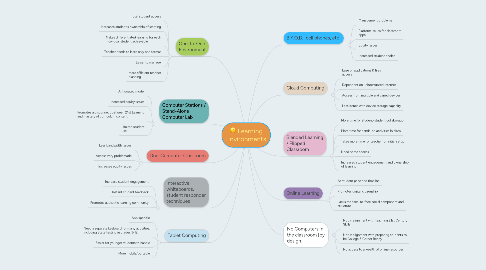
Learning Environments
Onderwijs en notities
DC
Daniel Chaja
Volg
Laten we beginnen.
Het is Gratis
Login met Google
of
registreren
met je e-mailadres
Vergelijkbare mind mappen
Overzicht van map
Learning Environments
Door
Daniel Chaja
1. One-to-One Environment
1.1. Total student access
1.2. Increases student's ownership of learning
1.3. Makes differentiated learning for each individual student achievable
1.4. Teacher needs to learn only one format
1.5. Easier to manage
1.6. More efficient teacher planning
2. Computer Stations / Stand-Alone Computer Lab
2.1. Antiquated model
2.2. Increased equity issues
2.3. Promotes a disconnect between 21st Learning and mastery of curriculum content
2.4. Limited student use
3. One-Computer Classroom
3.1. Less bandwidth issues
3.2. Access very problematic
3.3. Increases equity issues
4. Interactive whiteboards, student responder techniques
4.1. Increase student engagement
4.2. Instant student feedback
4.3. Promotes authentic learning community
5. Tablet Computing
5.1. App specific
5.2. Need a separate keyboard for many activities, including State testing in grades 3-12
5.3. Easier for younger students to handle
5.4. More mobile/portable
6. B.Y.O.D. [cell phones, etc]
6.1. Management problems
6.2. Platform issues for classroom apps
6.3. Equity issues
6.4. Increased student choice
7. Cloud Computing
7.1. Ease of applications & files access
7.2. Dependent on uninterrupted Internet
7.3. Access from multiple and varied devices
7.4. Less issues with device storage capacity
8. Blended Learning / Flipped Classroom
8.1. More time for student-student collaboration
8.2. More time for hands-on activities in class
8.3. Takes more time for teacher for initial setup
8.4. Need home access
8.5. Increased student engagement and ownership of learning
9. Online Learning
9.1. At student pace and timeline
9.2. Promotes digital citizenship
9.3. Lacks the face-to-face social component and structure
10. No Computers in the classroom [by design]
10.1. Not in alignment with teaching 21st Century Skills
10.2. Not in alignment with preparing students to be College & Career Ready
10.3. No access to a wealth of online resources
Begin. Het is gratis!
Verbind met Google
of
Registreren