

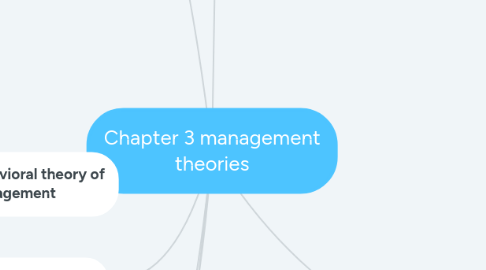
1. Bureaucratic theory of management
1.1. Made a distinction between authority and power
1.2. Power induced obedience through force
1.3. Three types of power
1.3.1. Traditional power
1.3.2. Charismatic power
1.3.3. Bureaucratic power and legal power
1.4. Five principle
1.4.1. Authority is the power to hold people
1.4.2. Position should be held based on performance
1.4.3. Position duties are identified so that people know what is expected of them
1.4.4. Lines of authority should be clearly indemnified
1.4.5. Rules standard operating procedures and norms guide the firm’s operations
2. Behavioral theory of management
2.1. Elton Mayo
2.2. An increase in work productivity was produced by the psychological stimulus
2.3. Social relationship and job content affected job performances
3. Douglas mcgregor
3.1. Theory X(negative)
3.2. Theory y(positive)
4. Management science theory
4.1. Uses rigorous quantitative techniques to maximize use of resources
4.2. Quantitative management
4.3. Operation management
4.4. Total equity management
4.5. Management information system
5. Total equity management approach
5.1. Analyzing input ,conversion, and output activities to increase product quality
6. Contingency theory
6.1. Class of behaviour theory that claims that there is not best way to organize a corporation to lead a company or to make decision ,instead optimal course of action is contingent
7. Theory of scientific management
7.1. Fredrick Taylor
7.2. Aimed at improving economic efficiency
7.3. Money motivated people at work
7.4. Introduce differential piece rate system
7.4.1. Efficiency greater than standard Paid 120% of normal piece rate
7.4.2. Efficiency less than standard paid 80% of normal piece rate
7.5. 4principle of scientific management
7.6. 1.Time and motion study
7.7. 2.teach ,train and develop
7.8. 3. Interest of employer and employees
7.9. 4.Fair levels of performance
7.10. Frank and Lilian Gilbreth
7.11. Improvement to the methodologies of time and motion studies
7.11.1. Time motion study
7.11.2. Breaking up each job action to its components
7.11.3. Finding better ways to perform the action
7.11.4. Reorganizing each job action to be more efficient
7.12. Henry grant
7.13. The grant chart
7.14. The task and bonus system
7.15. The task and bonus plan
8. Administrative management theory
8.1. Henry Fayol
8.2. Father of management
8.3. 14 principle of management
8.3.1. Divison of work
8.3.2. Discipline
8.3.3. Authority and responsibility
8.3.4. Subordination of individual interest to general interest
8.3.5. Remuneration
8.3.6. Controlization
8.3.7. Order
8.3.8. Equity
8.3.9. Initiative
8.3.10. Esprit de corps
8.3.11. Stability of tenure
8.3.12. Unity of direction
8.3.13. Scalar chain
8.3.14. Unity of command