
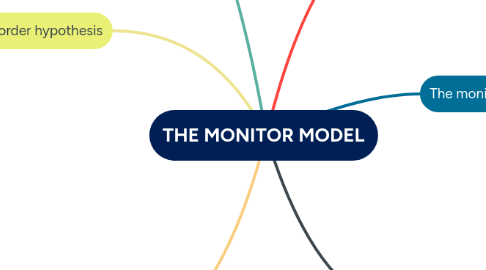
THE MONITOR MODEL

Stephen Krashen’s Five Hypotheses of Second Language Acquisition.

1. Stephen Krashen
1.1. Second language development
1.2. 5 Main hypotheses
2. The natural order hypothesis
2.1. Gramatical rules
2.1.1. L1: Learn faster
2.1.2. L2: Different order
2.2. Learner follow
2.2.1. Predicable order
2.2.2. Formal grammatical features
2.2.3. Not formal learning
2.3. Formal learning acquire
2.3.1. Receiving comprehensible and detailed information
2.3.2. Comprehension of the message
3. The input hypothesis
3.1. i + 1
3.1.1. i = learner knowledge
3.1.2. +1 = provided information
3.2. Refers to the acquisition
3.2.1. Focus on understanding
3.2.1.1. Not structure
3.2.2. Naturally develops language
3.2.2.1. Process of understanding
3.2.2.1.1. Listeting
3.2.2.1.2. Reading
3.2.3. Production ability emerges
3.2.3.1. Results
3.2.3.1.1. Speaking
3.2.3.1.2. Writing
4. The acquisition / Learning Hypothesis
4.1. Acquisition
4.1.1. Roughly tuned
4.1.1.1. Subconscious
4.1.1.2. Informal situations
4.2. Learning
4.2.1. Finely-tuned input
4.2.1.1. Conscious
4.2.1.2. Formal situations
5. The monitor hypothesis
5.1. Self correction
5.1.1. Previous knowledge
5.2. Use three conditions
5.2.1. Sufficient time
5.2.2. Focus from
5.2.3. Know the rule
6. The affective Filter
6.1. Self confidence
6.1.1. Feelings
6.1.1.1. Positive
6.1.1.1.1. Happiness
6.1.1.1.2. Interest
6.1.1.2. Negative
6.1.1.2.1. Stress
6.1.1.2.2. Anxiety
6.2. Motivation
6.2.1. Increases learning
6.2.2. Affects learning