

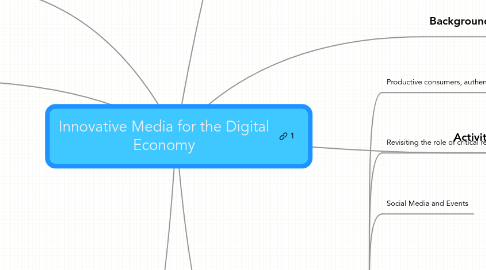
1. Challenges
1.1. Surveillance
1.2. Privacy
1.3. Policy frameworks
1.4. Inclusivity
1.5. Encouraging diversity and local content
1.6. Intellectual property rights
1.7. Infrastructure (broadband access and regulation
1.8. Digital rights management
1.9. Freedom of expression
1.10. Quality
1.11. Safety
1.12. 'Appropriate' and 'inappropriate' content and access
1.13. Security
1.14. Exploitation of content for commercial or political use
1.15. Deep social change
1.15.1. Etiquette
1.15.2. Sincerity
1.15.3. Friendship
1.15.4. Self and personhood
1.15.5. Networks and communities
2. Themes
2.1. Ownership
2.1.1. IPR and waiving of IPR
2.1.2. Individual and shared ownership
2.1.3. Ownership and exchange
2.1.4. Copyright, cpoyleft, and other models
2.1.5. collaborative governance
2.2. Blurring of roles
2.2.1. Producers and consumers
2.2.2. Creators and consumers
2.2.3. Experts and laypeople
2.2.4. Professionals and amateurs
2.3. Relationship of media to mediated
2.3.1. Representation vs Action, Interaction, Process
2.3.2. Intertwining of digital and real
2.4. Motivations
2.4.1. Commercial
2.4.2. Sociability
2.4.3. Communication
2.4.4. Interest
2.4.5. Commitment to a shared activity
2.5. Trust
2.5.1. New modes of trust, different expectations of trustworthiness, models of authoritativeness?
2.6. Economic models
2.6.1. Libertarain capitalism (individualist, instrumental rationality, laissez-faire)
2.6.1.1. Friedrich A. von Hayek
2.6.1.2. Milton Friedman
2.6.2. Welfare capitalism (common good oriented, instrumental rationality, planned)
2.6.2.1. Keynesian economics
2.6.2.2. State-directed capitalism
2.6.3. Grassroots economics (small-scale, bottom-up, local)
2.6.3.1. Co-operative model
2.6.3.2. Schumacher: 'Small is Beautiful: Economics As If People Mattered'
2.6.3.3. 'Nudge' economics: Thaler & Sunstein
2.6.4. Human fulfillment centred economics (non-instrumental rationality, emphasis on creativity)
2.6.4.1. Early Marx
2.6.4.2. Bronk: The Romantic Economist)
2.6.4.3. Sen and Nussbaum: Capability theory
2.7. Reconfiguration of roles, risks, costs, benefits and resources
3. Research questions. Please see slides from previous meeting attached here ->
3.1. Creative Industries
3.2. Transport
3.3. Health
3.3.1. Different visions of ehealth
3.4. Combinations
3.4.1. Creative and health
3.4.2. Health and transport
3.4.3. health and assisted living/housing
3.5. Cross-cutting issues
3.5.1. Substantive research questions
3.5.1.1. problems with current approaches, rethinking key concepts, need for new theories, novel infrastructures, technologies etc
3.5.1.2. Social networking systems produce different modes of co-production at all levels: software development, design, content, exchange
3.5.1.2.1. Interdependence of users and producers
3.5.1.2.2. Interchangeability of roles (amateurs, professionals, creators, providers, consumers, users)
3.5.1.2.3. Spirals of creativity
3.5.1.3. What are the different models and frameworks for inter-connections between different activities, technologies, media
3.5.1.4. What are people using and producing in these different roles?
3.5.1.4.1. in which media and forms: textual, audio, visual, software, tagging, messaging, emailing, broadcasting, etc
3.5.1.4.2. what activities: advice, feedback (on products and services), modifications or novel uses of a pre-existing resource, new applications
3.5.1.4.3. To what extent are roles genuinely interchangeable?
3.5.1.5. What are people's motivations for interacting on social networking systems?
3.5.1.5.1. Commercial
3.5.1.5.2. Sociability
3.5.1.5.3. Interest and dedication to a product or outcome
3.5.1.5.4. Under what conditions is IPR waived?
3.5.1.5.5. Is IPR being transformed?
3.5.1.6. How are different modes of interaction related to the quality or trustworthiness of content and services?
3.5.1.7. What different forms of value are being created or do social networking systems have the potential to create?
3.5.1.8. how is collaborative representation and governance achieved in digitally mediateed services that generate new costs, risks and benefits for stakeholders?
3.5.1.9. How can STS combined with other Web2.0 tools be used in order to capture and efficiently exchange knowledge?
3.5.2. Research methodology
3.5.2.1. new interdisciplinary relationships, rethinking methods, approaches to design etc
3.5.3. Research models
3.5.3.1. organisation of research, new approaches to research funding
4. People
4.1. Investigators
4.1.1. Marina Jirotka
4.1.2. Monika Buscher
4.1.3. Paul Luff
4.2. Project Manager
4.2.1. Annamaria Carusi
4.3. Cluster participants
4.3.1. document with participant lists to be added
5. Background
5.1. New Media
5.1.1. Web 2.0
5.1.1.1. Peer to peer
5.1.1.2. Blogs
5.1.1.3. Folksonomies
5.1.1.4. XML, RSS, RIA
5.1.1.5. Wireless
5.1.1.6. Pull vs push business models
5.1.1.7. Open source software
5.1.1.8. Software as a service (Saas)
5.1.1.9. Long tail
5.1.1.10. Decentralisation
5.1.2. Social networking technologies
5.1.3. User generated content
5.1.4. Mobile technologies
5.1.5. Re-use
5.1.6. Mashups
5.1.7. Dynamic vs static content
5.1.8. Examples
5.1.8.1. Yahoo!
5.1.8.2. Google (Google Docs, Google Maps, etc)
5.1.8.3. Facebook
5.1.8.4. YouTube
5.1.8.5. MySpace
5.1.8.6. Blogger
5.1.8.7. Flickr
5.1.8.8. Wikipedia
5.1.8.9. Twitter
5.1.8.10. Ebay
5.1.8.11. Amazon
5.1.8.12. Photobucket.com
5.1.8.13. Skyrock.com
5.1.8.14. Friendster
5.1.8.15. Image Shack
5.1.8.16. Daily Motion.com
5.1.8.17. Megavideo.com
5.1.8.18. Tagged.com
5.1.8.19. Live Journal.com
5.1.8.20. Fotolog.com
5.1.8.21. Bebo.com
5.1.8.22. PerfSpot.com
5.1.8.23. Linked In
5.1.8.24. Imeem.com
5.1.8.25. AOL Instant Messenger aim.com
5.1.8.26. GumTree
5.1.8.27. BBC
5.1.8.28. Guardian
5.1.8.29. Transport for London
5.1.8.30. Rotten Tomatoes
5.1.8.31. de.li.cio.us
5.1.8.32. Medpedia
5.1.8.33. NetMums.com
5.1.8.34. organizedwisdom.com
5.1.8.35. PatientsLikeMe
5.1.8.36. Healthtalkonline
5.1.8.37. Youthhealthtalkonline
5.1.8.38. Clinical Cases and Images
5.1.8.39. Trusted.MD
5.1.8.40. RateMDs.com
5.2. New modes of cooperation
5.2.1. Communities
5.2.2. Forms of value
5.2.3. Processes
5.2.4. Interactions
5.2.5. Business models
5.2.6. Opportunities
5.2.7. Challenges
5.2.8. Unpredictability, uncertainty
5.2.9. Collective intelligence
5.2.10. Forms of exchange
5.3. Three areas
5.3.1. Creative Industries
5.3.2. Transport
5.3.3. Health
6. Activities
6.1. Website
6.2. Context Setting Workshops
6.2.1. Creative Industries 29th May 2008
6.2.2. Transport 24th April 2008
6.2.3. Health 4th July 2008
6.3. Project Incubation Workshop 29th-30th September 2008
6.4. Seed funded projects
6.4.1. 16 projects
6.5. Other readings of interest (non-exclusive list)
6.5.1. Benkler, Wealth of Networks
6.5.2. Nesta Report 2008: Hidden Innovation in the Creative Industries.
6.5.3. Nesta Report 2008: The New Inventors: How Users are Changing the Rules of Innovation
6.5.4. OECD Report 2008: Shaping Policies for the Future Internet Economy
6.5.5. Mayo & Steinberg 2007: The Power of Information: An Independent Review
6.5.6. Cabinet Office 2007: Government Response to 'The Power of Information'
6.5.7. Department of Health 2008: Health Informatics Review
6.5.8. OECD 2008: Measuring User Created Content: Implications for the 'ICT Access and Use by Households and Individuals' Surveys
6.5.9. OECD 2007: Participative Web and User-Generated Content: Web 2.0, Wikis, and Social Networking
6.5.10. Gary Hall 2009, Pirate Philosophy (Version 1.0): Open Access, Open Editing, Free Content, Free / Libre / Open Media, In Culture Machine, vol 10
6.5.11. Christian Fuchs 2009, Social Networking Sites, and the Surveillance Society
6.5.12. Sonia Livingstone 2008: Taking Risky Opportunities in Youthful Content Creation: Teenagers' Use of Social Networking Sites for Intimacy, Privacy and Self Expression. In New Media Society, volume 10
6.5.13. Light, McGrath & Griffiths 2008, More Than Just Friends? Facebook, Disclosive Ethics and the Morality of Technology, ICIS Proceedings
6.5.14. Gray (2008) US and EU authorities review privacy threats on social networking sites.
6.5.15. Report from WRC Workshop on the Future of Social Networking
6.5.16. O'Reilly 2005, What is Web 2.0?
6.5.17. boyd, d. m., & Ellison, N. B. (2007). Social network sites: Definition, history, and scholarship. Journal of Computer-Mediated Communication, 13(1)
6.6. Tumbl'r
6.7. Crowdvine
6.8. Springboard Event
6.9. Reading group
6.9.1. Don Tapscott 1996 ‘Digital Economy’
6.9.2. Lash and Urry 1994 ‘Economies of Signs and Space’
6.9.3. Bruns, Axel and Humphreys, Sal (2007) Playing on the edge: facilitating the emergence of local digital grassroots. In Proceedings Internet Research 8.0: Let’s Play, Vancouver.
6.9.4. Don Tapscott & Anthony Williams 2006, Wikinomics: How mass collaboration changes everything
6.9.5. Benkler, Yochai (2006) The Wealth of Networks: How Social Production Transforms Markets and Freedom
6.9.6. Von Ahn, L. and Dabbish, L. (2008). Designing games with a purpose. Communications of the ACM August 2008, pp. 58-67.
6.9.7. Leadbetter, C. (2008) ’We-think. Mass innovation, not mass production.’ Profile Books.
6.9.8. Lettl, C., Herstatt, C., & Gemuenden, H. G. (2006). Users’contributions to radical innovation: Evidence from four cases in the field of medical equipment technology. R&D Management, 36(3), 251-272.
6.9.9. Chapter 1, Marcel Mauss The Gift. Routledge.
6.9.10. Georg Simmel and Everett C. Hughes (1949) The Sociology of Sociability The American Journal of Sociology, Vol. 55, No. 3, pp. 254-261
6.9.11. Boltanski and Chiapello, The New Spirit of Capitalism
6.9.12. Luhman, L. (1988) Familiarity, Confidence, Trust: Problems and Alternatives. In Gambetta, D. Trust. Making and breaking cooperative relations. Blackwell.
6.9.13. Turner, F. (2006) ‘The shifting politics of the computational metaphor’. In From Counterculture to Cyberculture: Stewart Brand, the Whole Earth Network, and the Rise of Digital Utopianism. University of Chicago Press. Introduction and Conclusion.
7. Seed funded projects
7.1. Productive consumers, authenticity and mediated enterprise for a digital economy
7.1.1. How does consumer generated content contribute to the digital economy and consumer behaviour?
7.1.2. In what ways does consumer generated content shape consumer behaviour (e.g. visiting a museum, restaurant etc)?
7.1.3. Is the use and generation of content on consumer review sites a part of an individual’s continuation of ‘social presence’? By ‘social presence’ we mean a life style that integrates the immediacy of, and social activity through digital media, for example, seamless integration with Facebook, Twitter etc.
7.1.4. In what ways does locality matter?
7.1.5. How is consumer generated content used by marketing or public relations divisions within the cultural industries?
7.2. Revisiting the role of critical reviews in film marketing
7.2.1. Challenge existing notions of the power of critical reviews
7.2.2. Study user-generated reviews
7.2.3. Influence of social media on cinema attendance vs other types of film consumption such as post-theatrical release
7.2.4. Influence of language
7.3. Social Media and Events
7.4. Exploring Wellbeing, New Media and Community Spaces
7.4.1. Using design tools such as visualisation, user-centred processes and prototyping, how might these inform and impact 'wellbeing' in public spaces as a place shaper?
7.4.1.1. What are the potential catalysts for a sense of wellbeing?
7.4.1.2. How might people become aware of wellbeing?
7.4.1.3. Is wellbeing separate from the perceptions of wellbeing?
7.4.1.4. What parameters can you change about wellbeing in public spaces? Can you mirror wellbeing?
7.5. Digital Economy forms of the survey
7.5.1. Health and wellbeing: expert patient, ;health lite' access to advice; e-health
7.5.2. Investigate two types of health websites: authoritative presenation; discursive account from patient's perspective
7.5.3. Relevance to Expert Patient Programme and Health Improvement Programme
7.5.4. How to get statistical significance with immediacy, contextuality and rapid responses?
7.6. Mashing up health with the creative industries
7.6.1. Integratinc User-Generated Content and Location-based services to transform passenger conduct
7.6.1.1. How to model traveller behaviour, latent capacity, routing and navigation based on historical data and real-time information to form the foundation for providing reliable and appropriate options in a complex system?
7.6.1.2. How to understand traveller behaviour with regard to the local context, demands and requirements of travellers so that suggestions seem appropriate and relevant to the concerns of travellers?
7.6.1.3. How to detect aspects and features of a route from heterogeneous sources, including smartcars, vehicle, CCTV, gate information, mobile phone location, GPS and electronic compass and by combining these, make reasonable inferences about traveller behaviour?
7.6.1.4. How to produce and support reliable ad hoc networks of services and resources for travellers, particularly when devices (and users) are not only clients of the services but also information and data providers?
7.6.1.5. How to integrate, provide and display information that is seen to be reliable, secure, trustworthy and appropriate even when it comes from both formal and informal sources?
7.6.1.6. How to assess whether the products and services can affect appropriate, relevant and efficacious changes in behaviour?
7.6.2. Would the use of social media for health lead to greater surveillance of users by medical professions?
7.6.3. What are the new opportunities arising from Web 2.0 for Health and Creative Inds that were not present in Web 1.0?
7.6.4. How should we regard art exhibitions in the 21st Century?
7.6.5. What is the role of artists & designers in social scientific and ethical research?
7.6.6. How is social media utilized in practice-based research?
7.6.7. How can we establish collaborative research environments for social scientists and practice-based researchers?
7.6.8. How can research on health/environment innovate by working with arts organizations? (beyond therapy)
7.6.9. How can the NHS become more open to social media?
7.6.10. How can informal learning environments be used more effectively in cultivating digital literacy?
7.7. Investigating the Usage of STS amongst Designers
7.7.1. How do designers use STS?
7.7.2. Relation between size of the company and use of STS
7.7.3. Relation between environmental, social, cultural, technological and/or economic factors within creative practices that hinder or support the take up of STSs?
7.7.4. Evidence to support the view that STSs are widely used and best utilised by those working in creative environments?
7.7.5. Is there singularity of STS usage in the approach of creative practitioners - do they use specific sites for specific things?
7.7.6. Do STSs positively influcence the creative process of practitioners?
7.7.7. Do creative practitioners have the knowledge to use STS tools in the best way?
7.7.8. What are the trends of STS usage associaged with emerging creative nations (e.g. Estonia, Croatia, Brazil, India)
7.7.9. Do STSs streamline working practice amongst new generations of creative practitioners?
7.8. Access Space Benchmarking Workshop
7.8.1. What metrics, questions and benchmark data may assist in understanding online and real-life digitally engaged communities?
7.8.2. What are the ethical and organisational implications of studying non-academic research communites such as Access Space?
7.8.3. What are the appropriate methodologies for or protocols for engaging with communities such as Access Space?
7.9. Mobility futures in the DE
7.9.1. How can more specific scenarios of future mobility systems integrate digital economy practices and technologies? What are the opportunities (e.g. richer exchange of local goods, motility, and skills) and what are the dangers (e.g. all-encompassing surveillance of physical and virtual mobilities)? How can opportunities be developed and dangers addressed?
7.9.2. How can digital economy technologies and practices foster both a sense of crises around current mobility issues and a sense of hope?
7.9.3. What digital economy cultural philosophies and practices could inform a re-evaluation of motility, experiences, goods and relationships needed for systemic innovation around mobility?
7.9.4. How can synergy between different mobility system innovation initiatives (political, technological, everyday, economic, etc.) be supported?
7.9.5. Examples
7.9.5.1. E-car-charging http://www10.mcadcafe.com/nbc/articles/view_article.php?section=CorpNews&articleid=658398
7.10. Ethics of Facebook Use
7.10.1. cultural and generational differences
7.10.2. shifting boundaries of private/public
7.10.3. provision of a platform for self-making
7.10.4. legal and policy implications
7.10.5. design and functionality possibilities
7.11. Legal Aspects of Social Networking Sites
7.11.1. As the terms and conditions are non-negotiated agreements, how is consent to them obtained?
7.11.2. How does the principle of contextual integrity apply to Social Networking Sites?
7.11.3. Are the controls on privacy sufficient for use, particularly in respect of use by children? Are they set sufficiently high, is their an op-out, and are users aware of their own role in assuring their privacy?
7.11.4. What role could a 'watchdog' have and how could this be implemented?
7.11.5. Do sites such as Facebook violate basic data protection principles?
7.12. Trust and Value Exchange in the DE
7.12.1. trust underpins effective organisations, but not well understood in this context
7.12.2. 'real world' face meetings builds more robust trust - why can this not be mirrored in the digital world?
7.13. Promoting Art and Creative Industries Collaboration through STS
7.13.1. What kind of cultural and philosophical frameworks are being developed to enable creative collaborations? What breeds success, what is difficult? Could open source practices and philosophies (e.g. crowdsourcing, copy-left, etc.) cross-fertiliste into the production of collaborative technologies and frameworks? How?
7.13.2. How can convergence between digital and physical or social technologies for creative collaboration be brought about?
7.13.3. What are the barriers for innovation for creative collaboration?
7.13.4. What kinds of research and espeicially action research methods are needed to drive innovation for creative collaborations (e.g. ethnography, virtual ethnography, participatory design, experimental implementation, living labs)?
7.13.5. What kinds of new technologies would be useful and desirable (pleasurable) in the context of creative collaborations?
7.13.6. Examples
7.13.6.1. Media Centre Huddersfield http://www.the-media-centre.co.uk/ using encounters (telling stories) http://www.sharrowencounters.org.uk/exhibitions.htm#batley
7.13.6.2. Spike Island http://www.spikeisland.org.uk
7.13.6.3. Ished at Watershed, Bristol http://www.ished.net/
7.13.6.4. Access Space Sheffield http://www.access-space.org/
7.14. Citizen Journalism vs Traditional Media in DE
7.14.1. What is the nature of news in the digital economy?
7.14.2. How can we improve the utility of consumer profiling?
7.14.3. What are the appropriate revenue streams for news organisations in the digital economy?
7.15. Trust in Digital Health Systems
7.15.1. What are the different criteria for trust in different stakeholder groups reflecting (a) their different aims, values and professional criteria as well as (b) their own insider knowledge of risk factors associated with the technology, the process, the interpretation of the data
7.15.2. What are the ways in which (a) new technologies and (b) new configurations of people, processes and technologies can harness data and local knowledge to best advantage using Web 2.0 technologies?
7.15.3. Collaborative governance of digtially mediated care - the future processes (or current lack of them) for managing decisions about how information is shared and how services are coordinated in this new, partly digital landscape. Collaborative governance mechanisms is a central part of the new US strategic plans in this area for this reason.
7.15.4. Different visions for telecare