

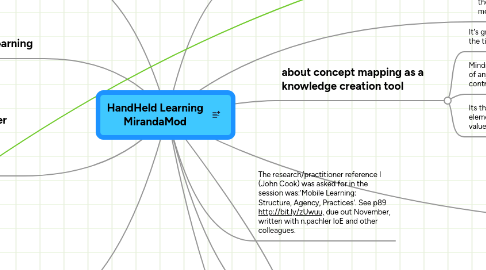
1. Theories in the use of ubiquitous technologies
1.1. What students want is to collaborate, communicate, this is what we need to provide access to through technologies, and teach how to do this effectively and safely Content may be brilliant, but if there is no communication / collaboration, it will not be accessed.
2. Impact on informal learning
2.1. Students like to add to their mobile resources at home Eg YouTube videos and podcasts, they like to share with their families too
3. How can we reconceptualise assessment, so that it better reflects the ways in which knowledge is developed collaboratively? Or should we give up on the nostrum of online learning?
3.1. eportfolios may be a step in the right direction
3.2. Students contributions and creations shared in an online space can be used as assessment of student understanding.
4. Can these technologies make learning for professionals more personal and relevant?
5. Can these technologies make learning for students more personal and relevant?
5.1. Yes. Particularly if learner's own technologies can be used.
5.2. A device provided to all students in a class / school can still be personalised in many ways and can be managed more easily.
5.3. Relevant as it is how they learn out with the school setting. It is the tools of their trade and generation. It enables learning anytime, anyplace anywhere and creates a shift from time zone learning in a class to learning when child is ready. Personalisation, schools provide all other tools so they should provide device to ensure all children have the same access to a range of tools and they can then personalise the device.
6. There needs to be an understanding of both the place of formal and informal learning with mobile devices.
7. Issues in the use of ubiquitous technologies
7.1. Students' own devices 'banned' in schools.
7.1.1. it was announced this week that some BSF schools are going to allow student devices
7.1.1.1. Some already do:)
7.1.1.2. does involving student's own technology, e.g. mobile phones, allow for comparison of makes and models and therefore teasing if a student has older technology or none at all?
7.1.1.2.1. This is why investment in devices is essential: a level field for all learners.
7.1.1.2.2. or perhaps there needs to be some 'safety net' provision - a bank of devices students could access (on a semi permanent basis) till their circumstances change
7.2. Having a consistent and achievable approach by teachers when there are too many devices to learn
7.2.1. many of the skills transferable - and learn through play / enjoyment of what it can offer (persoanl benefit)
7.3. Youtube banned in many schools.
7.3.1. Understand that good teaching doesnt equal lots of kit and open access (necessarily) - good teaching in this context still needs developing
7.3.2. We have way of white-listing selected YouTube content and giving access
7.3.3. but one of the affordances of YouTube is that you can search and find relevant and related content
7.3.4. One of the issues with youtube is not the content itself but the comments.
7.3.4.1. agreed there are various procedures and tools to deal with these e,g (commentsnob)
8. Impact on formal learning
9. What is the value of the learning experience balanced again the expense and the risk?
9.1. Similarly - what is the risk in a competitive world of not utilising
9.1.1. New node
9.2. We teach drugs & sex education so why not teach how to implement handheld learning as an effective learning tool?
10. Can these technologies make learning for teachers more personal and relevant?
10.1. Yes. Teachmeets, Edtechrounup, Flashmeetings etc. I agree it is especially relevant in enabling teachers to build up Personal/Professional Learning Networks
11. about concept mapping as a knowledge creation tool
11.1. It's great, we use Inspiration all the time.
11.2. Mindmeister adds an element of anywhere/anytime contributions.
11.2.1. collaborative features create an element of collective intelligence
11.3. Its the online or cloud element that adds the real value
11.3.1. and there are a growing number of these