

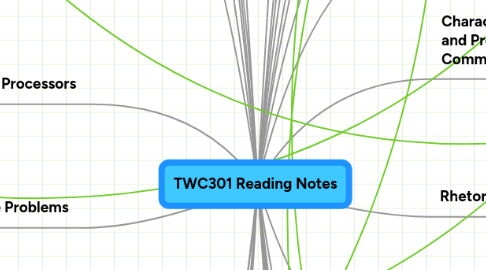
1. Processes of Technical Writing
1.1. planning
1.2. researching
1.3. organizing
1.4. drafting
1.5. designing
1.5.1. HTW: Layout and Design
1.6. integrating visuals
1.7. revising
1.8. rewriting
1.9. editing
1.10. testing
2. PSA: Problem Solving Approach
2.1. plan
2.2. research
2.3. draft
2.3.1. HTW: Writing a Draft
2.4. review
2.5. distribute
3. Workplace Problems
3.1. require information and action to solve
3.1.1. present obstacles to a particular workplace environment
4. Thinking Rhetorically
4.1. exigency
4.1.1. Document Purposes
4.1.1.1. inform
4.1.1.2. define
4.1.1.3. explain
4.1.1.4. propose
4.1.1.5. convince
4.2. audience
4.2.1. positive attitude
4.2.2. negative attitude
4.2.3. neutral attitude
4.3. document
4.4. contextual factors & constraints
4.5. workplace writer
4.5.1. correctness
4.5.2. experience & expertise
4.5.3. goodwill
4.5.4. identification
4.5.5. trust
5. Word Processors
5.1. revise or change documents
5.2. use templates and style guides
5.3. create tables or columns
5.4. use multiple windows
5.5. find and replace specific words or phrases
5.6. insert symbols, images, or charts
5.7. edit for language, grammar, or style
5.8. share or post documents
5.9. include active hypertext links
6. Desktop Publishing Software
6.1. magazines
6.2. newsletters
6.2.1. HTW: Newsletters
6.3. flyers
7. Communication Online
7.1. appropriate email address
7.2. appropriate subject line
7.3. respect others' bandwidth
7.4. lurk before leaping
7.5. polish writing
7.6. pay attention to capitalization
7.7. use attachments appropriately
7.8. back up and save files
8. Electronic Communication
8.1. wireless messaging
8.2. videoconferencing
8.3. instant messaging
8.3.1. HTW: Instant Messaging
8.4. email
8.4.1. HTW: E-mail
9. Ethics
9.1. right & wrong
9.2. understanding is crucial
9.3. metaethics
9.3.1. study of where ethical ideas come from and how they develop
9.4. normative ethics
9.4.1. study of ethics concerned with classifying what is considered right and wrong
9.5. applied ethics
9.5.1. study of particular ethical issues, problems, and circumstances
9.6. linked with law
9.7. code of ethics
10. Language
10.1. target language
10.2. official national languages
10.3. international English
10.4. text directionality
10.5. writing style
11. Avoiding Steroetypes
11.1. avoid assumptions
11.2. ask questions
11.3. collaborate with the translator
12. Transnational Ethics
12.1. write clearly
12.1.1. use correct punctuation
12.1.1.1. HTW: Punctuation
12.1.2. include definite articles
12.1.3. avoid using pronouns
12.1.4. use terminology consistently
12.1.5. avoid idiomatic language
12.1.5.1. HTW: Idioms
12.1.6. avoid comparatives
12.2. localize your writing
12.2.1. recognize alphabetic differences
12.2.2. use local numbers
12.2.3. be alert to time differences
12.2.4. avoid references to Holidays
12.2.5. avoid cultural references
12.2.6. avoid humor
12.3. account for visual and auditory perceptions
12.3.1. avoid images of people and hand gestures
12.3.2. reevaluate design elements and prniciples
12.3.3. account for differences in sound interpretation
13. Predrafting Strategies
13.1. confirm your purpose
13.2. analyze your audience
13.2.1. level of expertise
13.2.2. level of education
13.2.3. cultural differences
13.2.4. attitudes
13.2.5. expectation
13.2.6. context document will be read
13.3. gather your information
13.4. develop your ideas about the information
13.4.1. collaboration & discussion
13.4.1.1. HTW: Collaborative Writing
13.4.2. listing
13.4.3. freewriting
13.4.4. clustering
13.5. organize your information
13.5.1. purpose
13.5.2. audience
13.5.3. logic
13.5.4. ethics
13.6. organizational strategies
13.6.1. sequential
13.6.1.1. HTW: Sequential
13.6.2. chronological
13.6.3. order of importance
13.6.4. general/specific
13.6.5. division
13.6.6. classification
13.6.7. cause and effect
13.6.8. comparison/contrast
13.6.9. spatial
14. Characteristics of Technical and Professional Communication
14.1. rhetorical
14.2. audience centered
14.3. technology oriented
14.4. ethical
14.4.1. HWT: Ethics in Writing
14.5. research oriented
14.6. professional
14.7. design centered
14.8. visual
14.9. concise
14.9.1. HTW: Conciseness
15. Technical and Professional Communication Genres
15.1. e-mails
15.2. memos
15.3. letters
15.3.1. HTW: Letters
15.4. resumes
15.5. definitions
15.6. descriptions
15.7. websites and text messages
15.8. instructions
15.9. manuals
15.10. proposals
15.11. informal reports
15.12. formal reports
15.13. presentations
16. Rhetorical Problems
16.1. require choosing the best approach to communication problems
16.1.1. difficulties or troubles involved in the production of a text or document
17. Presentation Software
17.1. create slideshow with sound, video, or graphics
17.2. apply design themes and templates
17.3. use different views
17.4. share presentations
18. Graphics & Imaging Software
18.1. edit and crop images
18.2. erase parts of images
18.3. manipulate images
18.4. create text objects
18.5. develop graphic images
18.6. design graphs, tables, & flowcharts
18.7. change text appearance
18.8. add sound or motion
19. Web-authoring Software
19.1. enter text, graphics, & multimedia objects
19.2. switch between various modes
19.3. easily upload or post to a server
19.4. create Cascading Style Sheets
19.5. insert navigational buttons
20. Technology
20.1. makes collaboration more efficient
21. Email Efficiency
21.1. speed
21.2. price
21.3. convenience
21.4. organization
22. World Wide Web
22.1. access
22.2. storage
22.3. multimedia use
22.4. transmission
22.5. collaboration
23. Workplace Writers
23.1. attentive to law, honesty, and confidentiality
23.2. consider how editing and revising a document might alter the meaning
23.3. avoid using deceptive or evasive language, inappropriate jargon, or manipulating information
24. Transnational
24.1. global community without national borders
25. Multinational
25.1. distinctive borders between countries
26. Education
26.1. literacy
26.2. common body of knowledge
26.3. learning style
27. Politics & Law
27.1. trade issues
27.2. legal issues
27.3. political traditions and symbols
28. Society
28.1. age
28.2. business etiquette
28.3. family & social interactions
29. Differences
29.1. Language
29.2. Technology
29.3. Education
29.4. Politics & Law
29.5. Economics
29.6. Society
29.7. Religion
30. Enhancing Translation
30.1. terminology
30.2. clarity
30.2.1. HTW: Clarity
30.3. cultural & rhetorical differences
30.4. design
31. Accommodating Transnational Audiences
31.1. localization
31.1.1. general
31.1.2. radical
31.2. internationalization
31.2.1. the process of writing documents so they can easily be localized for transnational audiences
31.3. globalization
31.4. verbal comunication
32. Writing The Draft
32.1. parts of a document
32.1.1. front matter
32.1.1.1. table of contents
32.1.1.2. byline
32.1.1.3. list of figures
32.1.1.4. materials, parts, or tools lists
32.1.1.5. executive summary/abstract
32.1.1.6. inside and return addresses
32.1.1.7. cover image
32.1.1.8. introduction
32.1.1.9. alerts and warnings
32.1.1.10. definitions
32.1.1.11. date
32.1.1.12. title
32.1.2. body
32.1.2.1. procedures
32.1.2.2. data
32.1.2.3. steps
32.1.3. end matter
32.1.3.1. conclusions
32.1.3.2. additional information
32.1.3.3. troubleshooting suggestions
32.1.3.4. additional warnings or alerts
32.1.3.5. recommendations
32.1.3.6. indexes
32.1.3.7. appendixes
32.1.3.8. glossaries
32.1.3.9. contact information
32.1.3.10. follow-up information
32.2. a nonlinear process
32.3. drafting the body
32.3.1. coverage & length
32.3.2. organization & access
32.4. drafting the conclusion
32.5. drafting the introduction
32.5.1. purpose/objective
32.5.2. scope
32.5.2.1. HTW: Scope
32.5.3. statement of the problem
32.5.4. relevant information/background
32.5.5. key terms
32.5.6. overview of organization
32.5.7. summary