

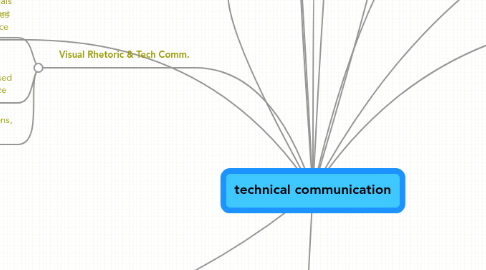
1. Visuals--pictorial,(other than text or words), conveys meaning and info to audience. 1. increases comprehension, gains attention, establishes authority, communicates with a broader audience
1.1. Graphics--rendered/drawn visuals i.e. charts, graphs,tables, maps
1.2. Images--photographic, realistic looking i.e. photos, screen captures, moving videos or animations
2. Organizing and Drafting Documents----strategize obtained info into drafts, PSA sensitive to contexts and situations
2.1. PSA to draft: 1. confirm purpose 2. analyze audience, 3.gather info, 4.develop ideas about the info via collaborations, discussion, listing and freewriting, 5.clustering
2.2. Organization--- the coherent arrangement of information in ways that make sense to and are useful to readers
2.3. Key factors of information control: purpose,audience, logic, ethics(listing benefits vs drawbacks)
2.4. Strategies for organizing: Sequential (progressive order, numbered lists, phases, transitional words), Chronological (order of time, flowcharts), order of importance, general to specific (abstract to concrete, or vise versa), division (treating info as a series of smaller parts--to divide and subdivide ideas or objects into various components), Classification (grouping items and ideas according to similarities or differences), cause and effect strategy, compare and contrast (very common in tech writing), spatial strategy (navigate info pertaining to physical space or objects i.e. info about a place with maps or schematics),
2.5. THE OUTLINE
2.5.1. think of how info flows logically
2.5.2. how you divide and label parts of the document
2.5.3. serves as a guide for your document and a draft for your table of contents
2.6. PARTS OF A DOCUMENT: the front matter, the body, the end matter (note--not all docs need all these parts; some combine parts or eliminate them)
2.6.1. title, cover image, date, byline, table of contents, list of figures, executive summary/abstract, materials, parts or tools lists, inside and return addresses, definitions, alerts and warnings, introduction
2.6.2. procedures, data (summaries and actual data), steps
2.6.3. conclusions, suggestions, final synthesis of data, additional info, troubleshoot suggestions, additional warnings or alerts, recommendations, indexes, appendixes, glossaries, contact info, follow up info.
2.7. Nonlinear Process --piece together bits of info and then organise and revise into readable docs.
2.7.1. drafting like part assembly, must have front matter, body and end, must have strong statement of purpose, must include all supporting info for the purpose., strong conclusions/recommendations
2.8. Drafting the Body --where you present info that solves the problem/s, how you will convince readers.
2.8.1. Coverage (use all pertinent info) and length(don't think about it, organization (strategies), access (guides)
2.9. Draft the intro: is done after the conclusion is drafted (interestingly)
2.9.1. identify purpose/objective, define scope, state problem, include background info, define key terms, overview of organization, summarize the whole
2.10. Draft Conclusion: do this before drafting the intro
2.10.1. offer summaries of the info, provide analytic predictions based on body's info, make recommendations for reader's response/act, make judgement about the info,
2.11. Electronic Templates/ Wizards: using tempates which are pre-established formats of docs developed by companies, custom templates. Wizards are interfaces that lead users through a series of dialog boxes to accomplish a task.
2.11.1. these are time saving, useful for beginners, they are generic, so can be limiting, and can lead to audience boredom (from overexposure to such templates, predictable), shows a lack of creativity and design.
2.12. Handbook of Technical Writing Ch 7 notes. Brainstorming, (clustering, mindmapping) p.53 (free association to generate ideas)1. can stimulate fresh perspectives and new connections 2.do not analyze ideas 3. ask what when who where how and why per idea. Group items based on:purpose, audience
2.12.1. Handbook of Technical Writing Ch7 notes:Division--a method of development breaking down a complex whole into a number of like units that's easier to understand. Classification: grouping like ideas into related categories--sort the items into the largest number of comparable groups and then establish this as a basis for the classification
2.12.1.1. Handbook of Technical Writing Ch.7 notes: p. 488 Revision---revising draft, evaluate from point of view of your audience. Revising is in different frame of mind from writing a draft---allow a cooling period between writing the draft and revisions for an objective evaluation. It is difficult to revise on a screen, read your draft several times. Seek problems and areas for correction. Check for completeness, accuracy, appropriate intro and conclusion, unity and coherence, consistency, conciseness, awkwardness, ethics, active voice, word choice, jargon, cliches, grammar, typos, wordy phrases.
3. Transnational Communication
3.1. Transnational Transcultural-There is a global community without national borders
3.2. encompasses concepts like: multinational, crosscultural, global, international (understand this audience)
3.3. trans--word suggesting "a Flow" or sense of movement ie. in communication or goods and svcs.
3.4. there is a connectivity, even despite differences
3.5. What is Culture? --it is language, (target language, official nat'l language, international english, text directionality, writing style), it is Technology (machine writing software, translation software), Education (literacy, common body of knowledge, learning style), Politics (trade issues, legal issues, political traditions and symbols), Economics (currency, status symbols, culture to value orientations), Society (age, business etiquette, family and social interaction),Religion
3.6. AVOID STEREOTYPES, be aware and respect differences, and be accurate, don't assume, ask questions, collaborate with translator for help
3.6.1. ETHICAL understandings don't cross cultural borders
3.7. enhance translation: pay attn to 1.terminology,2. clarity by avoiding complex grammar or syntax and idioms, 3.cultural and rhetorical differences, don't assume humor will translate, 4. Design- organization of info/layout or directional flow or reading
3.8. accommodating transnational audiences by: Localization--refers to adapting a product and or translating a doc. for a specific local audience.
3.8.1. Two degrees of Localization: 1.General Localization--adresses superficial cultural differences like language, currency, date and time 2. Radical Localization--focuses on substantive cultural differences affecting how readers think, feel, act, drastically changes language, design and approach of a doc.
3.8.1.1. 4 key benefits of localization
3.8.1.2. localized products improve sales
3.8.1.3. localized products overcome cultural differences
3.8.1.4. helps overcome inherent resistance
3.8.1.5. a good approach to being the first to reach world markets and entering global niche markets
3.9. Internationalization: writing, rewriting, designing docs so they can be localized to transnational audience
3.9.1. there is core info in workplace writing that can be reused
3.9.2. International Variables are parts of docs. that can be localized. Internationalization identifies these variables for later localization
3.10. Globalization--process of preparing docs. to be readily understood by as many transnational audiences possible
3.11. Transnational ETHICS: be aware of liabilities, accuracy of translation, cultural differences, business practices relative to ethical understandings, expectations of a country or culture, not all ethics crosses borders
3.12. Guide to write for Transnational Audience: Write Clearly (use correct grammar punctuation), use definite articles, avoid pronouns, use terminology consistently, avoid idiomatic language, avoid comparatives
3.12.1. Guide to Localize Writing:note alphabetic differences, use local numbers, pay attn time differences, avoid references to holidays, avoid humor, avoid cultural references
3.12.1.1. Visual and Auditory Rhetoric: avoid images of people and hand gestures, reevaluate design elements and principles (i.e. flow of document when reading, internet availability, small files for fast download), account for differences in sound interpretation
3.13. Handbook of Technical Writing notes: Global Communication p.228--acknowledge diversity, people interpret verbal and nonverbal communications differently.
3.13.1. Handbook of Tech Writing notes: P. 248 Idioms---a group of words that has a special meaning apart from its literal meaning. Avoid them if your writing is to be translated into other languages.
3.13.1.1. Handbook of Tech Writing notes: p. 265 International Correspondence--be alert to customary expressions, openings and closings, brief letters seen as rude vs. courtesy not wasting time, how is bad news expressed in other countries etc.)
4. genres
4.1. emails, memos, tech. definitions, websites, manuals, proposals, formal/informal reports
5. characteristics
5.1. rhetorical, audience centered, technology oriented, ethical, research oriented, professional, visual, design centered, concise
6. Electronic Technology and its impact on workplace communication
6.1. Writer, Keep up with Progress
6.2. Tools for creating docs: Word processors, presentation software, graphics/imaging software, web authorizing software, desktop publishing, help authoring tools, single sourcing programs
6.3. Tools for Communicating/collaborating: internet, email, WWW, IM, Videoconference, Groupware
6.4. ETHICS and ELECTRONIC COMM.= netiquette= choose appropriate email address, use apropos subject line, respect bandwidth, lurk before you leap, use attachments appropriately, back up and save, when it's out there, it's out there.
6.5. Ch 3 Related entries from Handbook of Tech Writing: Digital Tips, White Papers, Writing for the Web p570,
7. Ethics and the Workplace Writer
7.1. a code of conduct that helps individuals determine right and wrong
7.2. Types: 1. metaethics--where ethical ideas come from 2.normative ethics--how we arrive at standards 3. applied ethics--how metaethics and normative ethics relate to particular issues
7.3. Ethical Workplace Guidelines 1. Rules and Laws not the same 2. Be Honest 3. Respect Confidentiality/Privacy
7.4. Writer awareness of ethics to recognize ethics to make informed decisions and anticipate implications
7.4.1. writer is ultimately responsible for the info he distributes therefore adhere to laws which protect writers, and take ownership, always double check facts and ethics in content, do not disseminate false info do not obsure or use vague language
7.4.2. Note definitions for: Liability Laws, Environmental Laws, Copyright laws, patent laws, Trademark servicemark laws, contract laws,
7.4.3. Codes of Ethics address issues of
7.4.3.1. harassment, grievances, employee relations, business practices
7.4.4. Codes and Laws of Cyberspace-- cyberethics, the relationship between ethics and technology
7.4.4.1. avoid deceptive evasive vague obscure language, avoid manipulations from the truth or appropriateness, pay attn: plagiarism, writers must confirm all info received and report inaccuracies
7.4.4.2. ethics when addressing issues of email, web pages, visuals